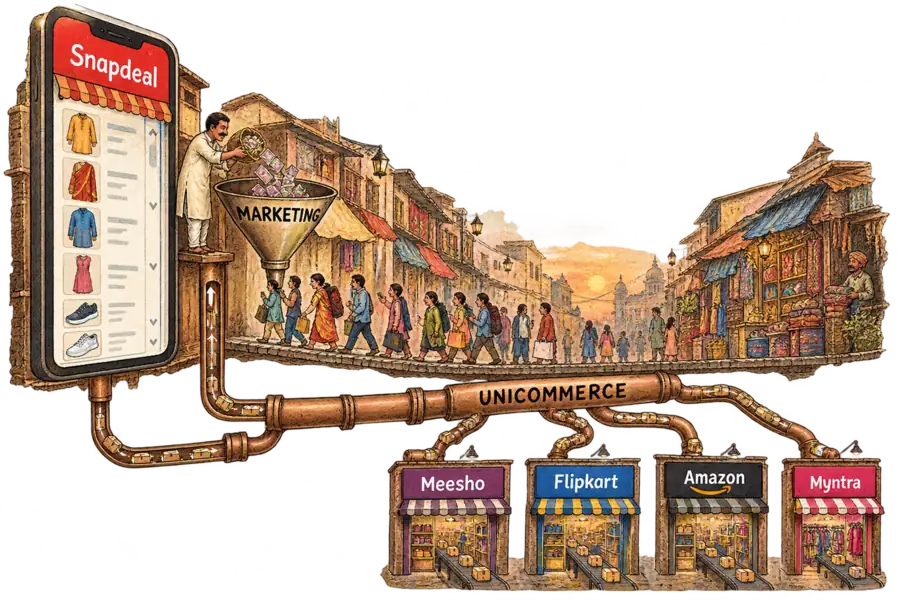
Snapdeal's Parent Owns All of the Feed and a Quarter of the Plumbing
AceVector, Snapdeal's parent, will spend the largest slice of its IPO money buying traffic for a marketplace where 72.69% of orders involve no search. Its profitable business is Unicommerce, software used by sellers on several Indian marketplaces, Meesho included, and AceVector owns 26.13% of it.
Admiral Neritus Vale
Snapdeal has handed product discovery to a recommendation feed, and it still pays to bring shoppers to it. In the year to March, 72.69% of the value marketplace’s orders were placed without a search term, its parent AceVector says in the red herring prospectus for Monday’s listing. The largest slice of the new money, ₹132 Cr, goes on marketing, while AceVector’s profitable business sells software to sellers on several Indian marketplaces. That business, Unicommerce, serves sellers on Snapdeal’s far larger rival Meesho too, and AceVector controls it with a minority stake.
Inc42’s coverage of Monday’s debut counted scale among several problems, marketing cost included. AceVector’s shares ended their first session 18.4% below the issue price, it reported. Its analysis that morning put the gap plainly: Meesho’s merchandise value is 38 times Snapdeal’s. A roundup the next day listed scale beside losses, negative operating cash flow, thin take-rates and “high marketing and logistics costs”. It also cited experts who no longer saw Snapdeal’s AI as a differentiator, and analysts who called Unicommerce “a potential valuation anchor, although it remains too small to offset Snapdeal’s challenges”. The prospectus puts a number on the marketing cost: filling the feed takes most of what the marketplace keeps after paying couriers.
Snapdeal publishes two AI figures that look alike and measure different things. The prospectus figure counts orders placed without the shopper entering a search term and credits them to “the effectiveness of our recommendation engine and personalised product feeds”. In August, Snapdeal said 76% of its orders “are influenced by” its StyleMatch engine, in a release carried by Digital Terminal that did not define influence. Neither figure shows how a shopper reached the product. Ads and push notifications also bring shoppers to products without a search, and the prospectus credits “targeted notifications” alongside its feeds for better conversion.
A feed can choose what a shopper sees after opening the app; it cannot make anyone open it.
Snapdeal pays a high price to get shoppers to the feed. Its marketing came to 7.72% of net merchandise value, the list price of goods delivered and kept, in the year to March. The prospectus says the marketplace relies on search engines, social media, emails and text messages “for a large portion” of its traffic.
Meesho, the larger rival, spends a fraction of that on the same measure. The prospectus’s peer table puts its advertising and sales promotion at 0.50% of merchandise value for the year to March. In the October–December quarter, when it stepped up user acquisition, the figure reached 2.4%, Inc42 reported. The smaller marketplace pays the higher rate.
Snapdeal’s revenue comes mostly from freight and cash-collection fees per unit delivered, not from commission. The prospectus says Snapdeal offers sellers a zero-commission option in some circumstances, and the marketing fees it does charge brought in ₹25.7 Cr in the year to March. Freight and collection income was ₹257.9 Cr.
Most of what the marketplace earns goes straight back out to couriers. What is left, which AceVector calls contribution margin, fell slightly in the year to March despite higher volumes. Calculated from the prospectus figures, marketing absorbed 77% of it, against 40% two years earlier.
Returns are rising with fashion’s share of sales, but the prospectus treats the cost as small. As fashion grew, returns climbed to 11.00% of units delivered from 8.70%. AceVector ties a ₹1.18 rise in courier cost per unit to that, calls the effect marginal, and says it charges sellers for return shipments.
Unicommerce is the plumbing behind sellers on several Indian marketplaces. Its Uniware software runs orders, stock and warehouses, and Shipway books couriers. Unicommerce’s integrations page lists Amazon, Flipkart, Myntra and Meesho among the channels it connects. In AceVector’s segment accounts, Unicommerce made an adjusted EBITDA of ₹41.3 Cr in the year to March, on pricing the prospectus describes as primarily subscription-based with usage-linked components. On the same measure, Snapdeal’s marketplace lost ₹50.3 Cr.
AceVector holds 26.13% of Unicommerce’s equity, which limits how much of that EBITDA is its own. It consolidates the company because the prospectus gives it the right to appoint a majority of the directors. The ₹41.3 Cr is segment adjusted EBITDA, not profit attributable to AceVector.
Snapdeal is a small invoiced customer of Unicommerce but a real source of its volume. The related-party tables show Snapdeal paid Unicommerce ₹0.395 Cr last financial year, for an address-autofill API. The same document says Snapdeal sellers use Uniware and Shipway, and that Shipway gains from Snapdeal’s order volumes as a large originator of e-commerce shipments. It adds that the joint volumes “help drive better 3PL cost alignment”.
The growth rate quoted for Unicommerce overstates its pace. Its revenue rose 51.6% in the year to March, the first full year that included Shipway. Unicommerce took control of the courier aggregator in December 2024, and Shipway’s revenue includes the freight it resells. In the quarter to June, with Shipway in both periods, revenue grew 14.3%, Unicommerce’s results release shows. Unicommerce remains the group’s sound business, but part of its fastest year was bought.
Profitability slipped as well. The same release puts the quarter’s adjusted EBITDA margin at 15.8%, down from 21.1%, though it also reports Uniware growth accelerating for a fourth consecutive quarter.
The strongest case for the IPO plan is that paid shoppers stay. Repeat customers accounted for 82.91% of delivered units in the year to March, so most sales go to people Snapdeal has already won. Marketing per unit delivered was also 17.79% lower than two years earlier. On that reading, the IPO money buys each customer once, the feed keeps them, and volume spreads fixed costs until the loss closes. The case holds only if marketing per unit keeps falling as the repeat base grows.
Volume did not make Snapdeal’s shoppers cheaper last financial year. Marketing per unit delivered rose from ₹31.73 to ₹32.49 even as the repeat share climbed, and the marketplace’s adjusted EBITDA loss widened. AceVector puts the rise down to buying more app users, who it says stay longer. The agency proposal behind the IPO budget lists brand-building, discovery-led marketing and interest generation alongside “retention marketing” on “two core global internet platforms”. Meesho said in its first-quarter update that it expected marketing spending to rise in the July–September quarter, ahead of the festive season, Inc42 reported. AceVector’s risk factors warn that if competition for advertisements increases, it “may be unable to cost-effectively drive users” to its platform.
AceVector is putting the largest share of its new money into the business it owns outright. For a parent holding all of Snapdeal and a quarter of Unicommerce, that is the rational choice. If marketing per unit keeps rising with volume, the ₹132 Cr will buy Snapdeal more customers and a larger loss. The part of the group that already earns sells to Snapdeal’s rivals as well as to Snapdeal’s sellers.