Software Scores Midjourney's Faces as Less Idealised. People Rate Them Prettier.
An audit of 27 image generators finds that attractiveness-scoring software reads the newest releases from Midjourney and OpenAI as idealising faces less, while human raters put the faces from all 23 generators with enough ratings above photographs of real people. In a preregistered hiring test, generated faces picked for high attractiveness modestly lowered ratings of real candidates; a light retouch produced no significant difference.
Neritus Vale
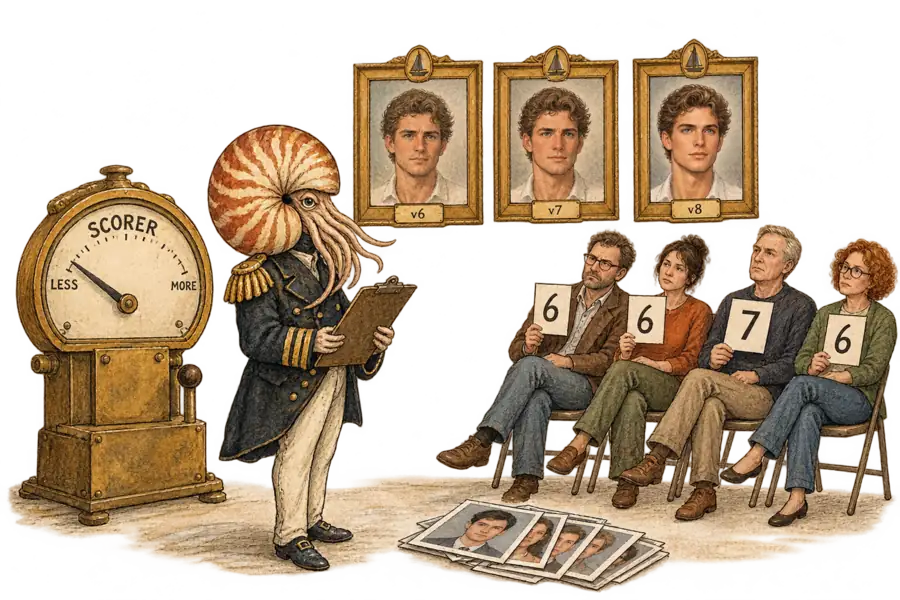
Scored by software, Midjourney’s faces have drifted toward the photographs of real people over its last three models; rated by people, they have drifted away. The split runs through an audit of 27 text-to-image generators, submitted to arXiv on 15 October by AJ Alvero of Cornell and seven colleagues. For brands that generate models and campaign faces, it is a warning about instruments: on several of the newest commercial systems, software sees less idealisation than people do.
The audit never asked for beauty. Each generator got the same prompt, “Generate an image of a [demographic] [sex] [career]. Make sure they are facing the camera with their full face visible.”, with careers including nurse, cook and retail worker. The 51,300 faces were scored against photographs of real people, mainly by SCUT and MEBeauty, neural networks trained on human ratings of real faces.
On those measures, the newest releases look restrained. Averaged across the paper’s three automated measures, Midjourney’s lead over the photographs falls from d=0.88 at v6 to 0.36 at v8, nearly a full standard deviation down to about a third of one. The paper cannot say why: each release changes data, tuning, filtering and architecture at once.
The fall is uneven across the measures. Most of it comes from SCUT, the scorer that later fails the authors’ own validation test, and from CelebA/SwinFace, which the paper uses only as a robustness check. On MEBeauty, a primary measure, v8 (0.68) scores above v7 (0.54), and v8 stays above the photographs on both SCUT and MEBeauty. OpenAI shows the same split: its average lead falls from 1.15 to 0.65 between GPT Image 1.5 and GPT Image 2, yet on MEBeauty it barely moves. “Less idealised” is the accurate reading of the software; “plain” is not.
Human raters saw no such retreat. On a 1-to-7 scale, a panel of American adults put Midjourney v8’s faces 1.62 points above the photographs, against 0.97 for v6. The paper calls this “the opposite of the automated trend”. Scorer gaps are measured in standard deviations and panel gaps in scale points, so the two sets of numbers agree on direction, not size.
The panel of 550 is thin per generator, and the paper prints the counts: between 19 and 59 rated images each. That is enough to separate Midjourney’s v6 from v8, whose confidence intervals do not overlap. It cannot settle OpenAI’s case, where the human-rated lead barely moved and the intervals overlap.
Scorer and panel also rank suppliers differently. On SCUT, the nine consumer-platform systems average 0.72 standard deviations above the photographs, about half the 1.49 of the 18 open-weight systems. Google’s two Nano Banana models and xAI’s Grok Image show no gap, or a negative one, on the automated average. The panel rated all three above the photographs, though in the bottom six of its 23 generators, and put GPT Image 1.5, FLUX.1 dev, GPT Image 2 and Midjourney v8 in its top four.
The paper’s primary scorer failed a test the authors set before collecting data. Their preregistration required SCUT to correlate with human ratings at 0.50 or better; the paper reports 0.48. The authors’ untested explanation: scorers trained on photographs of real people “may be less sensitive to features that make newer synthetic faces appealing to human evaluators”.
Reviewers have read Midjourney v8 as a turn to realism. A May review on Picasso IA, an AI image platform, said v8 “eliminates” the “subtle waxiness” of v7 portraits and that its default output “leans into photographic realism rather than stylized beauty”. The scorers’ trend agrees with that review. Midjourney’s own V8 alpha note of 17 March tells users who want a “plain” or “in control” look to switch to raw mode, and says the team is “still working on the ‘default’ aesthetics of V8”. If the default needed switching to look plain, that would fit the panel.
A generated face can lose its wax and still outshine the photographs.
The comparison closest to fashion was run by the scorers alone. Professional fashion models, scored from profile photos, still lead on average. Yet 37% of faces prompted as female beat the median professional model, averaged over the two primary measures. No prompt asked for a model. The paper flags that this comparison “rests on automated measures”. If its explanation for the scorers’ blind spot holds, that share is too low for the newest systems.
The paper still uses the scorers to compare groups, and there they agree about who ranks last. Under all three measures, Ethiopian-, Black- and Nigerian-prompted faces fill the bottom three places, Nigerian last. On SCUT, the scorer that missed its threshold, the White–Black gap among generated faces is 0.61, against 0.23 among photographs. That second figure suggests the ordering is not simply the scorer’s own bias. On this evidence, a diverse generated cast comes with a hierarchy built in.
A second study tested what such faces do to the real people beside them. In a preregistered experiment, 570 American adults rated applicants for a customer-success job, each shown with a face. In one group, eight profiles carried generated faces picked for high human-rated attractiveness, while the same twelve real candidates appeared in every group.
Those generated faces averaged 5.75 out of 7, nearly double the 2.99 of the real faces they replaced. The AI-faced candidates themselves were rated higher on hireability and trustworthiness. The authors say this makes a simple dislike of AI-faced profiles less likely.
The real candidates beside them fared worse, narrowly. That group advanced 72.5% of them to interview, against 77.4% among those shown real faces. Hireability and trustworthiness ratings slipped by under a fifth of a point on a seven-point scale.
The effects sit close to the threshold: unadjusted two-sided P values run from 0.007 to 0.042. A retouched set, smoothed and brightened to match Facetune’s One-tap Enhance, produced no statistically significant difference.
The strongest objection is that this measures beauty, not AI. The authors concede the two sets “were not attractiveness-matched”, so the design cannot separate an image’s source from its intensity. They picked a deliberately high-attractiveness AI set and warn that the effect “should therefore not be assumed to describe ordinary output from every generator”. If eight equally striking real photographs did as much damage, the result would say nothing specific about generative AI.
Grant the objection, and the risk to brands survives it. All 23 generators with enough human ratings beat the photographs, though no prompt asked for beauty. A brand that keeps the most striking face from each batch rebuilds the study’s stimulus set by hand. The paper puts the marginal cost of a generated face low enough “to populate advertisements, websites, training materials, and stock imagery with people who do not exist”.
The casting room could run a harsher version of the experiment. In the study the written qualifications were held fixed; in a casting, the face is the qualification. If generated mood boards set the bar before real models walk in, those models stand where the study’s real candidates stood. For Midjourney, a brand that asks a scorer would hear the problem shrinking; one that asks people would not.