Spring 2027's Runways Were Cast to a Sample, Not to the Till
Felicity Hayward's city counts add up to 115 curve or plus appearances in about 11,550 spring 2027 runway looks, while Universal Standard says nearly 90% of its US x Abisola first-week units sold in a size 14 or above. Sample size is one reason casting directors give for the thin runway cast, and Abisola Omole's launch post drew more engagement than the brand's own.
Parallax Pincer
An obsidian-gray cape in double-face wool blend buttons onto a double-breasted ponte blazer and falls over one shoulder, its buttonholes graded separately to meet the blazer’s buttons in every size from 00 to 40. US x Abisola, Universal Standard’s seven-piece capsule with the London-based creative director Abisola Omole, sold nearly 90% of its first-week units on the brand’s US DTC site in a size 14 or above, the brand told Glossy. Against that, 1% of spring 2027 runway looks went to curve models. Casting directors name sample size as one reason for the runway figure. Universal Standard is a plus-first brand, so its 90% also reflects who already shops there.
Glossy’s runway figure comes from Felicity Hayward, a model and size-inclusivity campaigner whose runway report began in 2019. Her counts for New York, London, Milan and Paris, published in Marie Claire on 9 October, add up to 115 curve or plus appearances in about 11,550 looks. The look totals are our sums, each city’s designer count (given as “over”) times an average of 32 to 42 looks a show, so they are floors; the curve figures are Hayward’s own tally, and her size threshold is not defined. London fell 56.3% to 21, its lowest since her report began, in a season without Karoline Vitto or Sinead O’Dwyer. The other three cities rose on the previous season, New York by nearly 50%, Paris by 139% and Milan by more than double, though 16 of Paris’s 43 walked for Ester Manas.
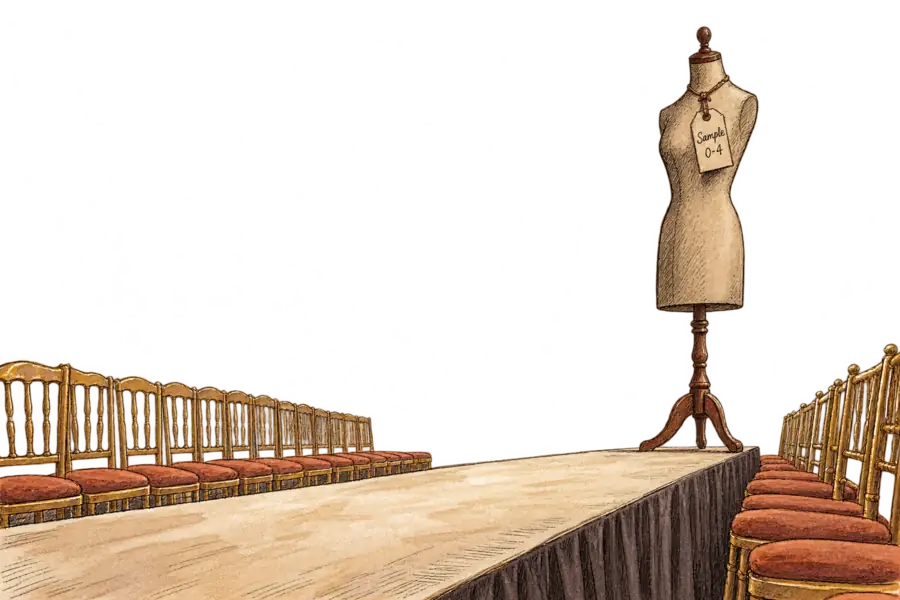
Vogue Business counts every show on Vogue Runway from the four official schedules and calls US 14 and up plus-size, so its figures and Hayward’s are not like for like. Its latest womenswear tally, for autumn 2026, put 0.3% of 7,817 looks in plus sizes and 97.6% in US 0 to 4, which Vogue Business’s Lucy Maguire calls a three-year peak. In its casting-director interviews, Emma Matell says a collection made “on a mannequin that’s straight up and down” leaves little room for curve models, and Maguire adds that most size-inclusive runway looks are stretchy spring dresses, since one stretch sample fits several bodies. The same Vogue pieces also cite conservatism, looksmaxxing and agents holding back their top curve models. A cape graded button by button is the harder job, which is our inference, not theirs.
Most of Milan’s curve count came from a show with a GLP-1 drugmaker among its sponsors. Seven of its 12 curve appearances came from Vogue World, and Vogue’s programme lists Eli Lilly and Company among four presenting sponsors. Hayward calls the sponsorship “a toxic partnership” in Marie Claire, which says Lilly funded the show. Casting director Barbara Pfister offered Vogue Business a different reading: “It’s not so much Ozempic driving the tastes in fashion, but more the other way around.” In the same piece, Rosolek says agents send models GLP-1 discounts.
GLP-1 users are already at the till, and many are changing size. In May 2026, 21% of US households had a current GLP-1 user, up from 9% in January 2025, on PwC’s analysis of Numerator data. In PwC’s survey, 73% of current users reported a meaningful change in clothing size, though PwC finds them “dropping sizes faster than they’re committing to new wardrobes”; the survey compares GLP-1 groups and does not represent all consumers. PwC also puts apparel spending among GLP-1 users up 9.9% after six to eight months. Maguire’s piece puts the average American woman at a size 16 to 18, plus-size on Vogue Business’s own scale, though it does not source the figure.
Whatever else shapes a cast, a sample cut at 0 to 4 leaves a casting director little room.
Glossy’s headline reads the capsule as a business case for size inclusion amid the GLP-1 boom, but Universal Standard starts design and fit at an 18, which it labels a medium. Its size labels put M at 18 to 20 and L at 22 to 24, and the runway’s US 0 to 4 at 4XS and 3XS. Of the first-week units, 54% sold in sizes 18 to 24, its own M and L. Glossy describes a profitable business built around customers of all sizes, with about $200m in gross sales and an 80% repeat rate. It did not get revenue, inventory allocation or sell-through for the capsule, so the figures describe Universal Standard’s customers, not broad demand, and those customers averaged 1.7 pieces an order, including blazer-and-wrap-pant pairs.
The launch post that drew more engagement came from Omole, not the brand. She styled about 12 looks from the seven pieces, and her post drew 1,700 likes and 183 comments, more than twice the likes and nearly three times the comments of Universal Standard’s corresponding post, Glossy reports. Glossy does not say what the post contained, and the comparison sets a creator’s account against a brand’s, so it measures engagement, not picture quality. Ramon Martin, Universal Standard’s chief creative officer, said styling helped answer a frequent customer question: what to wear with an item. Omole, who tries on luxury labels as a US 16 to 18, wore the capsule to September’s fashion-week events herself.
The V&A holds Elsa Schiaparelli’s “Cravat” jumper, on show until November and recorded as designed in 1927 and made in 1971. The museum’s current label calls the jumper “a turning point” that came a few months after her first collection of geometric knitwear in January 1927. It also records the luncheon story, Schiaparelli’s own telling in her memoir Shocking Life: she wore it to a society luncheon and “received numerous orders”. A sweater also led the capsule, the $150 Polo in Soft Spun yarn, with ballooned cuffs and a blouson effect at the waist, which took around a third of units sold. No source counts runway models in sizes 18 to 24; Hayward’s 1% is the nearest figure, and the shopper who bought most of this capsule is at best a part of it.