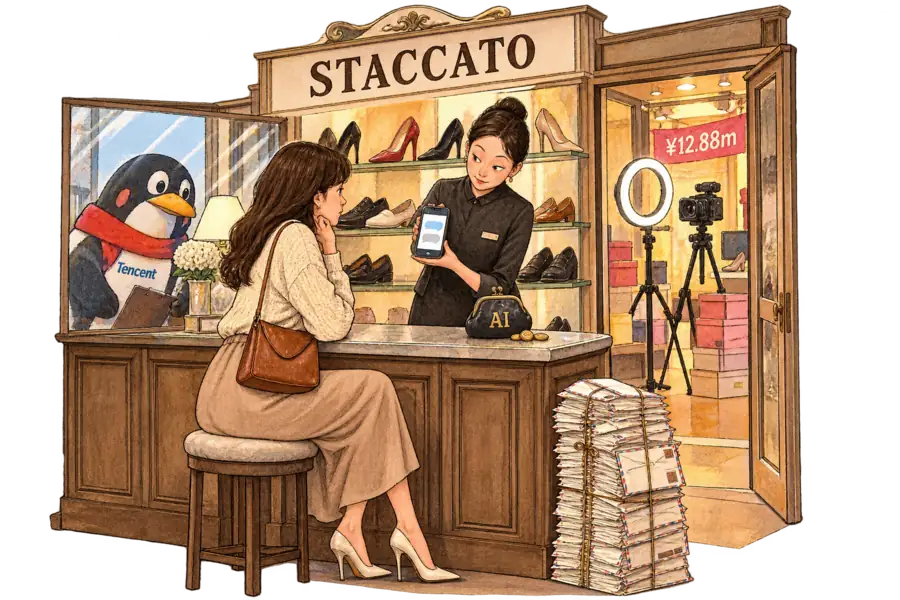
Five Days of WeChat Livestreams Outsold the Sales Staccato Credits to Tencent's AI
Two business papers report that Staccato's shop assistants shared 43% less with customers and sold 15% more after Tencent's MAGIC AI began choosing whom they contact. The sales credited to the algorithm are in the millions of yuan, less than one WeChat event's livestreams took, so the result the numbers support is fewer messages.
Neritus Vale
The clearest result Tencent’s AI can claim at Staccato, Belle Fashion Group’s premium shoe brand, is that its shop assistants message customers less. Their shares of content with customers fell 43% year on year after Tencent’s MAGIC AI began choosing whom they contact, what they offer and what they write, 21st Century Business Herald reported. The paper gives no start date or window for that before and after. That is a measure of how often staff speak. The sales the algorithm is credited with directly are 百万级, “in the millions”, with no currency stated; Staccato’s livestreams alone took more than ¥10m during one WeChat sales event in April.
The case study ran on 2 November in two business papers. National Business Daily, in a compiled piece, dates remarks by Luo Zheng (罗征), Belle’s chief user-operations officer, to 26 October at Belle’s headquarters. It repeats many of the Herald’s quotes and figures in different words. Both papers state the 43%, 23% and 15% figures in their own voice rather than as a named speaker’s quote, and neither cites a check from outside the two companies. Every number here comes from the case itself, and quotations from the Chinese-language reports are my translations. Both treat the case as proof that AI can measure store retail, and NBD boils it down to 少打扰,多成交: less intrusion, more sales.
MAGIC AI, sold through Tencent’s Qidian marketing cloud, chains three models. The Herald describes a crowd-prediction model that picks whom to contact, a product model that picks what to offer, and a large language model that writes copy for each audience and membership tier. Messages go out as Tencent ads aimed at lookalikes of Staccato’s store members and through WeCom, the business edition of WeChat. Tencent’s product page promises to “automatically match the right person with the perfect product, offer, and channel at the exact right moment.”
The 43% fall in shares is the system doing its job. The Herald says that before it, assistants did not know what to push, to whom or with what message, so they contacted customers often and customers unfollowed (Herald). Fewer shares therefore measure compliance more than effect. The outcome that matters is the 15% rise in assistants’ sales, a year-on-year change for which the paper gives no window. Tencent Cloud vice-president Li Xuechao (李学朝) says the assistant has become “an all-hours, all-channel business unit”; the figures describe one who shares less.
The unfollow figure should show whether the messages are better aimed, and the papers report it differently. The Herald reports a 23% fall in the number of WeCom unfollows, which NBD calls a fall in the unfollow rate. The 43% counts all assistant shares and the 23% counts WeCom unfollows only, so the two cover different bases. Read as a count, unfollows fell more slowly than shares, which would mean unfollows per share rose. Neither paper defines the rate. Fewer messages would lose fewer contacts even if none were better chosen.
The algorithm’s own revenue line is small. After “full-link tracking and attribution”, the Herald writes that the sales “directly contributed” by algorithmic recommendation are 百万级: in the millions, with no currency or period stated. The case calls the system traceable from end to end, and this is what the tracing gave the algorithm.
The case’s large sums come from WeChat. Staccato’s first Brand Friends Day on WeChat Shop, from 18 to 22 April, took ¥12.88m in gross merchandise value, the Herald reports. The model’s share of that is not given. Livestreams alone brought in more than ¥10m, which beats the algorithm’s figure whatever period that covers.
Those are gross figures. NBD reports that returns on WeChat Channels orders run between 30% and 50%, so the livestream yardstick is softer than it looks. The Herald also reports 129% attainment against a target, which means the event was measured against a plan and not against a control.
Even the event’s own credits overlap. Livestreams took more than ¥10m of the ¥12.88m, or 77.6%, and the Herald says private-domain assistants brought in close to 30% of sales. A July account, a Tencent-marketing roundup syndicated from 浪潮新消费, says Staccato had assistants send customers links to the livestream. Together the two credits exceed the total, so some yuan may sit in two columns. Neither source says they do.
The case’s other results are measured against the past or a target, and neither paper reports a control group. A “guess you like” feature beat “similar past campaigns” by 3.6%, the Herald says, on a measure it does not name, and that is the smallest gain in the case. Booked orders in the brand’s 千选 mini-programme rose 18% year on year. WeChat Channels bookings reached 千万级, tens of millions of yuan, which makes them the closest comparator to the algorithm’s line.
The case’s ledger rests on membership. Staccato’s member-sales ratio is above 97%, the Herald says, meaning that share of sales goes to members. The Herald’s wording, 思加图(百丽集团), leaves open whether the figure covers the brand or the Belle group. A store sale tied to a member could be matched to an online order, though the paper does not say Belle does this.
More than 20% of WeChat Channels buyers buy again in a store within 30 days, the Herald says, and NBD puts the figure in its headline beside a return rate of up to 50%. Elsewhere NBD says about half of the event’s guests went back to stores to try and rebuy. Neither paper reconciles the two.
What the figures support is smaller than either paper’s headline: Staccato’s assistants can message customers far less without selling less.
The strongest objection is that the sales rise is the model’s revenue. Assistants shared far less and sold more, so each share carries more sales. Direct attribution may also miss a recommendation that ends at a till days later. On that view the sum in the millions is a floor. For the thesis to fail, assistants working from the model’s tasks would have to outsell comparable assistants without them.
Neither paper reports a comparison group, and the 15% is a year-on-year change in a crowded year. This year Staccato ran its first Brand Friends Day and had hits in a Vera Wang collaboration and the Fireworks series, including a Birkenstock-style Fireworks Holiday shoe that sold more than 40,000 pairs in six months, the Herald reports. General manager Pan Jianhua (潘建华) credits AI and big-data insight into demand for those lines, so Belle itself counts them partly as the model’s work. From April the brand also sold store vouchers through Douyin. A 36Kr article has Luo calling Douyin’s videos an “online window” for the stores, the phrase the Herald gives WeChat Shop.
Restraint has a particular value for a brand that will not discount. Staccato keeps the same price, benefits and service across channels. Pan says that once a brand discounts for volume, “customers start waiting for discounts”. “The first thing diluted is not profit but brand equity,” he said. With price fixed, a message is one of the few levers left, and each unwanted one can cost a contact.
If Belle publishes the model’s attributed sales with a period and a base, retailers can price MAGIC AI as a revenue tool. Until then the case prices it as a way to message customers less, a result easiest to measure where most till sales carry a member’s name. For a retailer weighing a similar system, the purchase on offer is a quieter channel to its own customers, and the sales are still Tencent’s to prove.