Steve Madden Guided Its Fourth Quarter to a Tariff Nobody Has Imposed
Steve Madden raised full-year guidance on a 19.1 percent revenue quarter, but the raise came to less than half the earnings beat that produced it. The difference went into freight and a fourth-quarter duty rate that no legal instrument currently imposes.
Admiral Neritus Vale
Steve Madden beat Wall Street’s second-quarter estimate by thirteen cents and raised its full-year guidance by five. The rest of the beat went somewhere specific: second-half freight and a wider tariff assumption, because the Iran conflict has run longer than the previous forecast assumed, and management said so on the call. The revenue at Steven Madden is a product story, and a strong one. The earnings are a trade-law story, and trade law has not stopped moving this year. The raise is a bet that it will.
The headline growth rate is measuring two companies at once. Revenue reached $665.9 million, up 19.1 percent, while the company’s own organic figure, which strips out the Kurt Geiger business it acquired in May 2025, came in at 11.2 percent. The gap between those two numbers is an acquisition anniversary rather than demand, and the second quarter is the last one in which it flatters anything, since Kurt Geiger sits inside the prior-year base from here. Eleven percent is not a weak number; against this peer group it is an excellent one. It is simply smaller than the number in the headline, and it is the one the guidance has to live on.
The raised guidance carries the deceleration inside it. Full-year revenue growth of 11 to 13 percent, a point above the prior range, is built on a quarter that just grew 19.1 percent, which means the quarters ahead have to grow well behind that pace for the year to average out. Management called that shape ordinary rather than cautious. CFO Zine Mazouzi told analysts to expect a “more typical cadence” this year, unlike last year, when tariff disruption pushed fourth-quarter revenue and earnings above the third quarter’s. That explains the shape of the guide. It does not explain what fills the fourth quarter’s cost line.
What fills it is a duty rate nobody has imposed. Mazouzi told analysts the outlook assumes tariffs “basically in line with the announcements” for the third quarter, meaning the 10 to 12.5 percent tied to forced-labor findings, and still assumes 15 percent for the fourth, with two additional trade investigations pending. The fourth-quarter figure is not a rate the company pays or a rate any agency has set. It is a provision against proceedings that have not concluded, embedded in an outlook the market repriced the stock on. In February the same management declined to issue earnings guidance at all, on the reasoning that guidance is “a commitment to the investment community” and the trade picture was too unstable to stand behind. Five months on, the picture is stable enough to commit to, which is either a genuine gain in visibility or a decision to guess.
A cost line that can be guessed forward can also be unwound backward.
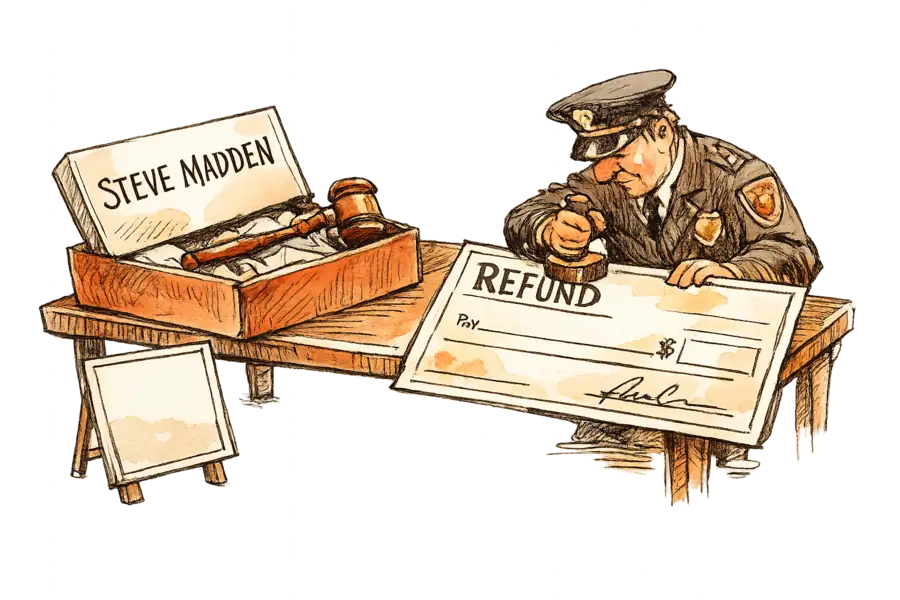
Steve Madden collected $92.1 million in tariff refunds during the quarter, interest included, and put the money against debt. The refunds followed the Supreme Court’s February ruling that the International Emergency Economic Powers Act does not authorise tariffs, which voided the reciprocal duties and sent the Court of International Trade to order Customs to give the money back. The replacement surcharge invoked days after that ruling was itself struck down in May. This is the same landed cost the company was hedging with a resale programme when we wrote about it in May, and it has now been set twice by judges rather than by suppliers. A company whose GAAP earnings guidance for 2026 sits fifty cents above its adjusted guidance is telling you where the one-time gains came from.

The part of the cost curve no court will touch is the part management sounded least comfortable about. Mazouzi added six cents of second-half pressure from freight, citing air shipments to chase best-sellers and ocean disruption in international markets. He was blunter about the supply base, saying the company is “seeing cost pressures coming from our suppliers since the conflict has gone on longer than expected, and it’s becoming a lot harder to push them off.” Vendor concessions are the quietest margin lever a footwear company owns, and this is the lever being described as spent. Rosenfeld still expects gross margin to improve year over year each quarter, but “not going to be as significant as it was in the first half.”
Crocs reported the same day, raised its own guidance, and lost twelve percent of its value. Crocs assigned roughly 160 basis points of its gross margin decline to duties and let the number sit in the reported results, where an analyst can mark it. Steve Madden’s tariff cost lives mostly in quarters that have not happened. The market rewarded the company whose cost problem is a forecast and punished the one whose cost problem is a fact. That response is rational, and it is not durable.
The strongest case against all of this is that the margin is structural and the cost line is noise. Gross margin reached 46.5 percent against 40.4 percent a year ago, lifted by higher average selling prices, lighter promotion, and a mix shift toward a heavily direct-to-consumer Kurt Geiger. If consumers keep paying up for Steve Madden product, the cost curve does not need to hold, because the company simply prices through it. That case rests on one condition: pricing power has to work on the core assortment, not only on the newness. Rosenfeld drew that line himself in November, telling analysts the consumer will pay for real fashion and that “where you have to be much more careful with price increases is on the core and more basic product.”
The control experiment is already running inside the same income statement. Private label, sold into mass and value channels where the company has no brand leverage on price, fell about fifteen percent in 2025 and is guided down mid-to-high teens again this year, an improvement on the nearly twenty percent decline guided in February, which Rosenfeld attributed to the business rather than to trade policy. Same factories, same duties, same freight; the only variable removed is the ability to raise the ticket. Rosenfeld has called it the biggest challenge the business faces. Pricing power is not a property of the company. It is a property of individual products, and the tariff is charged to all of them.
None of this makes the raise wrong. If the pending investigations land at or below where management has provisioned, and freight normalises as the conflict eases, Steve Madden clears its year with room and the second-half guide reads as conservatism. If the fourth-quarter rate arrives above fifteen percent, the cushion is already committed to freight and the pricing room exists only where the product is new. The line worth watching is not revenue, which is doing what a well-merchandised brand does in a good season.
It is whether the next trade instrument shows up as a number the company assumed or a number the courts wrote. Steve Madden has chosen which one to plan for. The market has taken the same side, which means the position is now held twice.