Stitch Fix Sells Human Connection at One Stylist per 1,450 Clients
Stitch Fix now markets its stylists as the scarce human answer to AI shopping, yet it closed fiscal 2026 with 1,575 of them and about 1,450 active clients per stylist. It grows by selling more to fewer clients, and its fiscal 2027 guidance leaves no room to grow spend per client and the client base together.
Admiral Neritus Vale
Stitch Fix now markets its stylists as the human answer to AI shopping while employing fewer of them than in any year since it went public. On 23 September, asked about Meta’s Muse agent, chief executive Matt Baer told analysts that as more interactions run through AI, “human connection becomes the scarce resource.” Stitch Fix, he added, is “the only retailer out there that has continued to invest in this human connection.” The 10-K annual report, filed that week, counts 1,575 stylists. The algorithm Stitch Fix sold to investors in 2017 has ceded the headline but kept its old job: spreading each stylist across more clients.
The 2017 prospectus sold a pairing. Stitch Fix told investors that data science and human judgment together made “a more powerful business model than either element could deliver independently,” and described algorithmic recommendations that would “streamline our stylists’ individualized curation process.” The streamlining worked. When it listed, Stitch Fix employed one stylist for fewer than 650 active clients; it now employs one for about 1,450, all part-time since 2024. The ratio counts accounts and heads, not people and hours, so it is a proxy. The headcount is down sharply from the over 5,700 stylists it reported in 2021.
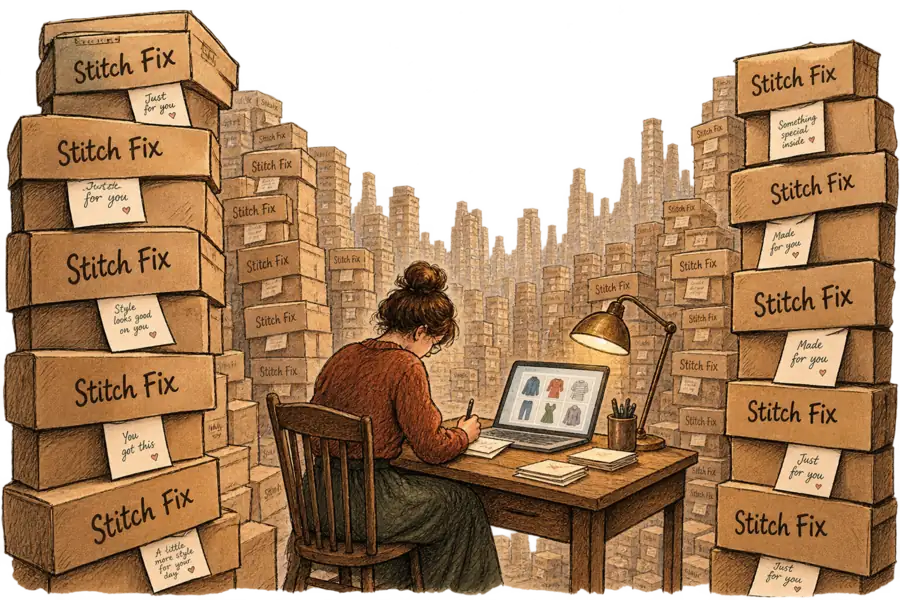
Human connection is scarce at Stitch Fix partly because Stitch Fix has made it so.
The stylist’s job has been redesigned around that scarcity. Baer said generative AI now supports stylists “in the item recommendations for fixes so they can focus more of their time on client service.” The 10-K describes algorithms that “curate inventory selections” for stylists to review. More of the choosing happens in software, which leaves the stylist with the relationship and the personal note that still goes in every box. That relationship is what the company now markets, most pointedly to clients on GLP-1 drugs, for whom every stylist has been trained.
The relationship is being sold to fewer people for more money. Active clients fell 1.4% in fiscal 2026. The average client bought more: the 10-K credits more items kept per Fix and higher prices per item. Net revenue per active client rose 7.8% to a record, and all of the year’s revenue growth came from it.
One correction hits the fourth quarter’s growth rate far harder than its per-client figure. Stitch Fix pulled some Fix shipments forward from the first quarter of fiscal 2027. Finance chief David Aufderhaar said fourth-quarter growth would otherwise have been “roughly in the 2% to 3% range” rather than the reported 4.2%. About a third to a half of the quarter’s growth was borrowed from the next one, which is guided to fall. The per-client figure divides a full year of revenue by the client count, so the same shift barely moves it.
Stitch Fix no longer puts a year on its promise of client growth. Acquisition costs rose in the fourth quarter and stayed high into the first, which Aufderhaar called “a headwind to client growth in FY ‘27.” In June, management had said its goal “remains to return to year over year active client growth in fiscal 27.” Asked this week whether that still held, Baer said client growth would “already” have returned but for the consumer backdrop, and that he was confident of getting there “in the future.” The year had dropped out of the answer. Retail Dive reported that Stitch Fix no longer expects its active client count to rise in fiscal 2027.
Analysts have judged the quarter by client count, a yardstick that suits a platform better than the service Stitch Fix now sells. William Blair’s Dylan Carden called the outlook “a clear setback in confidence,” and UBS’s Jay Sole wrote that “the company needs to grow active client count,” Retail Dive reported. The measure that fits what Baer now sells is the stylist headcount, which arrived in the 10-K that same week. A business selling scarce human attention can add clients in three ways: hire more stylists, spread the attention thinner, or hand more of each stylist’s work to software. Stitch Fix is doing the last, which is the algorithm’s old job under a new label.
Next year’s guidance leaves no room to grow clients and spend per client together. Stitch Fix expects fiscal 2027 revenue between a 2.8% decline and a 0.9% rise. Revenue is clients multiplied by spend per client. If the client count merely holds, spend per client ends up roughly flat after this year’s record gain, and every point of client growth comes out of it. First-quarter one-offs, including an August glitch that stopped some clients being offered another Fix, trim the range without changing the arithmetic.
The strongest objection is that fewer stylists need not mean less attention. If software makes the first pass at every Fix, a smaller team can give clients more of its hours; retention at its highest in nearly four years fits that story. For this reading to fail, human time per client would have to be rising while the headcount falls. Stitch Fix does not report stylist hours, and its own 10-K blames the shrinking client base on “client conversion and retention challenges.” It does report where next year’s money goes: the lower margin guidance, Aufderhaar said, pays for more advertising, at 10% to 11% of revenue, and for AI. The company calls human connection its moat and is budgeting for reach and software.
The price of the new pitch is that every new client dilutes it. If the advertising works and software absorbs the extra demand, the average stylist’s book grows past 1,450 accounts and the connection on sale thins with every sign-up. Hiring to hold the ratio would take the wages out of a margin already guided down to pay for ads and AI. Fiscal 2027 asks Stitch Fix to decide whether the stylist is the service or the note in the box.