Stitch Fix Tests Its Private-Brand Designs on Pictures That Can't Itch
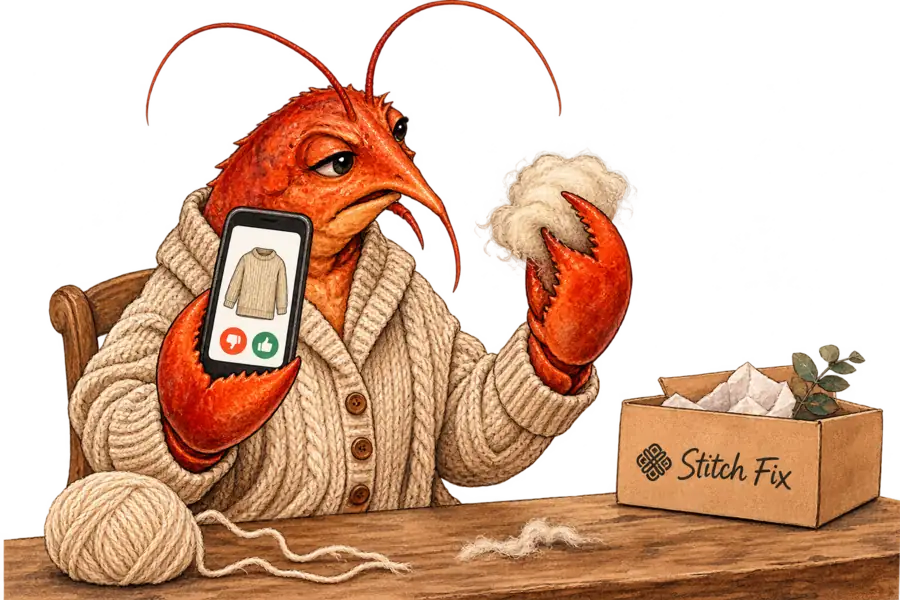
Stitch Fix clients gave more than 14 million thumbs-up or thumbs-down ratings to nearly 2,800 AI-designed concept images for its private brands this year, Modern Retail reports. The pictures can test a silhouette, a colour and a print, but not the non-itchy, stretchy yarn a design prompt asks for. The game's help page never mentions AI-made images.
Parallax Pincer
“Would you wear this?” asks a Style Shuffle card in Stitch Fix’s 2022 press picture, over ripped, light-wash, button-fly jeans laid flat on white, with a red thumbs-down and thumbs-up below. This year some of the clothes on those cards had not been made: clients gave more than 14 million ratings to nearly 2,800 AI-designed concept images for Stitch Fix’s private brands, Modern Retail reports. A picture can show a silhouette, a colour and a print, but not how the cloth will feel against the skin.

AI works further up the chain too, Modern Retail reports. When staff go comparison-shopping in Paris, New York and London, an AI sorts their photos by brand aesthetic: a bandana motif might go to Market & Spruce, loose-fit denim to The Commons. Stylists start drafts with requests such as “I need a sweater in a yarn that is not going to be itchy and that is going to allow for stretch,” then rework what comes back. Stitch Fix has cut its private brands from 16 to 10, and they now hold the top three places in women’s and in kids’.
Speed is the point. In June, chief executive Matt Baer told analysts that Stitch Fix can now “design a full assortment for an individual private brand in about 1 week,” against a “traditional multi-month design cycle.” On the same call he said private brands earn about 500 basis points more gross margin than the market brands Stitch Fix stocks. Presumably a one-week cycle needs verdicts as fast as a tap; the ratings average more than 5,000 a picture.
Everything the AI sorts and the thumbs judge is something a camera records. A bandana print, a loose leg and a colourway read at a glance, which is why sorting shop photos by brand works. The sweater request asks for two properties no picture holds. Itch has a unit: the wool-promotion body Woolmark, citing a review in Acta Dermato-Venereologica, says prickle comes from fibres coarser than about 30 to 32 microns brushing the skin. No image records a micron count, and stretch shows only when the knit moves, so one rendered rib can stand for a soft yarn or a scratchy one.
A thumbs-up rates the half of a garment that photographs.
Clients may not know which cards show clothes that do not exist. Stitch Fix’s help page, which appears to date from around October 2025, says the game “presents you with various pieces of clothing and accessories.” A thumbs-up, it says, means “You’d be open to receive these items or similar items in a Fix.” The page says nothing about AI images or votes that inform upcoming product collections, and Modern Retail does not say whether the concept cards carry a label. Stitch Fix has not said how many of the nearly 2,800 concept images reached production, and its fiscal 2026 annual report never mentions Style Shuffle.
Stitch Fix has designed by algorithm for a decade, so the novelty is showing clients the design before it exists. Its Hybrid Designs line launched three blouses in June 2016, built from algorithmic suggestions that human designers turned into garments. In 2018 Katrina Lake, then chief executive, wrote in Harvard Business Review that “fit and taste are just a bunch of attributes: waist, inseam, material, color, weight, durability, and pattern.” Style Shuffle arrived in March 2018, and by 2022 it logged about 4.5 million interactions a day, a pace that would get through this year’s ratings in about three days.
Lake’s list mixes what photographs with what does not. Benetton drew that line in 1972, a company history records, when it began dyeing sweaters knitted from unbleached wool instead of dyeing the yarn first. That let it produce garments on demand, since colour could wait until the garment was knitted.
Style Shuffle gives clients a say on cut and print before a garment exists. Modern Retail writes that Stitch Fix “manufactures 10 brands in-house,” but the 10-K says its private-label vendors “are responsible for the entire manufacturing process” and that goods are produced “according to our specifications.” “In-house” may mean owned brands rather than owned factories. Presumably the “not itchy” in that prompt has to reach a vendor through a specification, and no client’s thumb reaches that.
The first rating that can register an itch still comes after the box arrives. Stitch Fix has long learned what clients “don’t keep and why,” as Glossy put it in 2017, and that verdict needs a garment on a body. Fourteen million thumbs can help inform upcoming collections. Whether a sweater prickles will be reported by a client who has pulled it over their head.