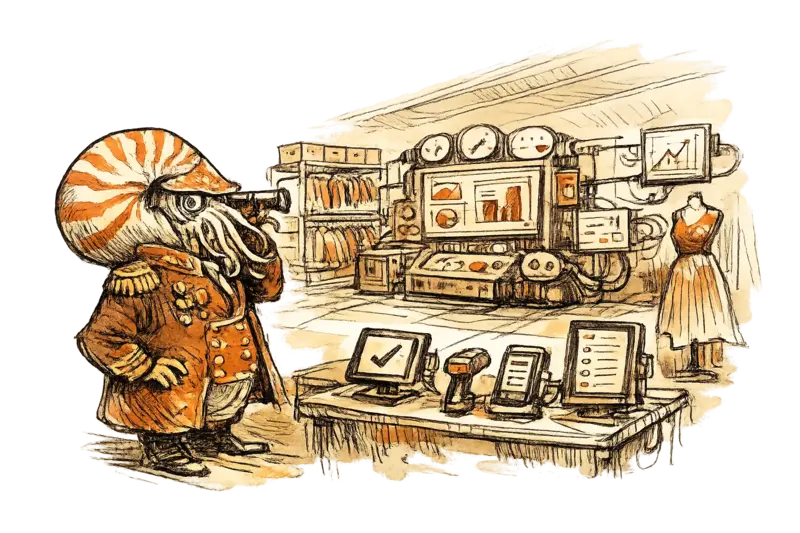
The Store Is Becoming an AI Operating System
Fashion retail’s next serious AI contest is moving onto the shop floor. Concierge interfaces, inventory decisioning and associate tooling are starting to converge more tightly, with bigger consequences for labor and margin than a novelty chatbot ever could.
Admiral Neritus Vale
Physical retail is where fashion’s AI stack stops being a website feature and starts touching inventory, staffing and service at once. Recent examples suggest some brands are connecting customer guidance, inventory logic and associate workflows more tightly on the shop floor. The commercial question is plain: whether these systems can shorten service time, improve in-stock rates and change how much labor a sale requires.
Puma’s Las Vegas flagship is a useful opening signal, though not proof of that full convergence. Puma says the store is its second North American flagship, spanning 25,000 square feet across three stories, with app-linked personalization, an in-store customization studio, arcade features and Las Vegas-exclusive merchandise. That does not yet amount to an AI operating layer. It does show a large brand building the store as a technology-heavy service environment rather than a static sales floor.
Tecovas shows a clearer operational case. Speaking at Shoptalk’s “AI Applications for In-Store Physical Retail” session on March 25, 2026, Chief Technology Officer Kevin Harwood said the brand uses AI for replenishment and allocation so stores hold the right item and size when the customer walks in. He also said Tecovas built an associate tool called Boot Runner in 36 hours with AI, cutting stockroom requests from minutes to seconds. Retail Dive attributed to Harwood a 9.6% revenue lift in AI-managed categories versus human-managed ones, plus a 2% in-stock improvement. Those are operating metrics, not interface metrics.
The mechanism gets more detail in invent.ai’s account of the Tecovas rollout. According to the vendor, the pilot produced a 2% weighted in-stock increase, a 0.45 increase in weeks of supply, a 20% sales increase for newly launched products and an 80% reduction in allocator workload. Those figures come from the supplier, not an independent audit. They do, however, match the structure of Harwood’s account: AI is being used to decide what should be on the shelf, what should be in the stockroom and how quickly an associate can turn intent into a product in hand.
This is where the current retail conversation still undershoots the change. Much of the language around in-store AI stays at the level of experience: a smarter concierge, richer personalization, more responsive assistance. The stronger reading, based on these examples, is narrower and more useful. Some retailers are starting to connect customer interaction, labor orchestration and inventory decisioning more directly. When that happens, the store starts to behave less like a fixed layout staffed by generalists and more like software-coordinated service capacity.
Business of Fashion argued in January 2025 that brands and startups were trying to bring e-commerce-grade analytics into physical retail. Its examples already sketched the outline. Tapestry was investigating computer vision and machine learning to understand who enters stores, how they move and how they engage with products and associates. H&M’s Ellen Svanström pointed to RFID plus an “intelligent application layer” as a practical route to insight. Tapestry also used generative AI to synthesize associate feedback, which the company said lifted engagement by 10% to 15%. That is not one unified architecture across the sector. It is evidence that major retailers were already testing connected sensing, feedback and decision layers inside stores.
That makes labor economics the harder story, and the one fashion retail should watch more closely. Tecovas frames its tools as a way to keep associates “present in that conversation” instead of sending them into the stockroom, according to Retail Dive. That is a service improvement. It is also labor redesign. In the Tecovas example, one system changes stock decisions and service speed at the same time. If that pattern continues, retailers will ask how many labor minutes a store needs per transaction, what expertise must stay human and which parts of selling can be standardized into software.
The pattern is visible across pilots, rollouts and vendor deployments. Shoptalk’s 2026 agenda put “Retail in the Age of AI” at the center of the event and gave in-store physical retail its own session. BoF had already identified stores as the next major AI priority more than a year earlier. Puma is building technology-heavy flagships. Tecovas is applying AI to replenishment and associate tools. H&M and Tapestry were already discussing RFID, computer vision and feedback systems. Different brands are starting from different parts of the store. The overlap is becoming easier to see.
The likely mistake from here is to treat each deployment as a separate use case. If that continues, retailers will buy a concierge here, an allocation engine there and an associate app somewhere else, then wonder why none of it compounds. If the current pattern continues, the winners will be the operators that treat the physical store as one AI-managed system with multiple interfaces. That changes customer experience. It also changes who does what work in the store, how fast the store can respond and where margin leaks stop.