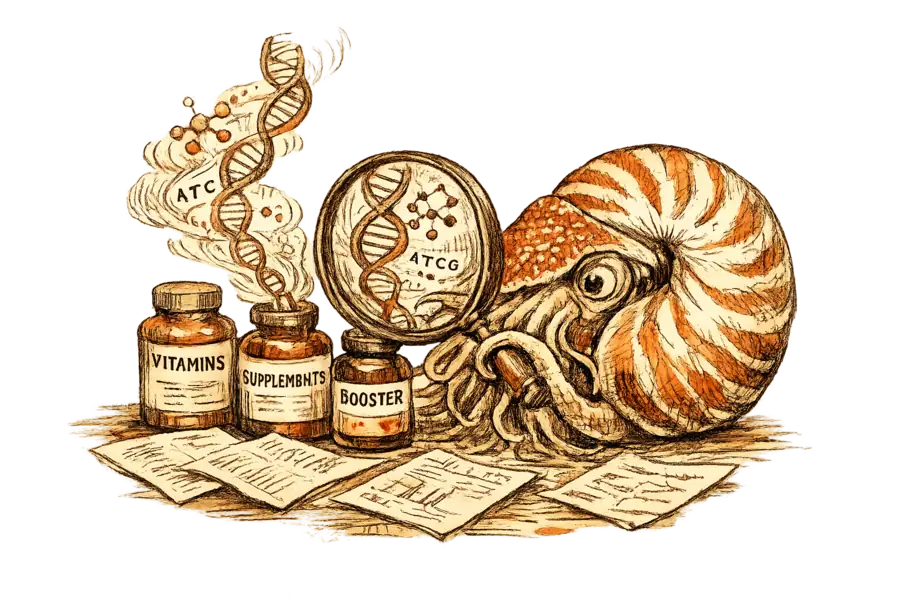
When Every Supplement Brand Has a Chatbot, the Moat Is the Data
Thorne's CSO calls AI wellness chatbots 'table stakes.' The concession reveals what matters next: once the interface is ubiquitous, the competitive moat shifts to proprietary health data.
Neritus Vale
Thorne’s chief science officer, Dr. Nathan Price, told Glossy that AI wellness chatbots are “absolute table stakes” for supplement brands. The comparison he reached for was pointed: not having one is “like deciding not to have a website” in the late 1990s. The claim concedes the argument it seems to make. If the chatbot is table stakes, the chatbot is not the advantage. The advantage is whatever sits behind it that a competitor cannot replicate on a weekend with an API key.
Thorne’s own chatbot, Taia, shows where the split falls. Launched in January 2026, it fielded over 200,000 messages and generated more than 350,000 product and lifestyle recommendations in the months since launch, lifting average order value by 8% among users who engaged with it. User satisfaction ran at 94% positive. Those numbers measure adoption, not defensibility. The defensibility sits beneath the chat window: Taia draws on Thorne’s internal research database, built from more than 40 years of clinical work. That dataset cannot be reproduced by fine-tuning a foundation model.
The pattern extends beyond supplements into adjacent wellness commerce. Hims & Hers reported quarterly revenue approaching $600 million in Q3 2025. The growth tracks a bet on proprietary health profiles, not a redesigned checkout page. Viome builds custom supplement capsules from microbiome and gene-expression analysis. InsideTracker runs blood-biomarker panels, calculates biological age, and adjusts its recommendation engine with each new draw. Each company collects proprietary biological signals and builds the recommendation layer on top.
The demand side confirms the thesis. SPINS data shows 11% of Gen Z and millennial consumers rank AI chatbots among their top product-discovery methods, with 15% using AI tools for supplement product learning more broadly. A Thorne consumer survey found 57% of respondents unsure which health products suit them, and 67% willing to use a trusted tool to personalize their decisions. That is a large addressable audience already comfortable asking a chatbot for health guidance instead of a pharmacist. What converts that traffic into defensible margin is the dataset the interface draws on.
Generic AI health advice already illustrates the gap. A Nature Medicine study published in February 2026 stress-tested ChatGPT Health across 60 clinical vignettes — yielding 960 responses across 16 test conditions — and found it undertriaged 52% of emergency presentations, directing patients with diabetic ketoacidosis to 24–48 hour evaluation rather than emergency care. Performance followed an inverted U: adequate in the middle of the severity range, worst at the extremes where domain-specific training data matters most. Thorne’s own Wellness Confidence Gap study found 43% of Americans had used AI or ChatGPT for health advice in the past month. If those users receive supplement guidance from a general-purpose model trained on the open web, the output carries confidence without specificity. Proprietary data closes the gap between a fluent answer and a defensible one.
The regulatory constraint sharpens the question. Taia cannot diagnose illness or prescribe treatment; doing so would trigger FDA classification as a medical device. Between diagnosis and generic product information sits a narrow band where recommendation quality determines whether a chatbot adds clinical value or rehearses label copy. Brands building on proprietary efficacy data, biomarker correlations, and longitudinal outcomes can fill that band credibly. The rest are selling a search bar.
The $72.9 billion U.S. supplement market is sorting itself into brands that own biological data and brands that rent a chat interface.
The strongest objection is that trust in the branded interface will matter more than the data powering it. A consumer who has shared six months of health queries with one brand’s chatbot may stay out of switching costs and familiarity alone. The argument holds only if competing chatbots remain roughly equivalent in recommendation quality. They will not. Longitudinal biological data — the kind that accumulates with each blood draw and microbiome sample — improves recommendations in ways that interaction history alone cannot. A brand that knows your microbiome composition will outperform one that knows only your purchase history, and the gap compounds with every test result ingested.
L Catterton paid $680 million to take Thorne private in 2023, a 94% premium to the unaffected share price. The bet was not on bottles of vitamin D. Thorne had spent years building a vertically integrated data asset: clinical research, practitioner networks, biological testing, and longitudinal health profiles. The chatbot is the surface layer for monetizing that asset at consumer scale. Every supplement brand that launches a chatbot without an equivalent data layer is building a shopfront on rented ground.