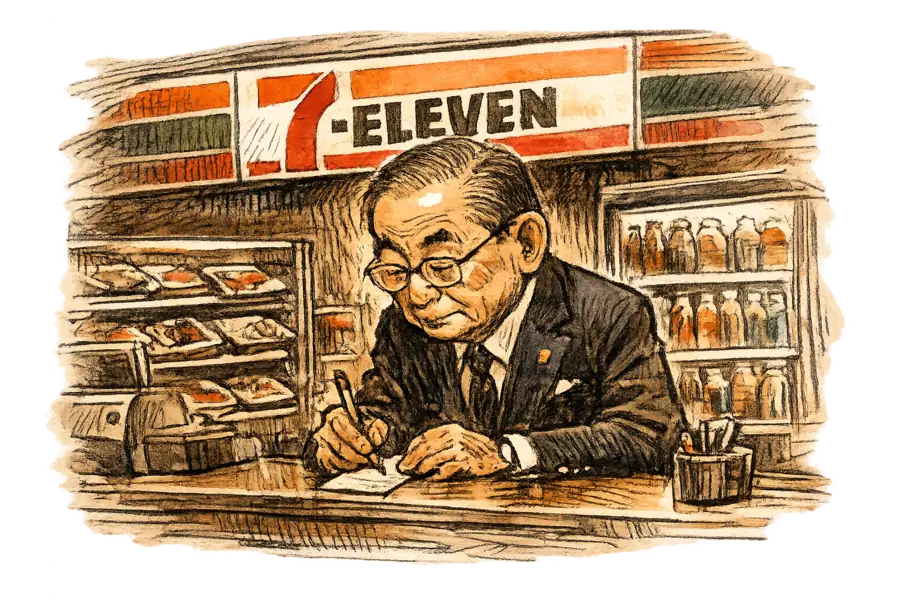
Toshifumi Suzuki Ran the First Demand Model by Hand. The Hand Was the Point.
Toshifumi Suzuki built Seven-Eleven Japan on tanpin kanri: human hypothesis-and-verification at the level of the single item, the exact judgment AI demand-sensing now promises to automate. His death is the moment to ask what merchandising loses when the hypothesis-maker is a model.
Sir John Crabstone
Toshifumi Suzuki died on May 18 at 93. The obituaries call him the man who pioneered the use of data to tailor inventory, and make him sound like the grandfather of the demand-sensing software now selling itself to every retailer. He was closer to its opposite: he built Seven-Eleven Japan on the human habit those tools are sold to replace, the discipline of guessing what tomorrow would sell and then answering for the guess.
His method had a name: tanpin kanri — the control of every single item. A clerk formed a hypothesis about the next day: a local match at a stadium three streets away, so order extra cold drinks and quick bites. He placed the order, then read the till to see whether he was right. Suzuki backed this with shared IT infrastructure that tracked performance across the chain; the data still came last, to confirm or refute a human call. He pushed the habit down to the part-timers, and turned shelf-stackers into analysts paid to think a day ahead.
The software is better at this, and it is worth saying so plainly. Machine forecasting consistently outperforms human estimation at scale: no clerk holds thousands of items across thousands of shops in his head, and none should be asked to. For a chain carrying thousands of new styles each season, the gain is real. On the arithmetic the machine wins, and not narrowly.
Fashion is where this stops being academic. Apparel is the demand-sensing vendors’ favourite case: short seasons, and no usable history for a style that did not exist last spring. Those are the conditions under which Suzuki insisted the past could not be trusted and only a fresh hypothesis would do. The vendors are careful to keep a human in the loop. They are less careful about where in the loop she stands.
The forecast was never tanpin kanri’s product. Its product was the forecaster. The demand-sensing firm Stylumia sells what it calls “True Demand,” set against what it describes as “subjective, expert-led or supply-driven trends” — the implication being that the machine reads demand where the buyer can only guess. Suzuki never claimed to know true demand. He built a chain on the opposite premise: that no one does, and that a person made to guess and then corrected will, over a career, come to read a neighbourhood very well.
Tanpin kanri turned every clerk into a merchant; demand-sensing turns every merchant into a clerk.
What disappears is not accuracy. It is authorship. A buyer kept in the loop to approve the machine’s call grades a hypothesis; she no longer makes one. The clerk who misjudged the bento faced the unsold trays the next morning and learned. The model that misjudges is retuned overnight by an engineer who never worked a counter, and learns nothing the shop can use tomorrow.
Suzuki’s wager was that an ordinary person, made to bet and then shown the score, would come to know a neighbourhood better than any system could. He may prove wrong; the software is very good and getting better. But a chain that needs no one to form the hypothesis will, in time, keep no one who can. He spent a career proving a person could out-think the data, and his memorial is a machine built to prove the reverse. That is the inventory he leaves unmeasured.