Taobao's Agent Sets the Recommendation Pipeline for Each Visit, and One Request in Five Gets the Cut-Down Version
On some Taobao marketing surfaces, the MARS agent sets the recommendation pipeline for each shopper and sends about a fifth of requests through two of the four stages, for what its report calls "promotion-abuse" and pass-through visits. Its reported lifts, up to 7.34% in GMV, are averages over everyone, and the report gives no figure for the requests served the shorter version.
Neritus Vale
On some of Taobao’s marketing surfaces, an AI agent now sets up the recommendation pipeline for each shopper, and it never picks a product. It decides how much ranking machinery a visit gets. About one request in five, a technical report posted on 18 November says, gets a cut-down version. Its results are averages over every shopper, so they cannot show how those requests fared.
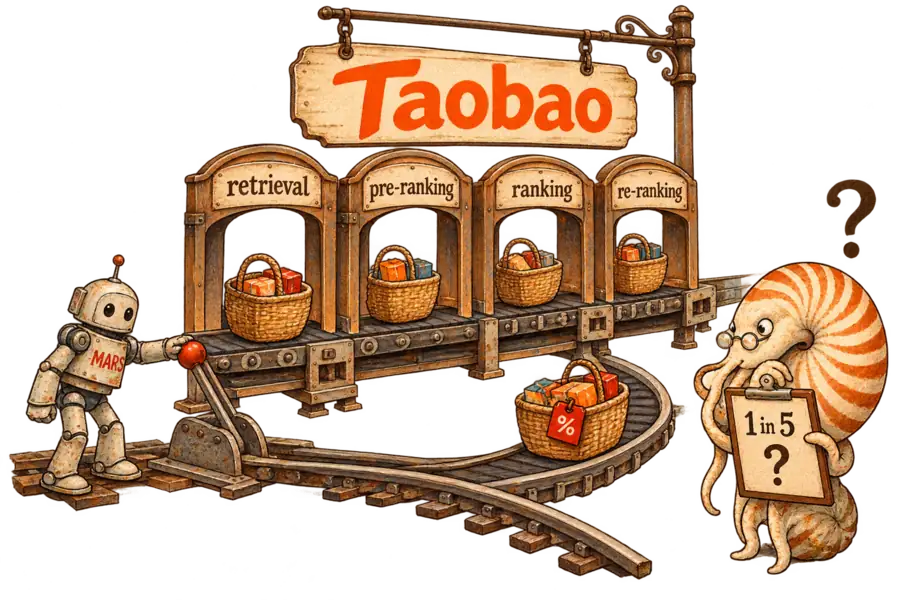
A Taobao recommendation passes through four stages: retrieval gathers candidates, pre-ranking thins them, ranking scores them for clicks and purchases, and re-ranking arranges the page. Normally, the report says, engineers set each surface’s channels, quotas, models and score blending, and every shopper there shares them.
The report’s system, MARS, hands those settings to a small model, Qwen3-0.6B, first trained on the outputs of the larger Qwen3.6-Max. Each configuration is written in advance, checked and cached by shopper and surface, so the pipeline never waits. Depending on the surface, 85% to 95% of requests use its settings and the rest get the default. The results are Taobao’s own; the report carries a Taobao copyright line.
The agent’s numeric settings are bounded: each retrieval quota may move by at most 20% from the engineers’ default. The mode is a coarser lever. Full runs every stage, Streamline drops pre-ranking, and Minimal keeps only retrieval and ranking. Minimal therefore skips re-ranking, where other Taobao researchers recently built an evaluator on the main feed to predict where shoppers stop scrolling.
The subsidy app’s prompt prices each tool on a ten-point scale, with the generative re-ranker the dearest of those shown. After reading the shopper’s profile and recent behaviour, the model is to decide by “jointly considering relevance, performance, and invocation cost”.
About a fifth of requests run Minimal and almost all the rest Full, one rounded split the report says holds on every surface. The agent picks Minimal, it says, for requests showing “promotion-abuse or pseudo-exposure tendencies”, such as promotion-focused entry with little item-level engagement afterwards, or pass-through visits. Its aim is “to save serving resources”. How those requests divide among these or other patterns goes unreported.
In Taobao’s Ten-Billion Subsidy mini-app, arriving for the deal and barely browsing can be a reason to rank less.
Rationing computation by request has a Taobao pedigree. DCAF, deployed in Taobao’s display advertising in 2020, started from the observation that servers spent “equal computing power” on requests whose value could “vary greatly”. Its authors gave each request “personalized” computation by value and reported the same business results on 20% less. The report names other predecessors, which tune budgets within a fixed pipeline; MARS adds a model that reads the shopper’s clicks, purchases and searches, and chooses the pipeline itself. In the report’s training diagram, a schematic sample that keeps the full pipeline opens its reasoning with a verdict: “The user is a typical price-sensitive, high-frequency, low-spending customer.”
The tests ran on five marketing surfaces: the Ten-Billion Subsidy mini-app, a flash-sale channel, the feed after payment in Taobao’s instant-retail service, the homepage marketing grid and campaign venues. The report does not list Taobao’s main homepage feed among them.
Each test ran for two weeks, with shoppers assigned at random to the agent or the old settings, each arm taking 5% of the surface’s traffic. V2P is the share of shoppers shown recommendations who bought, uCTR the share who clicked and pCTR clicks per impression. The results for purchase surfaces and click surfaces follow, with the report’s nominal intervals.
| Surface | Metric, relative change vs control, % [95% interval] | Metric, relative change vs control, % [95% interval] |
|---|---|---|
| Ten-Billion Subsidy (Baiyibutie) | V2P +5.22 [+4.58, +5.86] | GMV +7.34 [+6.18, +8.51] |
| Flash sale (Miaosha) | V2P +3.88 [+2.62, +5.15] | GMV +4.83 [+4.15, +5.50] |
| After instant-retail payment (ShangouPostPay) | V2P +2.24 [+0.10, +4.43] | GMV +7.17 [+1.56, +12.77] |
| Homepage marketing grid (MarketingBlock) | uCTR +1.08 [+0.47, +1.70] | pCTR +0.99 [+0.08, +1.90] |
| Campaign venues (Dacu) | uCTR +2.27 [+1.13, +3.42] | pCTR +3.47 [+2.24, +4.71] |
Every interval clears zero, some barely, and all are “nominal”. V2P and uCTR are user-level rates; for pCTR the authors defer within-user impression clustering, and for GMV day-to-day correlation, to “future offline reanalysis”.
These are averages over everyone assigned, fallback traffic included, so the requests served Minimal sit inside them. The report gives no click, purchase or GMV figure by pipeline mode, and its limitations section concedes that aggregate gains “do not directly identify” what each serving decision contributes. When Alibaba’s TriGen paper split a test by market, two of six had sold less than the control on point estimates, beneath a positive aggregate.
The abstract pairs the Minimal share with a mean serving latency 12 ms lower than in production, a gap the report calls “associated”. The figure covers the whole deployment, not Minimal alone; the baseline level is never given, and the figure leaves out the cost of running the model. The ablations are single online runs with point estimates only, by the report’s own account.
Taobao’s strongest defence would be that those requests lose nothing. A shopper passing through, or one who came for a single subsidised deal, may never study the list, so the skipped stages would have been wasted. The agent’s training rewards also counted clicks and purchases, never cost. For the defence to hold, the shoppers behind Minimal requests must click and buy as often as they would under the full pipeline.
Nothing in the report shows that. It calls its business scores, which match logged clicks, carts and purchases, “matching proxies rather than causal responses”, and its own evidence says configuration can do harm. In a live prompt test, a partly trained agent without the engineers’ written guidance cut the flash-sale purchase rate by an estimated 27%.
Alibaba pitches its Qwen shopping assistant as the shopper’s helper: in May, it said Qwen let Taobao shoppers “browse, compare, place orders, and manage deliveries”. MARS works behind the counter. If the design spreads, how hard a recommender works on a visit becomes a verdict a model reaches in advance, from the shopper’s record and the look of the request.
The report prints no line for the requests served Minimal, though Taobao logs each served configuration against purchases “by user ID and timestamp”. Its saving is counted in milliseconds; whatever the shortcut cost those shoppers is not counted.