Taobao Built the Refund Button in 2022. Alibaba Has Built the Shopper Who Presses It.
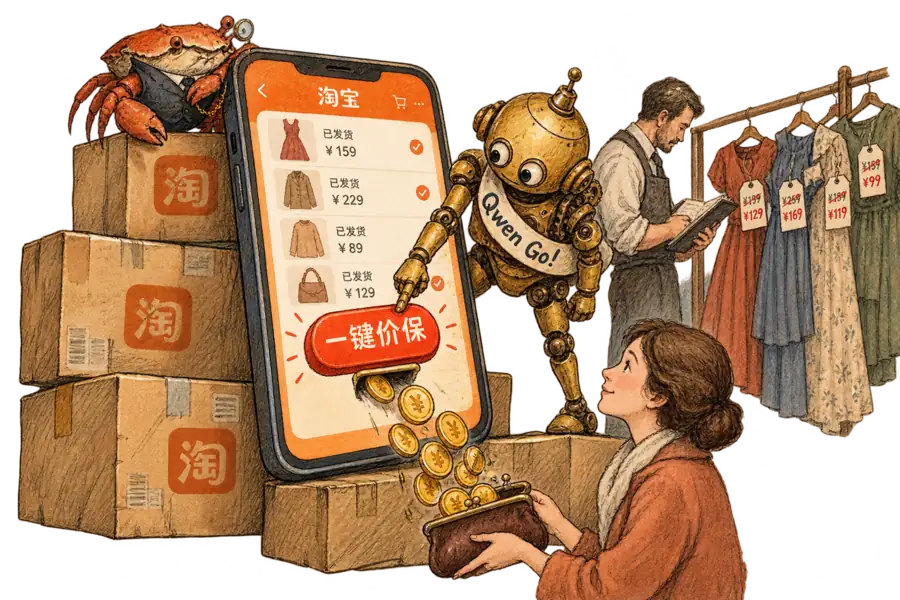
Taobao has offered one-click price-protection refunds since 2022, paid for by merchants. Alibaba's Qwen Go! agent, now in phased testing, claims them for shoppers just as Double 11 rules require full price protection until 28 November.
Sir John Crabstone
Taobao gave price protection a one-click claim centre in 2022. Collecting still takes attention, and Alibaba’s Qwen Go! (千问Go!), an agent inside its Qwen app, supplies it. Pandaily reported on 13 October that Alibaba had opened sign-ups, with access rolling out in phases and no date for everyone else.
One tester had heard that Taobao refunds overpayment but did not know how to use it, Qilu Evening News reported. Qwen Go! found the price-protection entry, checked every order and flagged a non-stick wok whose price had since fallen. It recovered 52 yuan. The launch coverage offers only this case and the flight case below, both drawn from user-shared videos and demo material; neither has been audited.
It was never hidden. Changsha Evening News, relaying Tmall’s figures in June 2022, described the mechanism: tap one-click price protection, the machine calculates automatically, and any difference is refunded within seconds. More than a million Tmall users collected refunds during that year’s 618 festival. The keenest took 12,681.3 yuan.
A refund nobody claims costs nothing; that may be why it was so easy to promise.
The bill goes to the seller. Taobao’s price-protection standard, last amended in April, makes the refund the merchant’s promise. Drops caused by the platform’s own red packets or subsidies trigger no refund, so the cuts that cost money are mostly the seller’s. The standard also lets Taobao remind eligible shoppers to claim.
Double 11 lengthens the window. Taobao’s Double 11 rules require full price protection on campaign goods from payment until 28 November, with spot sales from 20 October. Sellers must refund the price difference the system calculates. Campaign prices are locked until the campaign ends on 13 November, so the open stretch runs from 14 to 28 November, plus goods outside the campaign.
Alibaba writes the rule the seller signs and owns the agent that collects under it. A Wallstreetcn article from the WeChat account 硬AI says some of the small claims, price guarantees and price enquiries that shoppers abandon could turn into service calls and transactions. If they do, the seller books the same claims as cost.
The agent also haggles. A tester who could not remember which flight had been delayed asked for compensation. When a flight-booking platform’s customer service offered vouchers, the agent pressed for cash and won 70 yuan after several rounds, National Business Daily reported, citing the demo footage. A voucher keeps the money with the company that offered it; cash does not.
A rival’s agent would first need Alibaba’s leave. Taobao’s user agreement voids any grant of account access to a third party made without Taobao’s consent. The marketplace that does not fund the refunds can withhold that consent.
Taobao’s rulebook already names machines. The standard lets it refuse refunds obtained by cheating or farming with machines, refunds used by anyone but the buyer, and claims it has reasonable grounds to suspect. The launch reports do not say how Qwen Go! fits that clause, or whether a seller can tell an agent’s claim from a shopper’s.
Apparel is one of four categories where complaints cluster. Beijing Business Today reported in 2021 that price-protection cases concentrated in 3C electronics, appliances, apparel and cosmetics. One apparel seller told it that full price protection over Double 11 would leave sellers no reason to run a promotion. If sellers follow that logic, discounts may drift after 13 November into forms the standard excludes, such as flash sales and gifts.
A promise that relied on forgetful shoppers was a wager. The agent checks every order.