Pailitao's Photo-Search Test Lifted Transactions 27% and GMV 9%, Implying a Smaller Average Sale
In the Multimodal Search test of Alibaba's PailitaoMMSearch2.0 report, transactions rose 27.04% and GMV rose 8.94%, which implies an average transaction about 14% smaller. The model's offline lead is in matching items to a photographed product, not in finding the product, and one candidate source of the extra sales is what goes with it.
Neritus Vale
In Pailitao’s Multimodal Search test, Taobao’s camera search sold more often and, by our arithmetic, for less per sale. That is the sum inside a technical report Alibaba engineers posted on 27 October, though the abstract never does it. One candidate cause is the job the new model does best: finding what goes with the product in a photo, rather than the product itself. The authors themselves write that the online test “measures the deployed system as a whole and cannot attribute gains to individual components”.
The report describes PailitaoMMSearch2.0, the model now behind Pailitao, Taobao’s photo search. Its authors all list Taobao & Tmall Group of Alibaba, with Xu Chen as corresponding author and project leader. A single vision-language model reads a raw photo and a typed instruction, then writes out product codes called Semantic IDs.
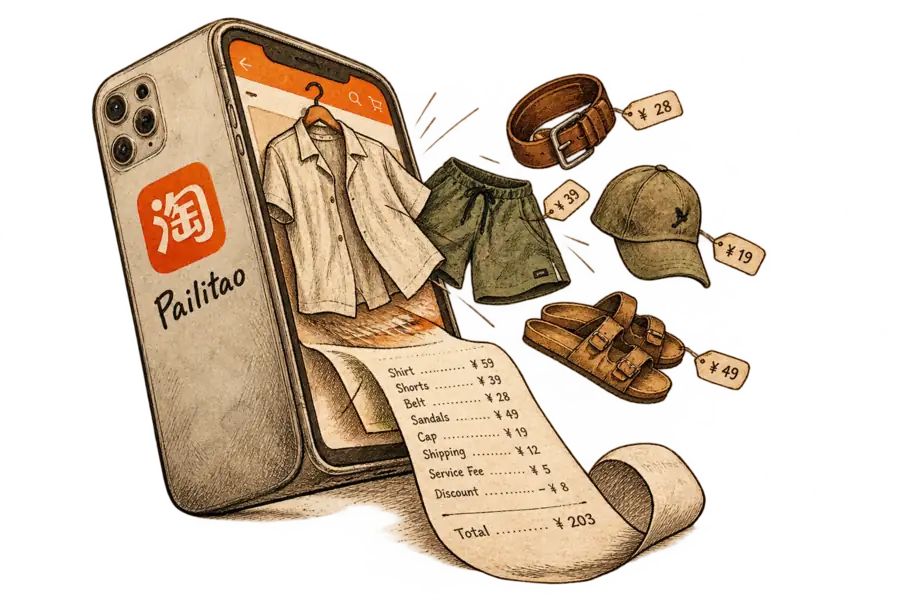
That one model now handles requests that Alibaba’s internal pipeline sorts with an intent classifier. The paper groups them as similar, editing and matching. Its first examples come from the wardrobe: a photographed shirt with the instruction “sports shorts to match it”, or sandals with “the women’s version from this brand”.
The abstract presents the live test as a list of gains. It reports “statistically significant improvements” in item page views, transactions and gross merchandise value. The tests gave the new model about 10% of traffic for about 14 days, against production baselines. Only one application, “Multimodal Search”, has its results printed.
Two of those gains moved at very different speeds. Transactions in the test bucket rose 27.04%. That is the largest of the online gains, ahead of item page views. Gross merchandise value, the money those transactions were worth, rose 8.94%.
Set GMV against transactions, and the implied average transaction in the test bucket is about 14% smaller than in the control.
That figure is our arithmetic, and it holds only if both numbers count the same thing. The October report does not define its metrics. The same team’s July report does: GMV “measures the total transaction value”, and transaction volume is “the number of completed purchase transactions”. On those definitions the ratio is the average sale, whether compared as bucket totals or per user.
An automatic judge produced the offline scores, and the report gives one check on it. Of the results the judge marks Excellent, held-out human labels confirm “from 93.6% to 93.9%”, depending on intent (Table 3). That figure covers only the judge’s positive calls. Shopify’s researchers gave no agreement rate for the judge behind their semantic-ID results.
The authors concede the judge “may share correlated errors with the evaluators used for data filtering and reward modeling” (limitations). Those evaluators picked the new model’s training data and scored its rewards. The authors reply that the different base models used for each role “avoid the player-referee conflict”. Different base models can still share errors, which is the concession itself, so our inference is that any lean would favour the new model.
On the job Pailitao was built for, the internal pipeline still wins on Excellent Rate. The service was originally built mainly to find the same item, Jiemian reported, and clothing is among its busier categories. On similar-item requests the internal pipeline scored 54.1% Excellent (Table 4). The best setting in the report’s scaling table reaches 50.6%.
Other measures are closer. On similar items the 2B model ties the internal pipeline on GR and leads on NDCG, 0.907 against 0.874. Editing goes the other way, and the paper says so.
Matching is where the new model pulls away. The team’s July paper names “accessory or outfit recommendations” among the things general-purpose vision-language models fail at in image search. On matching, the internal pipeline scored 44.2% (Table 4), its weakest score. The smallest new model scored 70.9%, which makes it the better stylist of the two and the worse finder.
The online test may have measured a blend. Where a mature recall-and-ranking pipeline already runs, the paper says the new model’s products are “interleaved with those from the existing pipeline at the final presentation stage” (online tests). It does not say whether Multimodal Search is such an application, or what share of its queries are matching, similar or editing. If it is, the old pipeline can keep supplying similar items while the new model adds what goes with them.
The same team’s July report offers the closest comparison. Its earlier model, Pailitao-MMSearch, was tested on the “PeiWoGuang” floor, which “aims to find similar items given user image queries” (online results). There, generative retrieval lifted transactions 3.74%. GMV rose 3.67%, so the average sale barely moved.
The same floor’s generative ranking test went the other way. GMV rose 9.94% against transactions at 4.47%, which puts the average sale about 5% higher. The ratio moves with the model type, so the October number cannot be read as a property of generative search in general.
The strongest objection is that Pailitao’s shoppers hunt for lower prices, and a better model may simply find cheaper versions. Photo-search users often ask why identical-looking items differ so much in price, Jiemian reported last year. Taobao had given every Pailitao user an AI tool for finding the same item cheaper since August 2025, and the report does not date its test. The judge grades relevance, not price, so a model could score worse and still sell more cheap near-matches. For the thesis to fail, the extra transactions must come from those cheaper versions, not from matching.
The published evidence leans toward the outfit over the bargain. The July retrieval test already ran generative retrieval on similar items, and the average sale barely moved. October’s model adds matching, where its lead over the internal pipeline is the widest in its comparison table. The report carries no price data and says its test cannot attribute gains to components, so neither reading is proved; only the matching one fits its offline tables.
The cleanest check on this argument is missing from the report. The model also runs in a “Find Matching Tab” and a “Find Similarity Tab” (deployment), and the report gives no test figures for either. Yet it was “fully rolled out to 100% of the traffic in the corresponding production scenarios” (online tests). Taobao has put all its traffic on the model before showing results by request type.
Alibaba deserves credit for printing both numbers. Tencent’s agent-evolved recommender, which we covered yesterday, reported clicks and no purchase measure at all. A retailer judging a visual-search vendor should ask for transactions and GMV together, and do the division Alibaba’s abstract skipped.
Pailitao was built to find the shirt in the photo. If Alibaba’s own tables are any guide, its new model may earn its lift on the shorts. That could be a good trade for Taobao and for whoever sells the shorts. It would still be a trade: transactions went up, and revenue per sale went down.