Taobao Said No to ByteDance's Phone Agent. Douyin Is Not on the List.
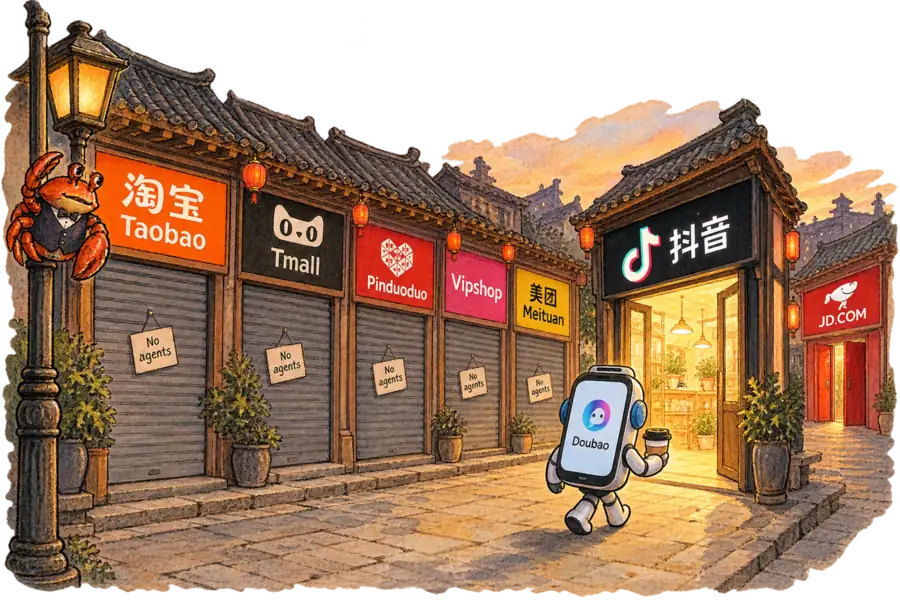
ByteDance's Doubao phone agent may now work third-party apps that have not refused it. Taobao, Pinduoduo and Meituan did; JD.com and Douyin are not on the list, and in a September test the agent offered to buy on Douyin when a shop was closed to it.
Sir John Crabstone
ByteDance frames its new agent protocol as a transparency mechanism for app developers. For retail it amounts to a published list of shops its phone agent may not enter. Douyin, the shop ByteDance owns, is not on it.
On 14 October the Doubao phone assistant ended a 30-day notice period for its Screen Automation Execution Protocol (SAEP). Since September it has said it prefers structured MCP and A2A connections; where none exist, it works apps by reading the screen and simulating taps. It may now do so, gradually, in third-party apps that have not refused.
The list runs past 150 names and is updated every Wednesday. Taobao, Tmall, Xianyu, Pinduoduo, Vipshop, Kuaishou, Meituan and Xiaohongshu all refused. JD.com is absent, as is Dewu, the sneaker marketplace. Developers can still refuse at any time.
Silence does not keep the agent out. Doubao’s statement, cited by National Business Daily, says apps that have neither replied by email nor declared a refusal will be opened “according to the app’s risk tier”. Only a refusal keeps the agent out for good.
SAEP’s developer guide lets the system demand the user’s confirmation or takeover before payments, account verification and deletions, and no app may loosen that baseline. The protocol also lets an app refuse by page or by action, down to flash sales and reward claims. The platforms on the list refused the whole app, which suggests they are protecting something other than the payment screen.
In September, before any refusal list existed, the agent mainly supported ByteDance’s apps, ZTE’s and a few authorised outsiders. In a Yicai report carried by 21jingji, a reporter asked it for a hot latte. Taobao Shangou, Alibaba’s delivery service, and JD could not take the order, so Doubao suggested ordering through Douyin’s services instead. With the reporter’s approval, it picked a Luckin Coffee shop there and handed back the payment step.
If refused shops are treated like unauthorised ones, a refusal is a routing instruction to an agent whose owner keeps a shop.
Jiemian wrote that the agent had run into “the thickest ecosystem wall” of the mobile-internet era. If refusals continued, it warned, Doubao would struggle to build “a complete service loop”. For shopping, the September test suggests that loop runs through Douyin. The shopper still gets the latte; ByteDance keeps the errand.
Amazon turned away Meta’s Muse in September, GeekWire reported, citing unauthorised access, an agent that did not identify itself and captured credentials. The same report notes that Amazon’s ad business, which earned more than $68 billion last year, depends on people browsing its pages. Agents are not people. One reading is that Amazon judges the browse worth more than the order; it has not said so.
JD.com, where 396,000 people had reserved the phone as of 16 September, has not refused. Under ByteDance’s rules its door may now open, tier by tier, at a pace ByteDance sets; a refusal would shut it again.