Target's Boycott Is Over. Its Founders Won't Restock.
Target's DEI reversal triggered a year-long boycott that has now ended; the costlier defection is on the supply side, where Black-owned founders refuse to restock. A near-complete $2 billion pledge bought a procurement number, not their return.
Sir John Crabstone
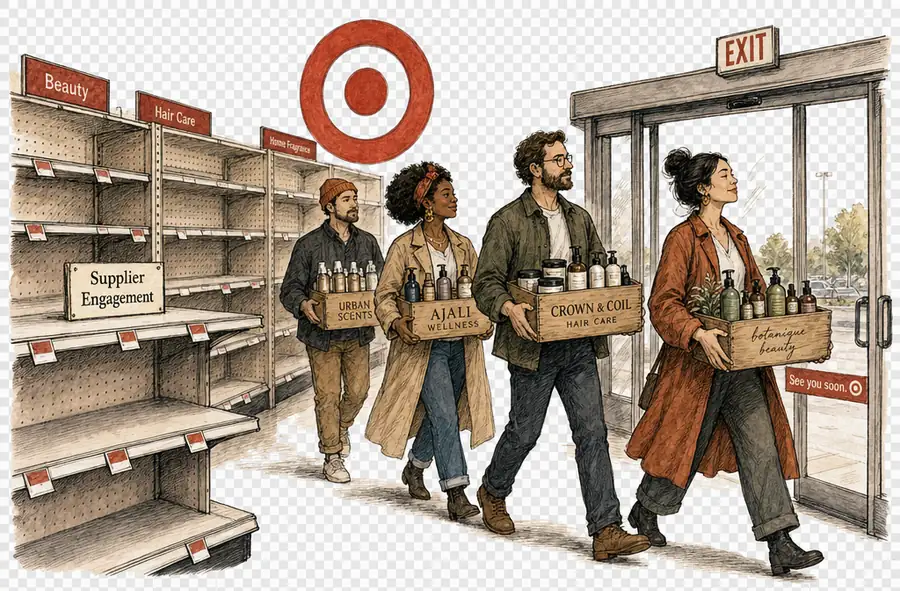
In January 2025, Target renamed its “supplier diversity” team “supplier engagement” and retired the goals behind it. The market read the reversal as a public-relations problem and priced a boycott. The deeper bill came from the supply side, where the founders who built that story are declining to restock. The rename was the tell: a commitment Target once reported had become a preference it could let lapse. A boycott lifts when the news cycle moves on; a severed sourcing relationship does not.
The visible wound was real enough. Black faith leaders organized a year-long boycott, and by August 2025 Target had logged a sixth straight month of falling foot traffic, down 3.1 percent against the prior year on Placer.ai’s count. The same firm’s model projected the quarter’s revenue down by as much as 4.4 percent. That is the kind of number a retailer knows how to read, and the kind it knows how to wait out.
On its own terms, the boycott worked. In March 2026 its most prominent leader, the Rev. Jamal Bryant, called off the boycott. He claimed three of four demands, pointing to Target’s $2 billion pledge to Black-owned business, by then more than 95 percent spent. Target had still not reversed the policy that started it. The boycott won a spending figure and dispersed; the reversal that drove the founders off stayed in place.
The founders saw it differently. April Showers watched her Afro Unicorn line cleared from Target by the end of 2025 and absorbed a $600,000 two-year revenue loss she attributes to the wider retailer DEI pullbacks, of which Target’s was the most visible. She says she will not return until Target “actually does what they did” — the pre-2024 version of itself, publicly. Trey Brown of Ride FRSH found his air fresheners stranded in back rooms and his questions routed to a “diversity initiatives guy” he never asked to speak to. Another founder described being required to pay for Black History Month promotions — $25,000 was the figure that made direct-to-consumer advertising look preferable — and a separate fee to be certified as a Black-owned vendor. The brand, she said, “spent much more money than we ever made,” and was dropped anyway. Curls Dynasty has since gone out of business. The founders who lent Target its diversity story are, one by one, taking it back.
These are different problems with different timelines. A boycott is a demand a shopper can resume; a discontinued vendor is a relationship someone must rebuild from zero, and that does not happen on goodwill. Target spent a year answering the first problem while the second one quietly hardened.
Target’s answer has been a campaign. Its post-boycott program funds HBCU mentorship and a partnership with an Atlanta entrepreneurship center, the stock meanwhile down 61 percent from its 2021 peak. Every line of it addresses how the company looks. Not one of them changes what it stocks. A near-complete spending pledge can sit in the annual report while the founders who gave it meaning decline to pick up the phone.
Target mistook a sourcing decision for a messaging one, and messaging is the only half it knows how to fix.