Target Built a Warehouse That Admits Walmart Was Right
Target's $265 million Houston 'receive center' adds the upstream holding tier Walmart's network has had for decades. The pilot framing is the part that confirms the rebuild will not stop at one warehouse.
Sir John Crabstone
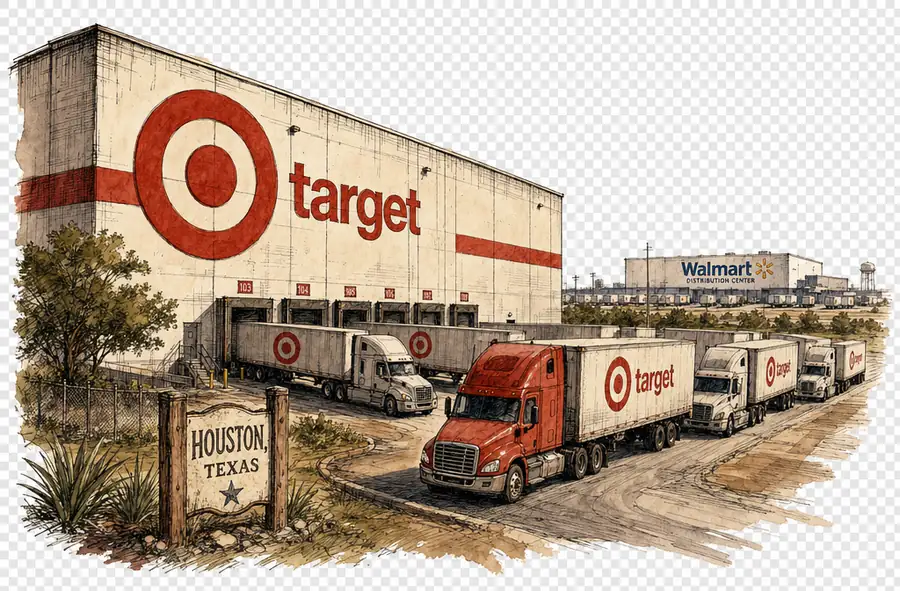
Target’s first “receive center” opened in Houston on 29 April. The company calls it a pilot. The word does more work than the building.
The facility holds imported inventory upstream and releases it to six regional distribution centers and a Chicago flow center only when stores call for it. That is the architecture Walmart has run on for years: regional capacity sized to demand signals, not to dock space. The $265 million Target spent in Texas confirms what every analyst chart has implied: that the gap was inland — a regional buffer between Target’s existing coastal import warehouses and its RDCs. Distribution centers ran hot; store backrooms ran hotter.
Walmart’s regional distribution centers each serve between 90 and 170 stores, at an average one-way travel distance of roughly 124 miles. The math has been public for decades. Target’s response, until this spring, was to call its own supply chain “lean” and reassure investors. Lean is what one calls a configuration before deciding it was undersized. The doctrine assumed merchandising could compensate for distance. It cannot.
The “pilot” framing is the admission.
Sousan Ortega, SVP of Field Replenishment, told Modern Retail the company would “start to decide” whether the receive center becomes “a future strategy” once the test site proves itself. That reads like caution; it functions as a budget request. Houston is not a stand-alone fix for one congested region. It is the engineering prototype for a tier Target spent fifteen years insisting it did not need. If it works, more will follow; if it does not, the rebuild becomes more expensive, not less. A single receive center cannot pay for itself. Its return assumes a network. Boards approve pilots when the second site is already sketched.
Coverage has dutifully noted the facility’s 1.2 million square feet and in-house line sorters that saved nearly $700,000 in construction costs by choosing an alternate design. The smaller story is more telling. Target designed the entire facility in a 3D simulation at its Minneapolis XR Experience Center before pouring a slab. Walmart has been pouring slabs since 1970. Simulation is the elegant version of arriving late. There are cheaper apologies, but few more visually satisfying.
The trade has been generous in framing this as catch-up. As eMarketer observed ahead of the Houston opening, two 2026 playbooks were already converging on the same imperatives. Convergence is the kind word; the harder word is admission. For two decades Target sold a different theory of the store — better merchandising, cleaner shelves — as though the underlying logistics architecture were a matter of taste rather than physics. The receive center says it was physics. The theory was correct on aesthetics and wrong on cubic feet.
What the receive center cannot do is shorten the next decade. Walmart’s regional density is compounding; Target’s is beginning. The pilot will succeed and the second receive center will be authorised within the year, because no board approves $265 million for a one-off. What follows will be three, then a programme described in investor decks as “foundational.” The cost of having been right about brand and wrong about boxes will not be paid in one quarter, or one warehouse.