Target's Title-Reading LLM Judge Missed Four in Ten Bad Recommendations on Its Benchmark
Seven Target authors describe MOSS, a monitor in which o3 grades live recommendations, search results and offers from product titles and strategy context. Its production evidence tests whether alerts are right; in the paper's retrospective benchmark analysis, the deployed configuration missed about four in ten of the pairs human reviewers flagged.
Neritus Vale
Seven Target authors have posted a preprint on an LLM monitor whose production evidence tests whether the judge is right when it complains. It says little about what the judge lets through. In Model Sanity Service (MOSS), OpenAI’s o3 grades live recommendations, search results and offers from item titles and strategy context. It has run for over six months at what the paper calls “a large U.S. retailer” and surfaced two confirmed serving defects.
The paper is under review at IEEE BigData 2026 and names no deployer beyond that retailer; the authors work in Target’s Data Sciences group. Every four hours, MOSS samples seed items by traffic and sends o3 the titles of each seed and its recommendations.
The judge sees less than anyone else in the paper. Brand, price, description, colour, material and audience stay in MOSS logs. Reviewers labelling the 498-pair benchmark saw full product metadata.
The two defects MOSS caught were the kind a title gives away. Backfill in one bundle placement attached an adult horror paperback and a teen fantasy novel to a children’s board book. The limitations section concedes that vague titles can produce false alerts; it does not address a matching title that hides the wrong fabric or cut. The paper reports no apparel results, so that case is inference.
Agreement with human reviewers, the usual defence of LLM judges, is a weak test for a monitor. Only 17.5% of the benchmark’s pairs were alert-worthy, so most agreement is earned on pairs that were fine. The paper’s chance-corrected figure puts o3 at a κ of 0.52, against 0.49 between the two reviewers.
On ranking, every frontier judge beat the retailer’s production embeddings, though the authors do not call the gaps significant. With its original prompt, o3 reached an AUC of 0.871, against 0.794 for the embeddings.
The deployed configuration is weaker. It uses a calibrated o3 prompt, chosen partly to bring alert volume “into a range that the human triage queue can sustain”. On the 419-pair subset where every method could be compared, its F1 is 0.556. Recall fell far more than the false-positive rate, so most of the alerts it shed were real. It let through about four in ten of the pairs reviewers flagged, a recall of 0.584 at the authors’ retrospective threshold.
The calibration cost most where the judge had been strongest. Its widest lead over the embeddings came on substitutes, items meant to replace the seed. The calibrated prompt halved its recall there, from 0.632 to 0.316 in the text; Table IV prints 0.737 for the starting cell. About 19 substitute pairs were alert-worthy, so that is twelve caught falling to six.
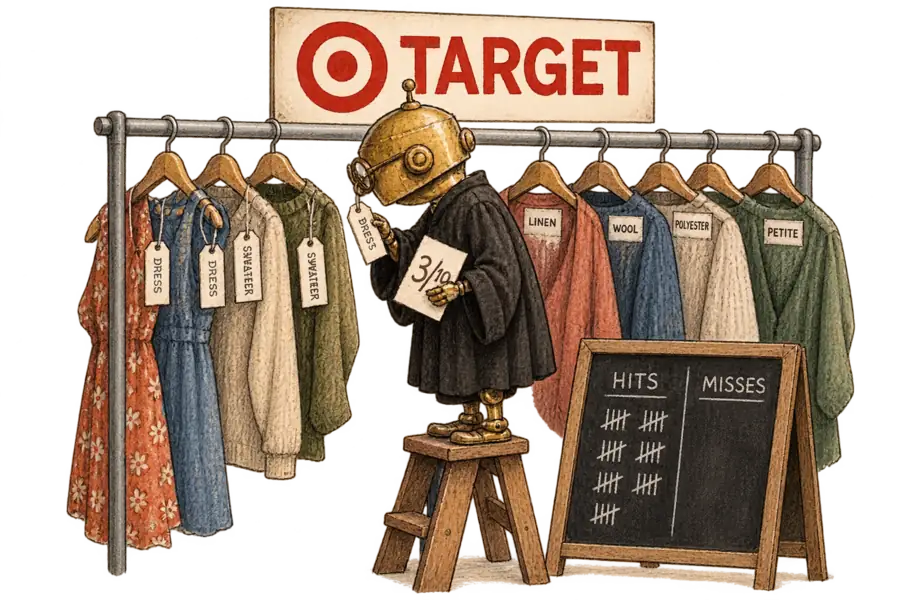
Related items, 60% of the production run, held up: their F1 moved from 0.729 to 0.737 under calibration. The four-in-ten figure therefore pools a loss that falls mostly on substitutes and bundles. In apparel, a substitute is the dress offered when the first has sold out, and it works only if material, style and wearer match. This judge sees those details only if the title carries them.
One representative run flagged 28.4% of the pairs it scored, a traffic-weighted rate. The paper does not report what reviewers made of that run. A separate study had reviewers read 116 alerts from the original prompt at a threshold of 2: 84.5% were judged actionable and 56.0% met the strict mismatch definition.
For offers, reviewers checked only flagged pairs and confirmed 83.2%, which tests, the authors say, “an alerting system’s precision”. A sample drawn from alerts cannot contain the offer the judge passed.
Nothing in the production record counts what the judge let through.
The search evidence rests on 21 queries. At the recommendation threshold, o3 scored an F1 of 0.831, with recall of 0.914. That recall is the best evidence against this article’s argument. The queries explain it: they were head queries, “product category terms”, and two of them hold just over half the pairs humans flagged. Titles probably serve category terms best; the paper does not test title-only prompts against queries about a fabric or a cut.
The 76.4% cut in alert rate comes from MOSS grading the fix for a fault it found. Offline, the replacement placement returned about a third as many pairs as the legacy one. That is by design, but an alert rate is a share, so a placement that returns fewer, safer items scores lower whether or not shoppers buy more.
The drift module watches the judge’s title-only scores, so on its own it sees only the drift that titles show. A 1.5-point fall in mean score triggers a warning, and a two-point rise is flagged as “more likely a data issue than a genuine quality improvement”. The paper adds periodic re-scoring of a fixed calibration set, which catches judge changes that leave production distributions untouched.
OpenAI’s deprecations page lists the o3-2025-04-16 snapshot for removal on 11 December, with gpt-5.6-sol as the replacement. The paper does not name the snapshot MOSS runs; it says only that scoring goes through “an internal enterprise API endpoint”. The same page retires the gpt-5-2025-08-07 snapshot that day, and the paper tested neither replacement. GPT-5 run with o3’s calibrated prompt saw its AUC fall to 0.528, so a successor cannot be assumed to inherit the calibration.
The strongest objection is that triage needs precision first, because a queue flooded with doubtful alerts gets ignored. The authors call MOSS a triage layer, “not an automated quality adjudicator”. That holds only if something else catches what the judge misses, and the paper’s premise rules that out: MOSS exists because behavioural metrics show narrow failures slowly and dilute them. If a wrong-fabric substitute is such a failure, it can earn the click and the order before any signal registers.
For a retailer weighing such a monitor, the choice is what the judge may read. The retailer can pay for longer prompts and a fresh calibration, or keep a judge that reads the title while the shopper reads the label.