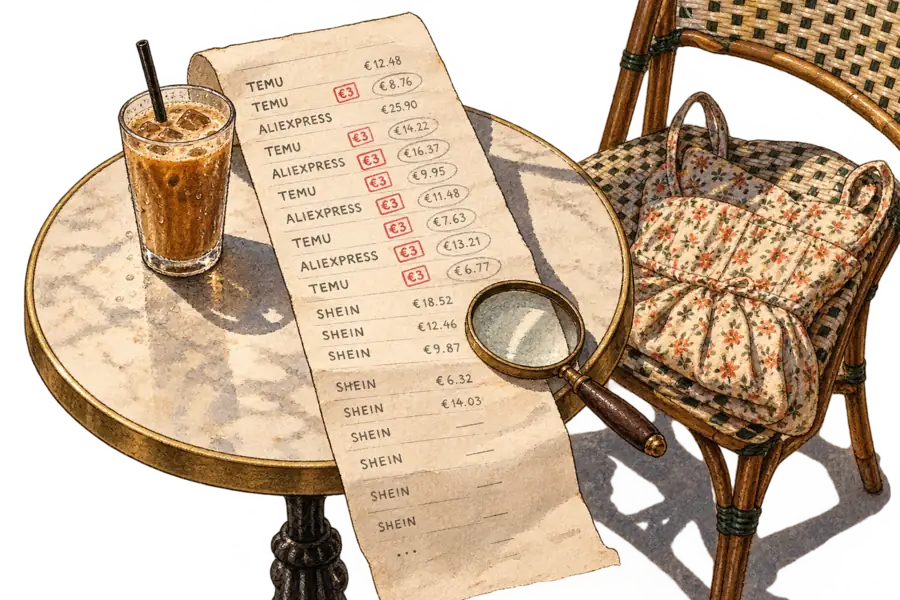
Temu's French Baskets Grew 34% After the €3 Duty. Shein's Held Flat, and Its Shoppers Left Anyway.
Bank data from the cashback app Joko show Temu's and AliExpress's French customers ordering less often and paying more per order since the EU's €3 parcel duty began, while Shein's basket barely moved and its customers kept leaving. The duty fits the two marketplaces' summer; Shein's slide began with its November troubles and deepened in a September that hit all French clothing.
Neritus Vale
French bank data show the EU’s €3 parcel duty reshaping how Temu’s and AliExpress’s customers buy, and leaving no such mark on Shein’s. Shoppers who stayed with the two generalist marketplaces ordered less often and paid more each time, as a flat charge at checkout would predict. At Shein the bill per order barely moved while customers bought less often and drifted away, which looks like fading demand.
The figures come from Joko, a cashback app that reads the bank transactions of 1.5 million French users and weights them to the population by age and sex. Les Echos reported on 22 October that Shein’s sales fell 26% “during the four weeks of the back-to-school season”. Joko’s chart is more exact: that is September’s value against August’s.
The duty is charged per line, not per parcel. Since 1 July the EU has levied €3 on each line of the customs declaration for any parcel worth €150 or less sold to a consumer, the Commission explains. A line covers goods that share a tariff classification, description and origin. Identical T-shirts share a line and pay once; add trousers, and the parcel pays again.
Temu puts the duty on the shopper’s bill. It adds €3.60, the duty plus VAT, for each type of product shipped from China and nothing for goods from its European warehouses, MacGeneration found when it tested the checkout in July. AliExpress has confirmed that its prices now include the duty, Joko says.
A bank statement cannot tell a taxed order from a bigger one. Joko’s chart of purchase frequency and basket size, which gives no dates, has Temu’s average basket up 34%. Joko offers two readings: the duty passed into prices, or shoppers bundling purchases into fewer orders. Only the second means customers bought more per order. Either way, they ordered 29% less often.
Temu’s remaining customers kept paying. Joko’s “customer value”, which combines the two, fell only 5%. Most of Temu’s loss therefore left with the customers who went: 37% fewer bought from it in the third quarter than in the second.
Shein’s basket did not move. It rose 1% on Joko’s chart, and Joko reads Shein’s case bluntly: “customers are simply buying less”, a “real retreat in demand”. Its customers bought 8% less often. In August Joko had credited Shein’s warehouse in Poland with reducing “its direct exposure to the tax”.
Shein’s customers left all the same. It had 23% fewer in the third quarter than in the second. Even its loyal buyers fell away: in September there were 31% fewer than in June. Those losses are smaller than Temu’s, but they came without the larger, rarer orders of a shopper adjusting to a new charge.
Shein’s French slide began before the duty. In November 2025 it opened at BHV Marais, and its marketplace was suspended after a customs check found non-compliant goods. Its French sales fell 54% year on year that month, Joko’s March review found. By March, after a run of monthly gains, they were still 38% below a year earlier.

September added two pressures on clothing. France’s anti-fast-fashion malus took effect on 1 September: an August order adds €0.50 to €12 per item, from socks to coats, to the recycling contribution that producers pay the textile recycling body. It applies to products scoring 0.8 or below on a measure built from range breadth and repair.
September’s heat hit clothing too. It was France’s second-warmest September since 1900, and shoppers put off buying warm clothes. The French clothing market fell 15% in value on a year earlier, IFM’s provisional figures show. Of the three platforms, Shein is the one built on clothing.
The strongest objection is that a flat bill can hide a price rise. If Shein spread the duty across the prices of goods it still ships from China, and shoppers bought fewer items per order, the basket would look unchanged while the duty did the damage. Bank data cannot count items. For the objection to hold, Shein’s customers should have flinched hardest when the price changed, in July, as Temu’s did.
Shein’s customers flinched hardest in September. Its value sales fell 18% in July against June, the mildest drop of the three, after Joko revised it from the 22% printed in its August report. They then fell more steeply in September, and Joko’s headline calls Shein “the hardest-hit”; that holds among the three general platforms, though DHgate fell further.
Shein’s September volume fell 21% against August, less than its 26% fall in value. If Joko’s volume counts orders, the average purchase shrank. A price shock leaves fewer, larger orders; Shein’s were fewer and smaller.
The duty explains Temu’s French summer, not Shein’s.
Paris is counting parcels to judge the duty. In August the economy ministry, citing French customs, said the number of small parcels imported into the EU had fallen by 30% to 40%, AFP reported. A parcel count falls whether a shopper leaves or orders less often and pays more.
If France’s clothing chains gained from the platforms’ summer losses, the gain did not last. In Germany, our 10 October analysis found the rest of online retail growing faster as the three platforms shrank. French chains’ web sales rose 3.7% on a year earlier in July and August, but the Alliance du Commerce credited July’s gain to heat pushing shoppers online, and August was down. In September they fell 15.9%, the Alliance reported.
Reading Shein’s slump as a border victory is a choice, and it has a price. It points the next lever, the customs handling fee due in November, at the order, where Shein’s customers show no sign of strain. Joko’s timeline sets that fee at €2 per category; AFP had it at €2 per parcel. A French chain that cuts prices to catch Shein’s shoppers is courting people who began leaving last November. This September they also bought less clothing from everyone.
French-language quotations are translated by Rack & Reason.