Ten Years of 3D in Munich Never Reached the Order Book
CLO's Munich office turned ten this month with 300 professionals in the room and a design-side standard to show for it. The showroom, the line sheet and the order book still turn on a physical sample, and nobody has written the rule that would let a render replace it.
Admiral Neritus Vale
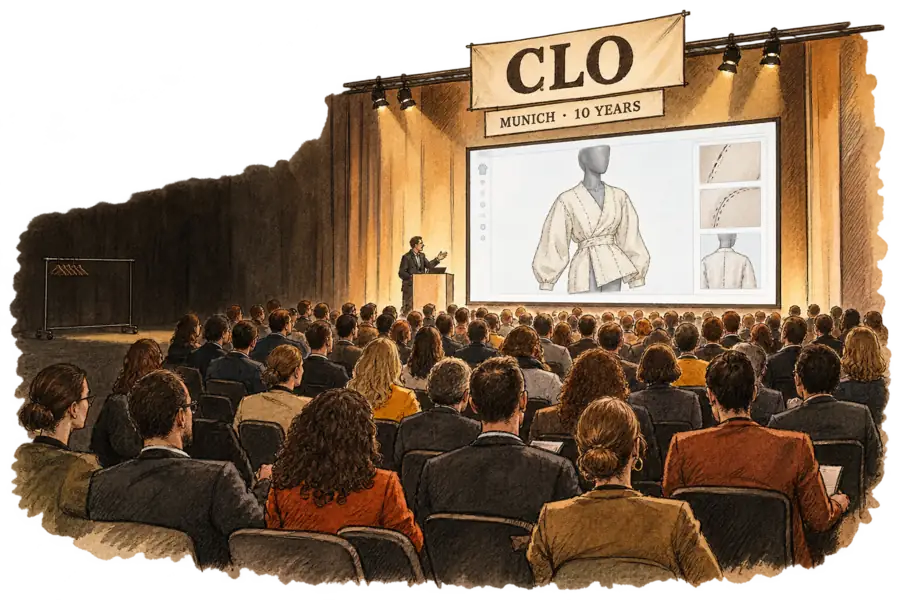
Ten years of CLO in Munich produced a design-room standard and no commercial counterpart. The company marked the tenth anniversary of its Munich office this month with a summit of 300 professionals from Lacoste, Vivienne Westwood, Zalando, s.Oliver and Fjällräven, alongside students from 58 European universities competing for its talent award. That is what a decade buys on the creation side: a trained labour pool, a common toolchain, and a workflow every large European apparel business now recognises. On the selling side it bought nothing that changed the transaction. The showroom, the line sheet and the order book still turn on a physical sample, which means the industry has built a garment asset its own wholesale side cannot transact against.
The clearest evidence sits in the language of the summit programme. CLO’s account of the Lacoste keynote describes a multi-year rollout that put 3D “into design & development, marketing and B2B divisions,” three destinations reached in that order. Naming B2B as its own project, years into a deployment, concedes that 3D does not arrive there by itself; someone has to carry it across. CLO founder Jaden Oh framed the ambition more narrowly still, telling the room that speed is about “eliminating the friction in handoffs between design, development, and production.” Production is where that sentence ends.
The imbalance compounds, because the pipeline feeding it is entirely design-side. CLO’s European talent award drew entrants from 58 universities this year, up from 39 at the 2025 Munich summit, a 49 percent rise. Each intake adds people who can build a 3D garment and nobody who can list, price or take an order against one. That is not a complaint about art schools, which are training for the jobs that exist. It is a description of where a decade of institutional investment went, and of what it left unstaffed.
The selling half was promised first and has been outstanding longest. Tommy Hilfiger had run a digital showroom since 2015 and began designing in 3D in 2017; by November 2019 it had committed to putting every apparel collection through the 3D platform by Spring 2022, with men’s dress shirts for Fall 2020 requiring no sample production at all. The same announcement described a capsule that would be designed, developed and sold entirely digitally. The first of those commitments is now unremarkable across European apparel. The second never generalised into a practice other brands could copy, which is the shape of a pilot that does not get a second season.

The money has already noticed. Kalypso’s annual benchmark of digital product creation, published with The Interline, found that only 4 percent of the retail, footwear and apparel organisations it surveyed had made significant changes to their product calendars after building 3D capability. Calendar compression is the reason most of them bought the software. What they got instead was sample reduction and virtual print approval, both real savings, and both banked entirely inside their own buildings.
The patience behind that spending is thinning, and the same research can date it. The share of companies struggling to justify further investment in digital product creation rose from 23 percent to around 40 percent in a single year, and the cause is not that the renders got worse. A capability that pays off only upstream will eventually be priced as an upstream cost, which makes it a budget line rather than a strategy.
The 3D file is now the cheapest object a brand can make and the only one it cannot take an order on.
The strongest objection is that wholesale digitised years ago and nobody missed the render. JOOR alone claims more than 700,000 buyers on its platform, and NuORDER competes for the same order flow, which suggests wholesale orders have been written in a browser well before the pandemic. If buyers were placing those orders against 3D at scale the argument here fails, so the test is the vendor holding the most assets and the strongest incentive to close the loop. CLO’s own virtual showroom invites buyers by link and offers “walk-throughs, selections, and inquiries.” Inquiries. What wholesale digitised was the paperwork, which is why NuORDER’s own account of how buying is changing in 2026 is about order management, inventory visibility and analytics, and never once about how the product is shown.
The blockage is commercial, not technical, which is why better rendering will not clear it. A 3D file becomes an offer only when the counterparty’s system accepts it as one, and the counterparty is a retailer whose buying, photography, quality assurance and allocation processes were all built to receive a physical object. The brand pays to create the asset; the retailer would have to pay to change what its own systems will take. No single brand can move that alone, and a company selling design software has no leverage over a buyer’s internal process. The sample survives every argument against it for a reason that has nothing to do with image quality: it is the unit the rest of the trade is built around.
If the next ten years look like the last ten, brands will pay twice for every style they sell wholesale. The first payment builds the digital garment that compresses development. The second is the physical sample, which carries the order and gets no cheaper as the render improves. That arrangement holds while 3D is filed as a design investment, and stops holding the moment someone in finance checks whether the thing bought to shorten the calendar shortened it. The missing piece was never a rendering standard. It is a commercial rule about when a render counts as an offer, and it belongs to the retailers and platforms that own the order book, who have not yet been asked to write it.