ThredUp Wants AI to Slow Its Hiring, and Nothing to Slow Its AI
ThredUp's chief executive shrugged at token usage that outran his expectations. The promised headcount saving is not yet visible in the accounts, and fourth-quarter guidance implies adjusted operating costs up about 2% at the midpoints.
Sir John Crabstone
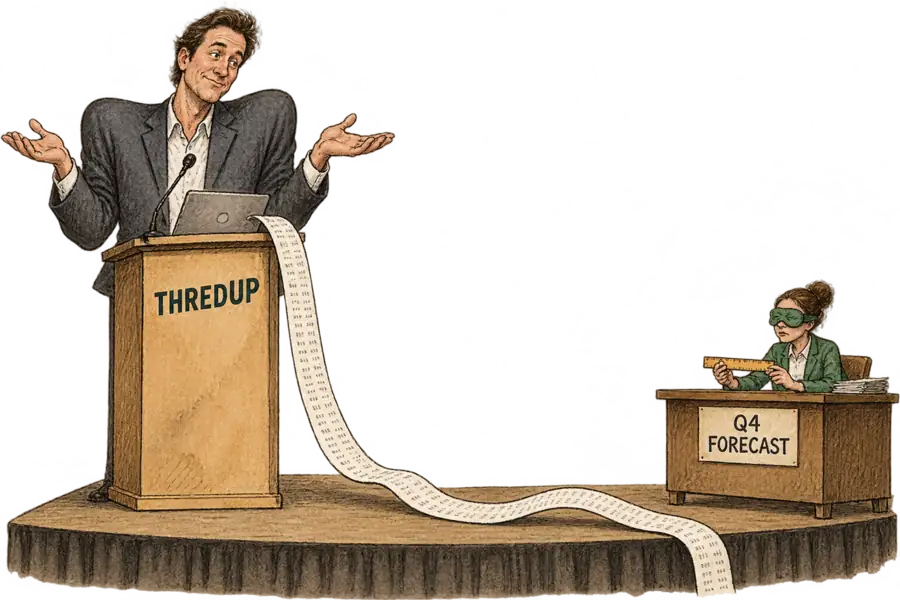
Most of ThredUp’s costs rise with the clothes it handles; the token use its chief executive described answers to staff appetite, which is harder to forecast. At September’s RetailClub AI Festival, Retail Dive asked James Reinhart whether scaling AI had proved surprisingly costly. The reply: “I was both surprised and didn’t care at all.”
Token usage had grown faster than Reinhart expected, yet he said nothing should be done to slow employee use. The slides on stage, new to their presenter, were built with Claude and checked by his assistant. As a public company, Reinhart allowed, ThredUp must get better at projecting such costs.
The promise came first. On the August earnings call, Reinhart named “efficiency and cost leverage” as AI’s short-term payoff, through “reducing the need to grow headcount as fast”. The bet may be sound: ThredUp reports that a real-time feed lifted profit per new buyer by 7% in its first A/B test, a result Reinhart called early. The only analyst to raise AI asked whether it could “offset some of the weaknesses”. Nobody asked what it cost.
The headcount in question mostly sorts clothes. ThredUp ended 2025 with 2,132 employees and contractors, 1,817 of them in its distribution centres. Its annual report describes machine learning there for pricing and listing, the kind of AI that could flatten a hiring curve. Slides built with Claude help the other one in seven.
The second-quarter accounts cannot yet say whether it is working. Operating expenses rose 17.4% to $78.6m on a GAAP basis, against revenue growth of 16.9%. Operations, product and technology costs rose 20.2%, led by personnel costs “mainly reflecting distribution center headcount”, while orders rose 21.9% on higher supply volume. Headcount that tracks volume says little about substitution; the test is headcount per order, which the filing does not give. Nor does it break out AI spending: the technology costs it does itemise rose $1.4m in operations and $0.3m in SG&A.
Accenture has measured how such usage concentrates. An internal analysis, reported by Fortune from Accenture’s report on token costs, found that one AI tool’s use rose 113-fold in ten weeks, with 19% of users accounting for about 80% of its spend. That is one tool at one firm. It still shows how few hands can move a bill.
A cost that rises with appetite will always be underestimated by those with the appetite.
ThredUp’s guidance leaves little room for such an error. Fourth-quarter revenue is forecast at $85m to $87m, about 8% growth, with an adjusted EBITDA margin of about 6%, up from 3.7% a year earlier. By our calculation, guided gross profit minus guided adjusted EBITDA at the midpoints leaves about $62m for adjusted operating costs, 2.3% more than a year before; across the guided ranges the figure runs from about 0.4% to 4.2%. In the second quarter the same measure grew 15%, and ThredUp’s own non-GAAP operating expenses rose 15.8%.
ThredUp has not said whether token costs sit inside that guidance. It reports its third quarter on 4 November. Analysts may ask, this time, what the tokens cost; Reinhart may not care about the answer, but the forecast will have to absorb it.