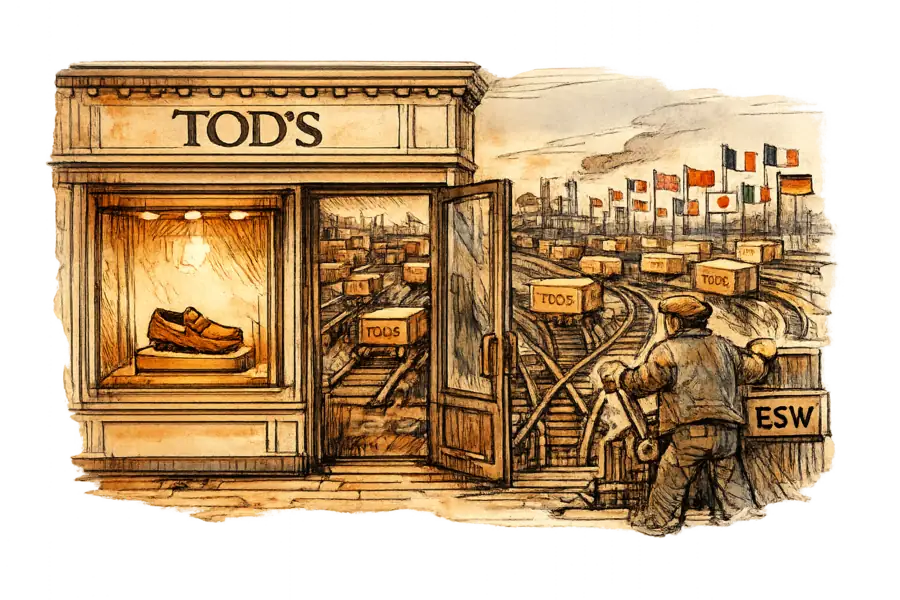
Tod's Handed 50 Markets to a Vendor. Owning the Store Wasn't Worth It.
Tod's has handed cross-border e-commerce for all four of its brands to the vendor ESW across roughly fifty markets. The deal reads as luxury's quiet verdict that owning global direct infrastructure is a cost, not a moat.
Neritus Vale
Tod’s Group has decided that selling directly to shoppers in 50 new markets is not a capability worth building. The Italian house has handed cross-border e-commerce for all four of its brands (Tod’s, Roger Vivier, Hogan and Fay) to ESW, a Dublin vendor that will run localized checkout, duties, tax, fraud liability and shipping, lifting the group’s direct reach past 80 markets. The arrangement carries a quiet verdict: global direct infrastructure is a cost center, not a moat. Distribution-as-a-service is eating the owned storefront, and a heritage house just signed the paperwork.
The brand keeps the storefront customers see; the vendor takes the machinery underneath it. ESW becomes the merchant of record: the seller of record in each market, the party that books the sale and absorbs fraud and chargeback exposure. It runs that machinery across more than 200 markets and wires it into Tod’s existing site, so the shopper still sees Tod’s. ESW’s chief executive, Eric Eichmann, describes the job as absorbing “the complexity of getting those brands to market”: duties, compliance, localisation, logistics. The skin stays Italian; the transaction belongs to a Dublin subsidiary of Asendia, the postal joint venture of La Poste and Swiss Post. That gap between the skin and the transaction is the whole story.
For a decade, luxury argued the opposite of what Tod’s just conceded. Houses pulled inventory out of wholesale and department stores, poured capital into direct channels, and called the owned storefront their defense against discounting and dilution. The merchant of record was the prize in that argument, because whoever is the seller controls price, data and the relationship. Tod’s has now leased that role to a vendor whose name no shopper will read. The concession is not that duties are hard, since everyone always knew duties were hard. It is that the direct international relationship, the thing luxury spent years calling strategic, turns out to be something a brand can procure.
The industry already ran this experiment at the platform layer, and it ended in writedowns. Farfetch was meant to be luxury’s shared storefront and back office; it couldn’t service its debt load and was absorbed by Coupang in a distressed sale that wiped out its shareholders. Richemont, which had bet on Farfetch to carry Yoox Net-a-Porter, walked away and wrote the notes down. Then it did something stranger: it paid Mytheresa to take YNAP, handing over the business plus €555 million in net cash for a third of the buyer. The seller wrote the cheque. YNAP’s white-label infrastructure — which had run Richemont’s own Maisons online — is being wound down as those houses move to their own platforms.
The storefront, it turns out, was overhead dressed as a moat.

The strongest case against reading this as surrender is that Tod’s kept the crown and rented out the commodity. ESW preserves the house’s data, its branded checkout and its white-glove delivery. If the customer relationship and the first-party data genuinely stay with Tod’s, renting duties and tax is ordinary capital discipline, the retail version of running on someone else’s cloud. On that reading the moat was always the product and the name, never the payment rail, and the only condition that has to hold is that the data stays usable. But the merchant of record is not a cloud bill, because the vendor becomes the seller and owns the transaction and the compliance relationship in every market it runs. Lease the spine in 50 markets and you keep your logo on a checkout another company operates, with a data feed and a renewal date on which ESW holds the leverage.
The timing explains the decision better than any e-commerce roadmap. Tod’s is no longer a public growth story but a private-equity turnaround, taken private by LVMH-backed L Catterton, with management under a mandate to find operating leverage. Group revenue reached €1.13 billion in 2023, up 11.9 percent — healthy, but not the kind of number that funds building direct infrastructure market by market while also satisfying new owners. Asked to choose between owning the rails and renting them, a house under that mandate prices ownership as cost. The capital that would have gone into payment localisation and compliance teams can now go into product and stores, where Tod’s still believes the moat lives.
If distribution-as-a-service keeps absorbing the back end of luxury, the owned storefront narrows to a brand skin stretched over rented rails. The visible site, the campaign and the unboxing stay with the house; the seller of record, the data pipe and the economics migrate to whoever runs the most markets most cheaply. That is a defensible place to stand only as long as the product and the name carry the relationship by themselves, which is precisely the bet Tod’s is making. The houses can file this under efficiency or under concession, but the distinction will not survive contact with the renewal clause. What Tod’s handed ESW was never 50 markets. It was the admission that owning them was a bill, not a wall.