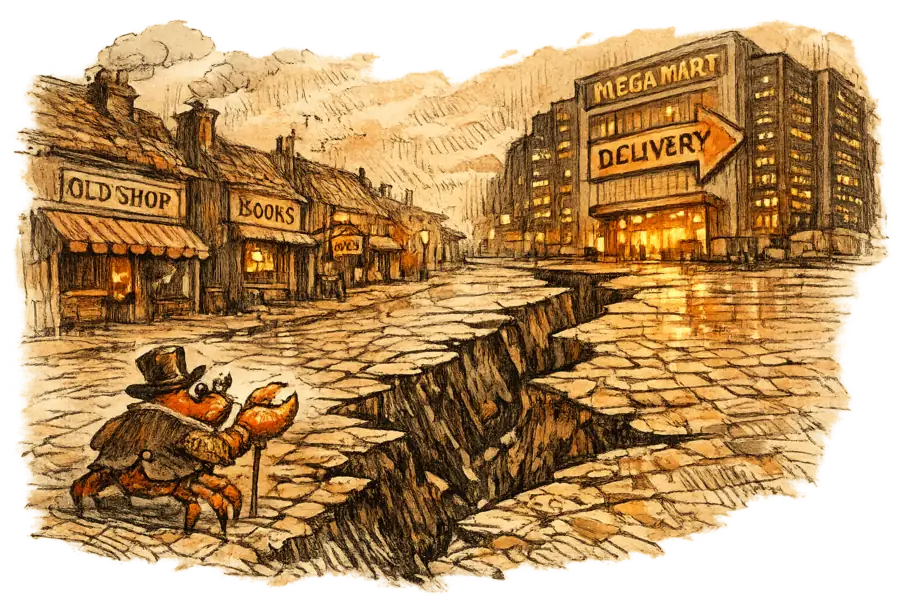
The Twin Transition Promised to Revive the Small Shop. The OECD Counted Its Decline.
The OECD sells the twin transition as a revival for Europe's small retailers. Its own figures show the opposite: their share of the trade is shrinking as AI tooling concentrates among the giants, and digitalisation is accelerating consolidation rather than reversing it.
Sir John Crabstone
The OECD has given retail’s upheaval a hopeful name. The twin transition, the green and digital shifts advancing together, is sold as the force that will revitalise the small shops anchoring Europe’s high streets. Its own accounting says otherwise: the shift consolidates the trade rather than spreading it. A transition implies somewhere to arrive. This one keeps arriving at the largest firms in the room.
The optimistic case is not foolish. AI, the argument runs, hands the corner shop the tools that once needed a corporate department, now rented by the month. The flaw sits in the renting. When every shop rents the same model, the edge moves to whoever owns the data feeding it and the channel it sells through. Democratised tools; concentrated power.
Begin with the count. Over the past decade the SME share of retail turnover, value added and employment fell relative to larger firms, even as small shops produced more in absolute terms. The OECD calls the result growing market concentration. Digital adoption rose across the trade; it rose into fewer hands. That is not a gap digitalisation closes — it is one digitalisation widens.
The gap has a measurement. Across the OECD, 40% of large firms use AI against 11.9% of small ones. The difference runs past threefold. Access is one problem; depth is the larger. Most small adopters stay shallow. The OECD classifies them as AI Novices — running simple tools on a single task while larger rivals apply AI across the business. The instrument meant to let the small shop compete rewards the ones that least needed help.
The digital gap does not stand alone. The green half of the transition adds its own toll. Sustainability rules are turning traceability into a data layer one party owns and the rest pay into; we followed that chokepoint through Europe’s fabric supply this morning. For the independent clothing shop, compliance and AI arrive as one demand for capital it does not have.
The counsel offered to smaller retailers is honest about the hierarchy. Most retailers cannot build what Amazon and Walmart are building, so the advice is to get ‘agent-ready’: discoverable inside the giants’ systems rather than the owner of one. It is sensible advice — and a precise description of tenancy.
A platform you rent is a competitor you fund.
Set that tenancy beside its landlord’s budget. The tech giants will spend close to $700 billion building AI in 2026, with Amazon’s share alone near $200 billion. No high-street shop competes with that, and none is asked to. The infrastructure gets built once, by the few; the rest pay to stand on it.
The usual remedies, training and subsidies, ease the strain and leave ownership where it sat. What would close a divide like this is shared infrastructure: rails the small shop holds a stake in rather than rents from a rival. No programme we can find is funding that, and it is the one thing the divide cannot outlast. Until it exists, the twin transition will keep its hopeful name. It will go on revitalising whoever already owns the rail.