Two Sisters Refused the Drop Calendar. Scarcity Is Their Product.
Façon Jacmin's twin founders built a denim label by skipping the industry's grow-and-drop calendar. As AI scales assortments toward thousands of styles a day, that deliberate scarcity is the product, not the constraint.
Parallax Pincer
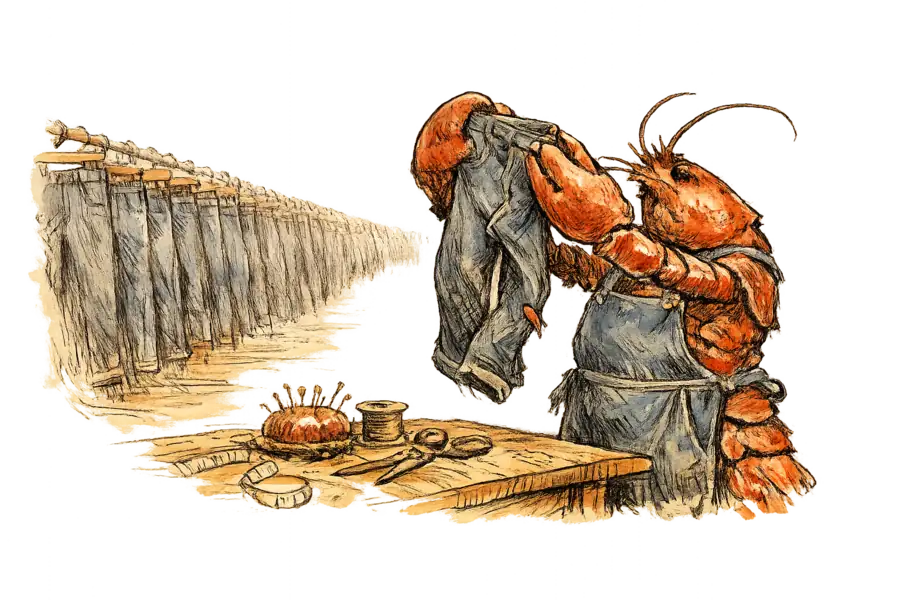
The side seam spirals up the leg where it should run flat, turning a pair of jeans into something closer to engineering. Façon Jacmin, the Antwerp label twin sisters Alexandra and Ségolène Jacmin started a decade ago, grew by refusing the cadence the trade treats as law: grow, drop, repeat. In a year when an assortment can be scaled by machine, that refusal is the product rather than a limit on it. Much of the denim is Japanese, finished without the usual bath of water and chemicals, and the styles wear people’s names, VILHEM or MEDEA, never a season or a drop number.
The sisters are unusually candid about the machine they declined to feed. “Until now, we have always done everything to keep up with this pace, and it is only now that we are realising it may not be necessary,” Ségolène Jacmin told FashionUnited. She names the wholesale calendar as the thief of judgment: “It takes time to think, and that is really the negative point of B2B for me.” Slowing further is not entirely free — Alexandra is direct that presenting later than June leaves buyers with less budget for orders, and a small label cannot miss that window. Alexandra describes the same instinct in the clothes: a deliberate balance between new styles and ones carried over and remade in another fabric, so a silhouette can return the next year instead of disappearing at season’s end.
The industry default runs the other way. Between July and December 2021, Shein loaded between 2,000 and 10,000 new styles onto its app each day — more than twenty times the combined new-item rate of Zara and H&M. Software sorted and resurfaced each batch by reading what sold by the hour. Generative design has only cheapened the next variation in the years since — the marginal cost of one more style now slides toward zero. An assortment that size is engineered to stop a thumb mid-scroll, and whether the garment survives ten years on a body is beside its point.
When the next variation costs a machine nothing, the rarest move on the board is the decision to stop.
The restraint isn’t a marketing pose; it has a traceable lineage. Before the label, Alexandra Jacmin worked inside Maison Martin Margiela and Jean-Paul Gaultier, houses built on deconstruction and the remade garment. Façon Jacmin’s upcycling runs on that premise, with an atelier in Bulgaria sourcing second-hand garments and reworking each by hand, so every finished piece differs slightly from the next. Buyers trained on identical samples have to be taught to read that variation as worth paying for, which is the slow, unscalable opposite of a drop.
The dividend shows up in the cloth. Raw Japanese denim of this kind ages instead of expiring, fading at the knee and softening along that spiralled seam until it fits one wearer and no one else. A silhouette carried over and rebuilt in a new fabric is one a customer can look for again next year, a promise an algorithmically scaled catalogue cannot make. That steadiness is what the sisters are selling now, and it reads as confidence rather than shortage. The label that makes less on purpose is, in 2026, the one that looks like it meant it.