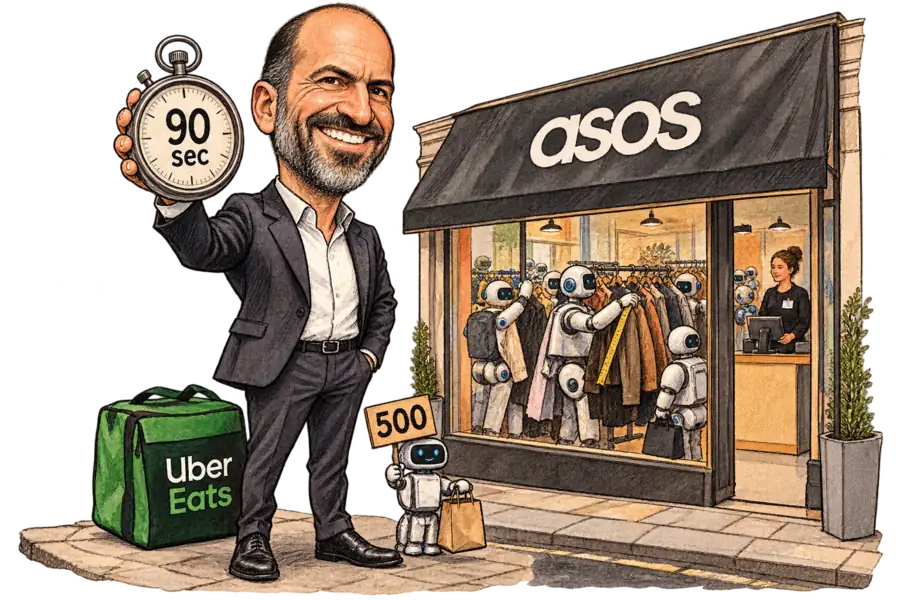
Uber Counted 500 Agent Orders Against a 90-Second Habit
Uber's first disclosed count of agent orders, around 500 Uber Eats orders and four rides in Halloween week, measured agents against a reorder its app already makes fast. Clothing is arguably slow at the search, which ASOS's ChatGPT app takes on before sending shoppers back to ASOS.com to buy.
Sir John Crabstone
Booking a ride in Uber’s app takes 50 seconds on average and reordering a favourite meal a median 90, chief executive Dara Khosrowshahi told analysts on 4 November. Against that habit, third-party AI agents placed around 500 Uber Eats orders in Halloween week. The count says little about clothing, where the slow part of buying is arguably the search.
Balaji Krishnamurthy, the chief financial officer, gave the figures when asked about transaction volumes, citing “last week because it was Halloween”. In one of its largest weeks, Uber ran about 320 million trips across Uber and Uber Eats, he said, and agents booked “a grand total of 4 trips”.
This was Uber’s first such disclosure, The Verge reports, and its headline put the four rides in “last quarter”. The story places them in “the third quarter of 2026”. Halloween fell on Saturday 31 October, in the fourth.
TechCrunch had the week right in its text, “the week of Halloween”, though its standfirst repeats “last quarter”. It set the counts beside DoorDash’s agent orders and took them as a sign that “the agentic web still has a long way to go”. That verdict judges every purchase by the quickest kind.
DoorDash’s chief executive had already drawn the line. Tony Xu told analysts on 29 October that he would neither “fight gravity” nor “be delusional”: third-party agents had sent “maybe several hundred orders in total”, a figure he put “across the time that they’ve been up and running”. Uber’s 500 is one week. Xu saw a path to incremental orders “especially for long-consideration purchases”, and he did not mention clothing; that extension is ours. For “the everyday ordering”, he said, people come back to DoorDash.
An agent saves time only where the shopper would have spent it.
Clothing is where shoppers spend that time. Few, we suspect, buy a coat by repeating last year’s order; they search, then guess at a size. Wrong size or fit is the commonest reason Americans give for a return across all categories, and on our reading a return sends the shopper back to the search.
No fashion retailer we have found publishes a count of agent orders. ASOS’s results this morning report traffic up 10% and a bounce rate 4 percentage points better since its ChatGPT launch in May, along with a dedicated agentic commerce team. Orders do not appear.
That is by design. ASOS Stylist, launched in ChatGPT on 20 May, lets shoppers browse there, then tap “Shop on ASOS” to buy on ASOS.com. ChatGPT hosts the search and ASOS keeps the till. ASOS could count what those visitors buy; its results do not say.
Khosrowshahi has been the dependent party before. His old trade, travel, was “dependent on the Googles of the world”, he recalled, and he does not want to go back. This time “every single AI system company is talking to us”, he said. He counts eight assistants, against two big delivery firms in most markets.
He cited early signs that Uber’s own Cart Assistant builds baskets “roughly twice” the average. Outside agents got an order count. Uber is “negotiating the terms of trade”, and a small count reads as useful at that table.
Clothing has no 90-second habit to bargain with, and no shortage of shops. Khosrowshahi called travel’s arrangement dependence; ASOS has not yet said what it calls its own.