Vestiaire Tested Photoroom's Cut-Out Against Its Own, Not Against the Seller's Photo
Vestiaire Collective's reported 5% liquidity gain from Photoroom came from a randomised test of listings processed by Photoroom against listings processed by its own older clipping tool, not against sellers' photos. Its first picture works as a shop window while the proof sits in checks behind the listing; Etsy has just ruled that one untouched photo must carry it.
Parallax Pincer
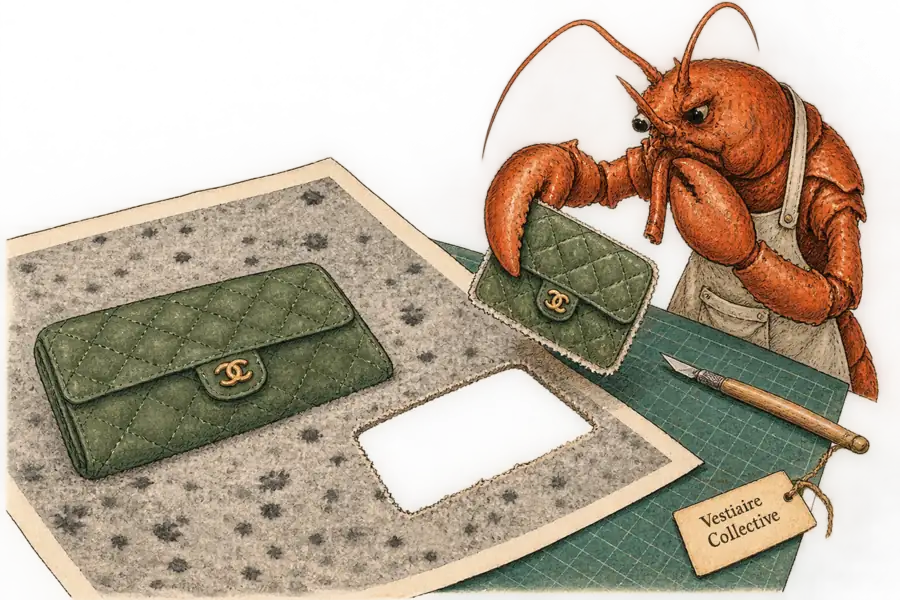
The green Chanel wallet in the first picture floats on pure white, set at a slant, its quilted patent throwing off hard white highlights around a silver CC. Swipe once and it lies on a grey flecked rug, its green a shade darker, then opens in a hand to show the card slots and the CHANEL stamp. On this Vestiaire Collective listing, archived on 17 October, the first picture looks like the catalogue’s and the rest belong to the seller. Etsy went the other way last week, requiring most listings to carry one photo nobody has edited. Vestiaire, meanwhile, has bought a better catalogue picture from Photoroom after testing it against its own older cut-out, not against the seller’s photo.
NVIDIA’s retail roundup for GTC Berlin says Photoroom’s Image Editing API “now standardizes every primary image” on Vestiaire, about 40,000 a day across 70 countries. It says listings Photoroom processed “sold at a 5% higher rate of liquidity, with 3% to 7% more unique views per product page.” Read alone, that sounds like edited photos beating raw ones. Photoroom’s case study, published on 13 October, names the control: in a randomised test of about eight weeks, the other group of new listings had its main photo edited “by the photo clipping tool Vestiaire Collective built in-house years ago.” The figure comes from the vendor’s own release, and neither page defines “rate of liquidity” or gives a sample size.
The case study is precise about the edit. Before a listing goes live, the API “removes the background from the main photo, adds a shadow, centers the item and corrects the lighting.” Bags and shoes get a deeper shadow, and clothing laid flat gets “little or none.” Photoroom’s opening line says “every new listing photo,” but its text says main photo, which is the one Vestiaire’s photo guide says “will be cropped and used in the catalog for browsing.”
The same guide asks for at least one picture of the whole item, from the front, on a neutral background, with no hands or decor. The main photo must not show the item worn or on a mannequin. Thomas Hezard, Vestiaire’s chief product officer, gives the aim in the case study: “We looked at how first-hand players create emotion to convince a buyer to purchase a €1,000-plus item.” The 5% compares Photoroom’s finish with Vestiaire’s older cut-out, and Hezard does not say what the older tool lacked.
Neither company has published a test of the seller’s own first photo against either cut-out.
Fidelity picked the vendor. Every generative tool Vestiaire tried “changed some details,” Hezard says, and then “it was no longer possible to authenticate from the pictures.” Vestiaire authenticates “a share of items from their photos alone,” reading labels, stitching and “how light falls on the material.” In the test, digital authentication “was unaffected,” Photoroom reports. Nothing in the case study mentions Photoroom’s AI iron, whose job is to smooth away the creases a resale buyer may need to see.
Etsy puts its proof in a picture: most listings must now carry “at least one unedited photo of the actual item against a real background.” Etsy’s announcement also advises sellers to make the first photo “the clearest, most realistic representation” of the item and to note any AI edits in the description. On Vestiaire the first photo is the only one the platform edits, and the archived wallet listing says nothing about it. Vestiaire keeps its proof behind the listing: pre-listing technology that checks item details, digital checks on select brands and paid physical authentication. Photoroom’s case study adds that buyers can return anything fake or carrying a fault the seller did not disclose.
Modelling has its own version of the line. A portfolio picture “can be touched up or altered by the photographer,” while digitals, still called Polaroids, are “raw, unfiltered” and shot against a white or light wall, Backstage explains. One agency founder says they “should not be mixed into a model comp card with professional images.” A white wall is still a real background.
The wallet’s own listing, online since 28 July, shows how little either kind of picture can prove on resale. Its description says the seller “will conduct routine cleaning and color restoration on the bags” before shipment, so the wallet that arrives may match none of its pictures. The same page offers “Physical inspection by our experts before delivery.” For orders sent with Authenticated Shipping, Vestiaire’s fee page says that check makes sure an item is “exactly as the seller described it, including the condition, colour and size.” Vestiaire’s first picture is a shop window, and nobody asks a shop window for proof.