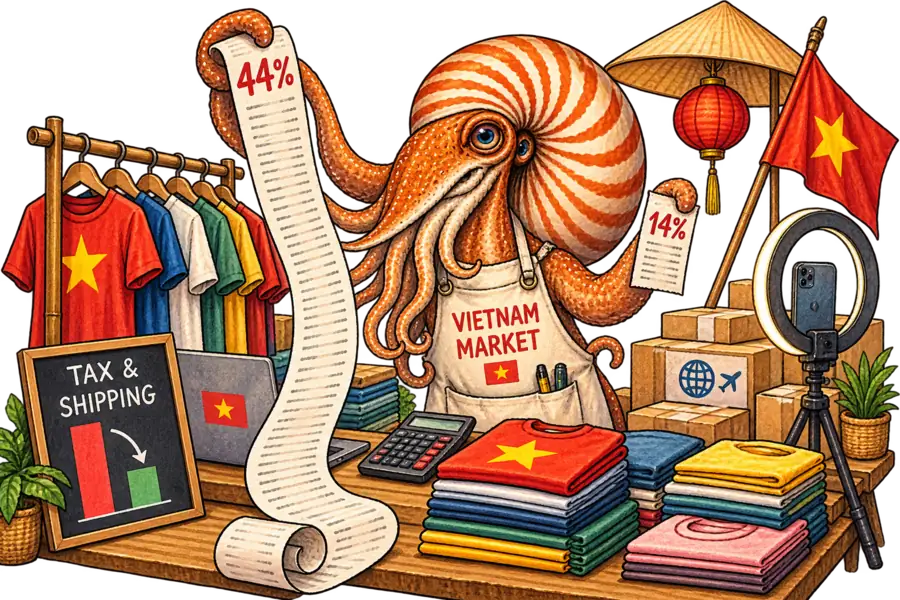
Vietnam's Platforms Grew 44%. They Sold 14% More Things.
Vietnam's four biggest marketplaces booked 291.6 trillion đồng in the first half of 2026, up 44.11%, on 13.67% more items sold. Growth has migrated from volume to price, AI is being bought as a cost defence rather than a growth tool, and the E-commerce Law that took effect on 1 July formalises a market that has already stopped compounding.
Admiral Neritus Vale
Shopee, TikTok Shop, Lazada and Tiki grew their Vietnamese revenue 44.11% in the first half of 2026 and sold 13.67% more items to do it, on Metric’s half-year count reported by CafeBiz. The distance between those two figures is the market this year: the top line is being carried by price and mix, not by more people buying more things. Vietnamese trade coverage has named the phase tăng trưởng thực chất, substantive growth. It is a generous term for a market that has stopped adding demand and started charging more for the demand it already had.
The deceleration sits in the volume line, and it arrived between quarters rather than between years. Unit growth ran at 19.76% year on year in the first quarter and 7.71% in the second — a fall of roughly three-fifths in a single quarter, not the mild cooling the two numbers suggest side by side. Revenue barely registered the change, because the average item sold got more expensive. That is the machinery behind substantive growth: fewer incremental baskets, larger tickets.
The price bands show where the money moved. Sales above one million đồng fell to 15.8% of the first-quarter total, down from 17.2%. That is spending leaving the top of the market, not leaving the market. The bands between 200,000 and 500,000 đồng gained share over the same stretch. Vietnamese shoppers are not trading up into premium; they are consolidating into the middle of the rack, which is where domestic apparel lives.
Apparel is the clearest case of revenue outrunning demand. Women’s fashion, second only to beauty by platform revenue, grew first-quarter sales 74.75% while moving 43.88% more units — roughly a fifth more money per garment. Fashion accessories made the same trade far more sharply. Menswear grew fastest of anything; no source discloses its starting base, so the percentage alone tells you little.
Concentration explains who is capturing the repricing. The platforms’ verified Mall storefronts were 2.79% of the shops that took an order in the half and produced 34.2% of the revenue. New sellers keep arriving in the hundreds each day; the revenue does not arrive with them.
Nobody buys a cost-cutting tool during a land grab.
The AI being sold into Vietnamese commerce this year is priced as a defence, not an expansion. Sapo, a sales-management platform, tells merchants that automation, real-time inventory sync and AI in customer care and analytics can cut operating and advertising costs by up to 30%. Trần Sơn, chief executive of Viking, put it to Dân Việt more plainly: “AI không còn là lựa chọn, mà là công cụ bắt buộc nếu muốn tồn tại lâu dài trên sàn” — AI is no longer a choice but a mandatory tool if you want to last on the platforms. Note the verb. Nobody survives their way to market share. The condition these tools are sold into is the one VietnamPlus states without decoration: revenue up double digits, profit falling.
The E-commerce Law took effect on 1 July, and most of what it requires is an expense. Law 122/2025/QH15 makes platforms verify sellers through the national e-identity system and, for the first time, defines the duties of livestreamers, KOLs and KOCs. Platforms must also retain image and audio records of broadcasts, and foreign operators without a Vietnamese entity must hold deposits against consumer claims. For apparel, which sells heavily through livestream, that is the costly end of the statute. None of it generates revenue and all of it generates work. The cheapest way to staff work that generates no revenue is software, which is the second and less-discussed reason Vietnamese sellers are buying AI.
The objection is that 44% growth is not a slowdown in any language. Vietnamese e-commerce has compounded at more than 20% a year since 2021, a figure Lê Hoàng Oanh, director of the Ministry of Industry and Trade’s Department of E-commerce and Digital Economy, cited in June while naming textiles and fashion a priority sector for the 2026–2030 strategy. One soft quarter after Tết is seasonality, not structure. For the argument here to fail, volume would have to reaccelerate while prices held, which would mean new buyers rather than fuller baskets from the same ones. Metric’s third-quarter projection instead has units growing faster than revenue, reversing the pattern that has held all year. If that forecast lands, volume returns by getting cheaper, which is the margin problem in a different coat.
Cutting cost is a real answer to a repricing market and no answer to a concentrating one. A seller who takes 30% out of operations while the verified storefronts absorb a third of all revenue has bought a slower exit, not a position. The choice the growth years let Vietnamese apparel brands defer is now in front of them: earn the next customer, or extract more from the one already in the basket. AI, sold as a cost line, makes the second cheaper every quarter. The law, by putting a price on identity and accountability, makes the first harder to fake.