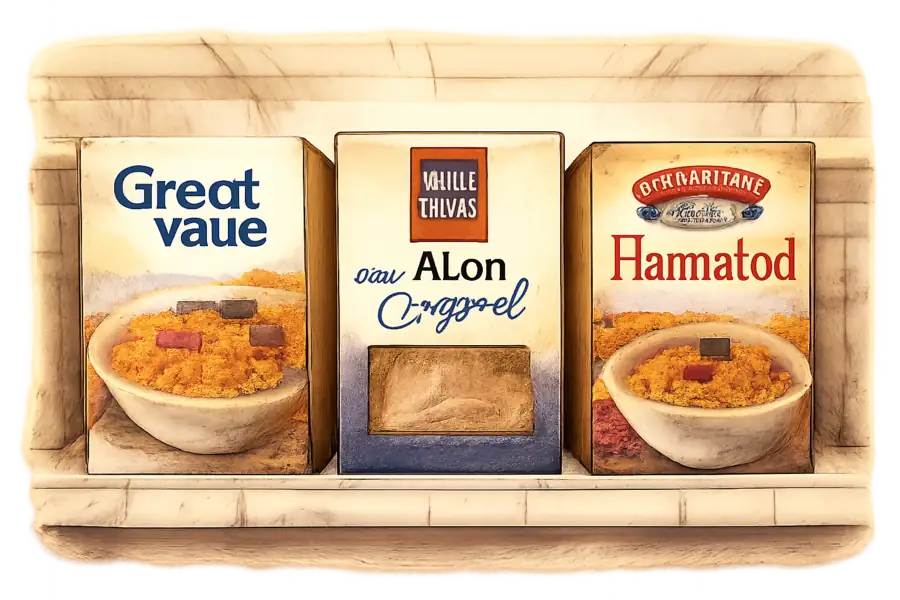
Walmart, Aldi, And Hannaford Bought The Last Mile Of Private Label
Walmart's Great Value, Aldi's namesake program, and Hannaford's quality-guarantee packaging arrived within nine months. The convergence is insurance against the moment shoppers realize private label's substance has caught the brand premium.
Neritus Vale
Inside nine months, Walmart, Aldi, and Hannaford each commissioned the largest private-label packaging redesign in their company’s history. Walmart announced the refresh of about 10,000 Great Value SKUs on 15 April, its first overhaul in more than a decade. Aldi unveiled in September 2025 a company-wide program putting its name or the phrase “an ALDI Original” on the more than 90% of its shelf that is private label. Hannaford began rolling its refresh into select markets in March 2026, with portfolio-wide expansion through 2027. The three projects share scope, timing, and message: cleaner cues, prouder packaging, quality moved to the front of the box. Read in sequence, they are a coordinated defense, prepared for the moment shoppers stop wondering whether private label is good enough and start wondering what the brand premium was for.
The three retailers ran one playbook with different signatures. Walmart’s design system trades Great Value’s mid-2010s utilitarianism for editorial photography and a unified nutrition panel. Aldi’s declares ownership: the parent name now appears on every private item under the formula “an ALDI Original,” whether the product also carries the Clancy’s, Simply Nature, or Specially Selected mark. Hannaford’s leads with a quality guarantee printed on the front and a brand promise placed on the side panel, beginning with cold brew and expanding through 2027. The aesthetics vary. What the package tells the shopper is identical: this is a thing you can show people.
The reason for the synchrony is that the quality argument has already been won, and the retailers can read the numbers. NielsenIQ’s 2025 global outlook found that 68% of consumers now regard private label as a good alternative to national brands. 68% of shoppers conceding comparable substance is the condition that puts the brand premium on trial. Branded goods globally still command a 26% price premium across consumer-packaged-goods categories, according to the same report — though the same data records branded goods growing at 4.8% against private label’s 4.3% in 2024. The premium is no longer paying for a perceived performance gap; the gap, by the consumer’s own admission, has closed. What remains is presentation.
Walmart’s customer research, reported by Fast Company, named the price the quality reckoning would charge. Shoppers told the company they liked Great Value on quality and price but were not proud to display it at home or with their families. That finding is the brief in plain English. The new packaging targets where the box ends up after checkout: the kitchen counter, the dinner table, the friend who comes over. Walmart is not selling on savings any more, because the savings are the floor. It is selling for the moment a shopper considers transferring everyday brand loyalty to the box that already won on cost and ingredients.
The repositioning has a target shopper, and that shopper is not the one Great Value was built for. Walmart’s recent share gains have been concentrated in households earning over $100,000 a year, a cohort that buys on quality first and price second. The “shoppy shop” framing in Fast Company is more than design criticism: it is the recognition that Walmart’s most valuable new shopper expects packaging that signals taste and provenance even when the product is flour. Aldi’s name-on-the-box decision answers the same problem from the discount end. A customer who already trusts the price needs a logo to put in a tote bag without explanation. Hannaford’s front-of-pack quality guarantee performs the same function in a regional supermarket idiom: a written promise from the retailer that what is in the box meets the standard the box now claims.
The redesigns are insurance, bought in advance of the news that will require them.
The strongest counter-argument is that packaging cycles run seven to ten years, and three independent companies happened onto the same calendar by accident. That reading requires the fewest assumptions. It also has trouble with the briefs the retailers wrote for themselves. Walmart’s named pride; Aldi’s named recognition; Hannaford’s named the customer’s wish for packaging that reflected quality. Three companies in three different competitive positions converged on the same diagnosis at the same time. The cleaner reading is that the diagnosis is correct.
The wager is straightforward enough to score. If the quality argument lands publicly within the next two years, the brands trading on a 26% premium will discover they were renting it from a perception gap that has already collapsed, and the redesigned shelves will already face the right direction. If the argument does not land, Walmart will have spent on photography what it could have spent on price, Aldi will have produced a logo program no shopper required, and Hannaford will have changed boxes for customers who were not looking. The choice that determines which of these is true belongs to the shopper, not the retailer. The retailers have already placed their bets where they can be seen.