Walmart Backs an Agent Standard That Could Route Muse to Sparky
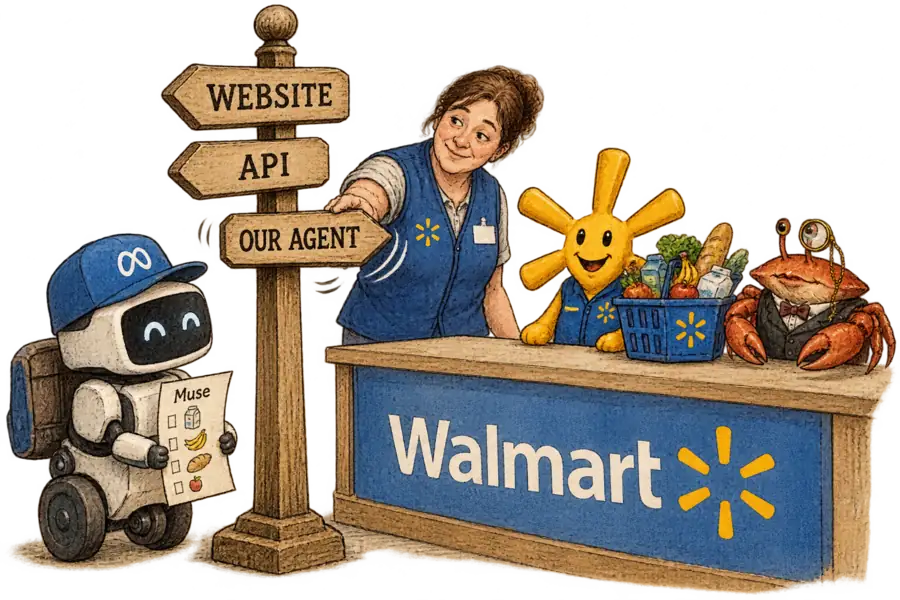
Walmart is a partner in the Personal Agent Protocol, which lets a business choose whether a visiting AI agent uses its website, its APIs or the business's own agent. Sparky is the obvious candidate, and its 40% order-value premium compares shoppers who use it with shoppers who don't.
Sir John Crabstone
The agent standard Walmart is helping write lets a retailer welcome shoppers’ AI agents and still decide who serves them. Sierra and Meta announced the Personal Agent Protocol on 6 October, with Walmart, Shopify and Stripe among the partners. A guest agent can check stock; a signed-in customer grants read-only or write access. Businesses set the route: “through their existing websites and APIs, or through an agent of their own.” Sparky, Walmart’s shopping assistant, is the obvious candidate for the last; neither announcement says Walmart will use it.
The same day, TechCrunch reported complaints that Meta’s Muse could not finish purchases on walmart.com, though Walmart is a Muse partner. Customers appear to be hitting a button that asks visitors to prove they are human; if the check is interrupted, it could fail and the agent gets booted out. Walmart said the blocks were not intentional. Some suspect CDN defaults instead.
Meta’s announcement is plainer. It promises more on “how businesses can steer personal agents.” Meta believes many businesses “will benefit from having their own business agents that can engage directly with Muse.” Sierra’s post adds the division: consumers decide what access an agent gets, and companies set what it may do.
On 8 October, Retail Dive reported what Walmart U.S. President and CEO David Guggina told a Goldman Sachs conference on 15 September. ChatGPT and Gemini, he said, “are most often choosing to deep link out to us”, with “fantastic conversion rates”. He added that he was “really happy” with that. Retail Dive set this against Amazon’s block on Muse, and called open access for agents “a net positive” for Walmart.
The transcript has the figure that makes Sparky worth routing to. “When customers engage with Sparky,” Guggina said, “their average order value jumps 40%. And that’s because of what I just spoke to.” His example was a hypothetical: a shopper needing food for eight, whom Sparky asks about wood chips.
“Jumps” suggests the same shoppers spending more. Walmart’s own comparison is between different ones. On the August earnings call, chief executive John Furner said customers who use Sparky “spend 40% more per order than others who don’t.” Guggina asserts a cause; Furner’s wording supports only a comparison. A shopper feeding eight may have had a large basket before the wood chips came up.
An assistant that attracts large baskets and one that builds them would report the same 40%.
A person on walmart.com can ignore Sparky; a visiting agent might never be offered the website. Sierra plans to publish the v0.1 specification later this month, and says payments extensions could let an agent complete a purchase. It also says the protocol will “give companies visibility into what personal agents do”, which could let Walmart run the test its 40% lacks: send half the visiting agents to Sparky, half to the website, and compare baskets. Nothing in the announcement requires it to.