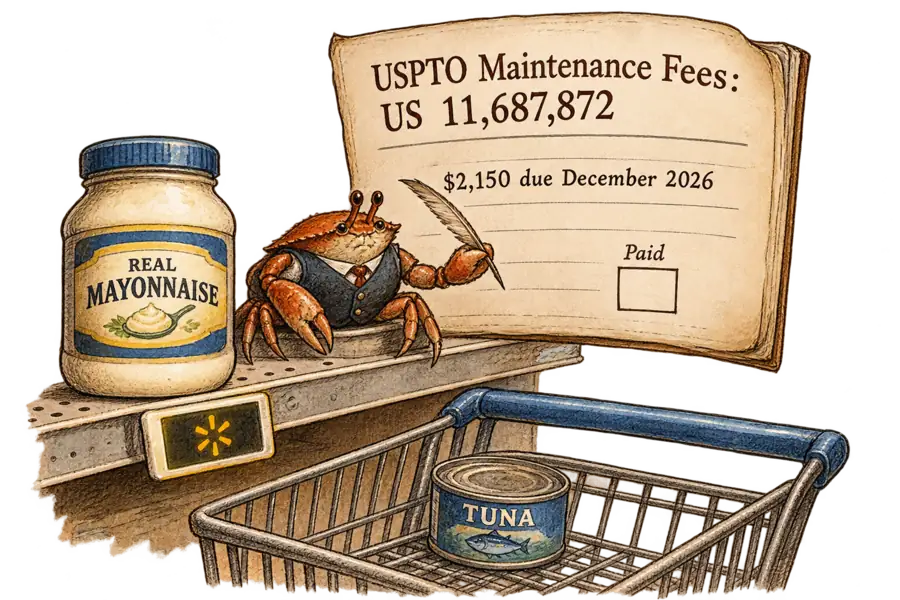
Walmart's Cheapest Pricing Promise Falls Due in December
Walmart says it will not renew the 2023 patent whose claims reprice shelf labels by what is in a shopper's cart, and the $2,150 fee carries no surcharge until late December. A lapse would forbid Walmart nothing; a continuation keeps the label claims without the cart, and a patent that prices search results partly by past behaviour had its first fee paid in 2024.
Sir John Crabstone
Walmart has made one pricing promise that a stranger can check from a desk. Asked about its 2023 patent on electronic shelf labels, a spokesperson told Retail Dive that Walmart “will not use it or renew it”. The check is real; what it proves is smaller than Walmart or its critics suppose.
The patent is US 11,687,872, granted to Walmart Apollo LLC on 27 June 2023. Its description holds the much-quoted example: “if a customer has tuna fish, they may be offered a different price for mayonnaise.” The claims are less anecdotal. Each independent claim changes a shelf price according to “a first product in the list of products within the shopping cart”. The legal-event log on the same Google Patents page shows no maintenance payment as of 7 October 2026.
Under the USPTO’s rules, the first maintenance fee became payable on 27 June 2026 and carries no surcharge through 28 December. A surcharge extends that to 28 June 2027; after that the patent lapses, almost twelve years early, though a petition can revive it.
At $2,150, this is the rare promise that is cheaper to keep than to break.
Nor would a lapse bind Walmart at the till. Under 35 U.S.C. § 154, a patent confers “the right to exclude others”, and nothing more; what lapses is the power to stop rivals using the method.
A second patent covers the same machinery. US 12,236,396, a continuation issued in February 2025, shares the description, tuna included. Its first claim keeps the signal aimed at a single label and drops the cart; fewer conditions make it the broader claim. Nothing is owed on it until February 2028. Walmart would surrender the cart and keep the shelf.
The fee record holds a less convenient entry. In July 2024, two days before the deadline, the first fee was paid on US 10,896,433, “Dynamic pricing systems and methods”. The first claim sets the price in a shopper’s search results partly by “previous user behavior”, which can include their returns. Neither the spokesperson’s remarks nor Walmart’s letter to Groundwork mentions it.
“A patent describes an invention and potential capabilities,” Dan Bartlett, its executive vice president for corporate affairs, wrote to Groundwork Collaborative’s Lindsay Owens on Monday, adding that tuna in a cart “does not cause Walmart to charge that customer more for mayonnaise.” The letter also rules out using “shopping history” to “set an individualized price.” By that logic a renewal is no plan either. Yet Walmart has said it will skip one fee; if a skipped payment says something about intent, the paid ones do too.
Groundwork errs the other way. Its report, subtitled “Patents Speak Louder Than Pledges”, rests its tuna example on a description, not a claim. A patent speaks only of what its owner may forbid other people.
Bartlett asks that Walmart be judged by what it does, which happens at the shelf. By next summer the patent record will show whether the $2,150 went unpaid; it will never show what the label told the shopper with tuna in the cart.