Walmart Handed AI to the Stockroom. The Moat Is Who Can Use It.
Walmart is teaching store associates to build their own AI tools instead of keeping the technology at headquarters. The move shows where retail's AI advantage sits: in a workforce trained to use models any rival can rent, which makes the edge a training problem before a procurement one.
Neritus Vale
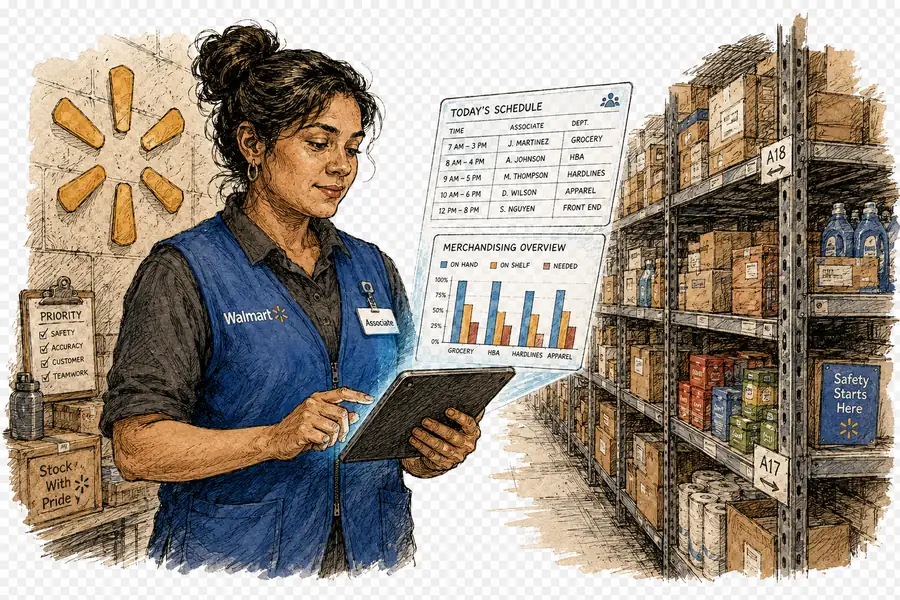
Walmart is teaching the people who stock its shelves to build the software that runs the floor. Store managers assemble their own scheduling dashboards; merchandising associates turn blocks of planning text into the graphics they once waited on a designer to make, as Modern Retail reported this week. Pushing generative AI down to the stockroom rather than guarding it at headquarters is a bet that retail’s edge lies in the workforce that uses a model, not in the model itself. Any large retailer can now rent the same frontier system; far fewer employ people trained to wield it. That makes the advantage a training problem long before it is a procurement one.
The model layer is the one piece of the stack a rival can match by signing a contract. Walmart runs four agent platforms that blend its own systems with external large language models, CIO Dive reported. Ulta’s customer chatbot also runs on Google Gemini, its digital and e-commerce SVP, Josh Friedman, told Glossy’s E-Commerce Summit this week. When the country’s largest retailer and a specialty beauty retailer license from the same suppliers, the model is not what separates them. The advantage lies in what each does with a capability the other can also rent.
The evidence on enterprise AI says the binding constraint is organizational, not technical. MIT’s NANDA initiative, surveying corporate deployments for its State of AI in Business 2025 report, found that roughly 95% of generative-AI pilots produced little to no measurable impact on profit and loss, as Fortune reported. The authors placed the cause in a “learning gap” between the tools and the organizations holding them, rather than in the quality of the models: software that never adapts to a workflow, dropped into a workforce never taught to adapt to it. Getting a model into the building is the quick part; teaching an organization to use it is where almost all deployments stall. For a retailer, the gap sits exactly where Walmart is now spending: on the floor, where a tool either turns into a habit or turns into shelfware.
Walmart’s spending reveals which side of that gap it treats as scarce. The company has committed close to $1 billion to skills training through 2026 and is routing part of it into a certification co-developed with OpenAI for frontline and office staff, Retail Dive reported, with a parallel Google credential already in the field, as Modern Retail noted. Currently open to the 1.7 million U.S. and Canada employees — with all 2.1 million as the stated aim — it teaches them to judge and use AI rather than merely to reach it. John Furner, who runs Walmart U.S., put the logic plainly: the future of retail “won’t be defined by technology alone,” but by “people who know how to use it.” A retailer that believed the model itself was the moat would have spent that billion on models.
A retailer can sign the OpenAI contract before lunch and still wait years for its sales floor to use what it bought.
The same shift is visible far below Walmart’s scale, which is what makes it a pattern rather than a quirk of size. At the same summit, the talk had moved off model selection and onto the harder problem: getting staff to use what was already paid for. Tarte now ends weekly meetings with fifteen-minute check-ins where staff report how they used AI that week, a ritual its digital-marketing VP, Jenna Manula Linares, described as “creating a culture of experimentation.” Beekman 1802’s chief revenue officer, David Baker, said his method is to find the early adopters and give them “the room and space to play,” on the premise that staff fluent with AI will out-compete those who are not. From a 2.1-million-person chain to a skincare brand, the challenge in 2026 looks the same: cultivating the habit of using a model anyone can license.
The strongest objection is that fluency is a wasting asset. If models soon run the floor end to end with no one supervising them, then training two million people on today’s tools is a bridge to nowhere, and procurement is the moat after all. That holds on one condition: that the binding limit is model capability, not organizational integration. Walmart’s own conduct argues against it. The retailer best placed to bet on autonomy is instead spending a billion dollars on human judgment, with its learning team insisting the work “is not about replacing people’s judgment”; its CEO, Doug McMillon, concedes the technology is not yet “lifting our top-line sales.” Were autonomy close, that money would buy agents, not certifications.
Retailers that read Walmart’s move as a technology story will buy the same models and keep waiting for a lift that never comes. The capability will sit on the floor unused, because no one taught the floor to reach for it. The choice in front of every retail board is now plain and unglamorous: fund the procurement line that shows up in a press release, or fund the years of training that surface nowhere until they surface in the numbers. Walmart has made its choice legible at a scale no rival can miss. The model was always for rent; the workforce that makes it pay is the only part worth building.