Walmart Lets Shopping Agents Order the Usual. It Keeps the Receipts.
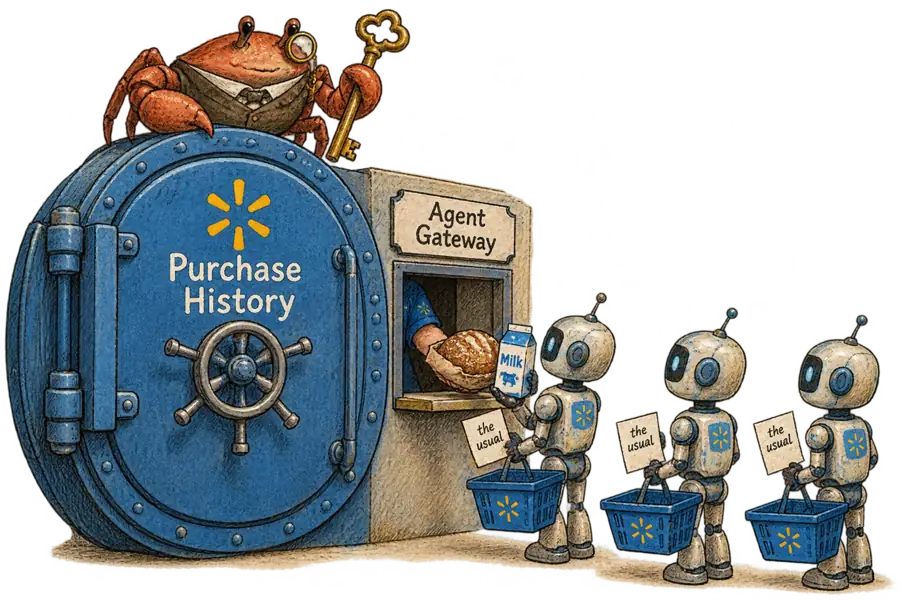
Walmart's Agent Gateway lets approved AI agents search and buy at Walmart and Sam's Club, and promises to help them find a customer's usual items without sharing the broader shopping history. Walmart's release says what the gateway withholds, not what the agent receives instead.
Sir John Crabstone
Walmart chose a loaf of sourdough to explain what a shopper’s AI agent will be told. If a customer tends to buy it, Walmart “will help the agent find those usual items for the customer without sharing the customer’s broader shopping history,” its announcement says. The announcement says what the gateway withholds; it does not say what the agent receives instead.
John Furner, Walmart’s chief executive, set out the plan at the Masters of Scale Summit in San Francisco on 21 October, TechCrunch reported. At its centre is the Agent Gateway, an MCP server through which “approved agents” can search and buy at Walmart and Sam’s Club. Walmart already has a partnership with Meta’s Muse and integrations with ChatGPT and Gemini. Agent profiles, the report adds, roll out next month.
The gateway, which begins as a beta “for companies and developers,” also changes how an agent appears in the account. At present, the release explains, an agent “signs in using a customer’s account,” and the purchases appear “together, without any differentiation.” Walmart creates a profile the first time a customer shops through the gateway with an agent. The customer links it by signing in to Walmart: “Only Walmart sees this.” Walmart likens the arrangement to adding a cardholder to a credit card, and says it lets customers “see the agent’s purchases separately.”
Two lines in the release’s terms list cover information. Walmart “collects and processes information the agent provides” under its Privacy Notice. Agents, in turn, “can access only the information needed for the task and allowed by the customer,” and those that break the terms “will be blocked.” The customer’s permission is necessary, then, but not sufficient; the release does not say who judges what a task needs.
Walmart presents profiles as a matter of visibility, a way to see what the agent bought. Custody is our reading. The release does not say what an agent signed in as the customer can see today; presumably it sees whatever the account shows. The gateway lets customers use agents “without having to share their personal information or purchase history,” which leaves Walmart holding it.
Whoever holds the history decides what counts as usual.
Customers “must approve agent purchases by default,” the release says, or set a spending limit such as $100. Even within the limit, Walmart “may require additional approvals.” Its returns process applies, “including if an agent doesn’t act as intended.” By default, then, the agent proposes and the customer signs off.
TechCrunch casts Walmart as Amazon’s opposite. On access that holds; Amazon turned Muse away last month, while Walmart opens a gateway for approved agents.
On 10 October we noted that the Personal Agent Protocol, which Walmart backs, lets a business route visiting agents to an agent of its own, and called Walmart’s Sparky the obvious candidate. If Walmart took that route, the visiting agent would be asking Walmart either way. Walmart has the receipts.