Walmart Took Sam's Club's Supply Chain. The Membership Stayed.
Walmart has spent two years absorbing Sam's Club's supply chain, e-commerce technology and ad business into the parent. What is left under the club's own name is a pricing format and a membership file, and only one of those was ever the point.
Sir John Crabstone
Sam’s Club still sets its own prices. Very little else. Walmart has spent two years folding the club’s supply chain, e-commerce technology and advertising into the parent, leaving a pricing format and a membership file behind the club’s name. Only one of those is worth owning.
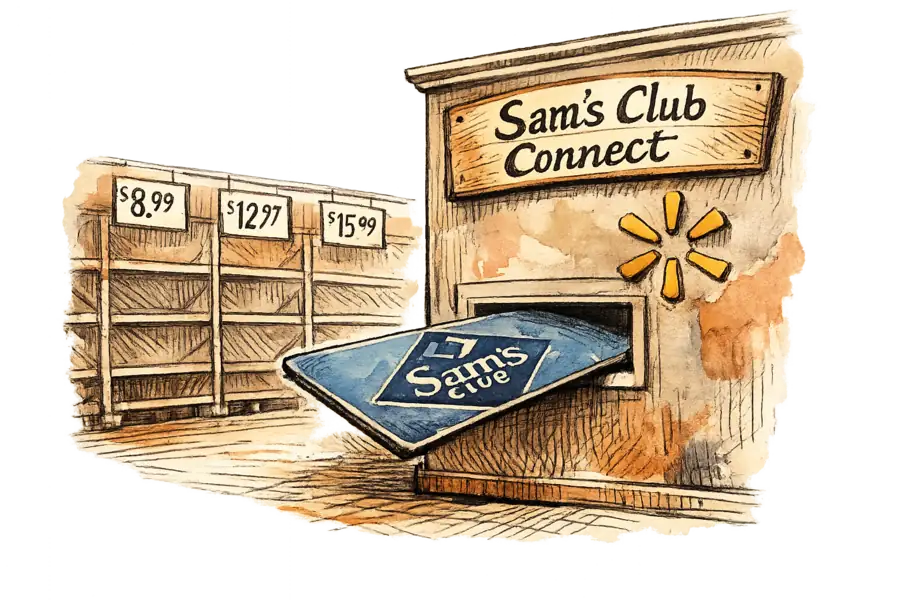
The unwinding was staged rather than announced. Sam’s Club’s corporate supply chain team began merging into Walmart’s in 2024. In September 2025 the club relaunched its site and app on Walmart’s design, and in June the media network was renamed Sam’s Club Connect. Modern Retail reads the three moves as one pattern, and the club’s e-commerce chief says “leveraging the technology is a significant competitive advantage”. It is, though not obviously for the borrower.
The story is being told as efficiency; it reads better as a transfer. Sam’s Club has run as a separate culture since Sam Walton founded it in 1983. When the supply chain merged, a Kantar analyst told Modern Retail the change would help “move faster to get those innovations into Walmart”. Capability flowed down; advantage flowed up.
Walmart states the ambition plainly. Its June announcement describes increasing alignment across Walmart Connect U.S., Walmart Connect International and Sam’s Club through “shared technology, tools, platforms and capabilities”, on advertising revenue that grew 37% globally in the quarter. Alignment is a generous word for one buying desk facing two audiences.
A club knows the name of everyone at the till. Sam’s Club’s media chief sells precisely that, offering advertisers “more than 40 years of first-party deterministic membership data” — every interaction tied to a verified member ID. A supercentre cannot say the same about a stranger paying cash. The scarce asset was never the pallet of paper towels. It was the card required to buy it.
That is not a subsidiary being upgraded — it is a subsidiary being read.
The member is paying more for the privilege. On 1 May the annual fee rose from $50 to $60, and the Plus tier from $110 to $120, the first increase since 2022. Sam’s Club said the new pricing supports “the things our members love”. Independence was not on the list.
Read as an operating story, this works, and Kantar’s Anna Brennan calls Sam’s Club the primary beneficiary of the operational shift. She is describing the balance sheet. Sam’s Club e-commerce grew 23% in the quarter to April and membership and other income rose 11% to $674 million, so nobody is being starved. What the club wins now is share inside someone else’s system. A format can be priced and scheduled. It cannot argue for its own roadmap. The card still works; what it opens is no longer a company.