Parliament Voted to Trim a Waste Rule That Binds EU Labels Harder Than Foreign Sellers
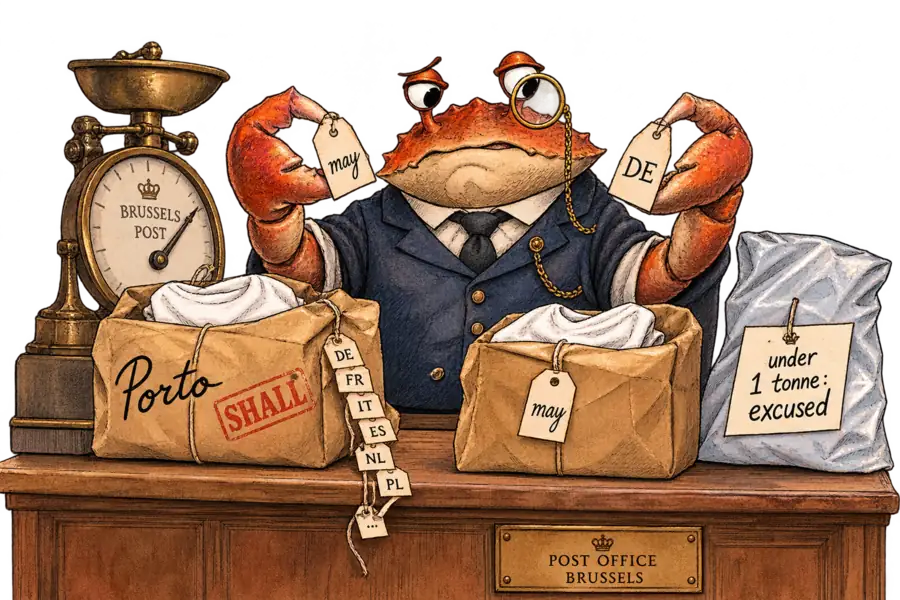
MEPs want EU clothing and footwear firms under 50 staff spared a waste-compliance representative in every country they ship to. For distance sellers, the textile directive already asks less of firms outside the EU: capitals 'shall' demand a representative from a label in another member state and 'may' demand one from a seller in a third country.
Sir John Crabstone
On 20 October the European Parliament voted 612 to 8 to excuse small EU clothing and footwear firms from appointing a waste-compliance representative in each country they ship to. That is Parliament’s negotiating position, not law; talks open only once the Council adopts its own. Reporting on the file drew a tidy moral: European labels relieved, foreign sellers still bound.
For clothing sold directly to customers, the law already leans the other way. The duty sits in the revised Waste Framework Directive, which gives member states until 17 April 2028 to set up textile schemes and spares micro-firms a year longer.
Capitals “shall” require an authorised representative from a producer shipping directly to customers from another member state. From a producer established in a third country, they “may”. Both rules cover sales by distance contract to end-users.
The label in Porto gets a “shall”; the seller in Shenzhen gets a “may”.
After the committee vote, LexisNexis wrote on 7 October that non-EU companies “would remain subject to the authorised representative requirements”. In clothing, what they remain subject to is each capital’s discretion.
Ecommerce News Europe opens by crediting Parliament, then attributes the small-firm limit to the Commission. The Commission had offered more, and the medium-sized label is the one that loses it.
Its December proposal would have suspended the textile duty until 2035 for every producer established in the EU, whatever its size. For non-EU sellers, capitals could have chosen between a representative and “alternative means”.
Parliament’s amendments confine the pause to micro and small firms: fewer than 50 staff and no more than €10m in turnover or balance sheet. Representatives stay, the text says, “for larger companies, such as medium and large enterprises”. MEPs struck out the alternative means and left the “may” alone.
So a 40-person label in Porto turning over €6m would shed up to 26 representatives, while a 60-person rival down the street would keep the lot. The text bars it from splitting in two to qualify. The seller abroad needs one only where a capital chooses to ask.
One firm selling into 15 member states told the Commission it paid an estimated €6,000 a year for representatives; divided by 15, that is €400 a country. The source does not name the firm’s sector. Commission staff put the market across all producer-responsibility sectors at perhaps one to two billion euros a year, and estimate net savings from the suspension at about €300m, or 20% of existing costs.
The relief leaves registration and scheme fees in every country untouched, and the directive already lets a label’s producer responsibility organisation double as its representative.
Member states have not moved on the shirt. Their ambassadors discontinued work on both suspension proposals under the Cyprus presidency, deferring to the coming Circular Economy Act. When delegations asked to reopen one in September, they asked only for small packaging producers.
They got their wish. On 21 October the Council agreed a mandate that would, until 2032, exempt EU producers placing less than a tonne of packaging a year on another member state’s market.
The Council’s statement covers only packaging, and talks on the textile file cannot open until the Council adopts its own position. Brussels may yet excuse the mailer bag before the shirt inside it.