Whatnot Doubled to $20 Billion. The Brands Booked It as Marketing.
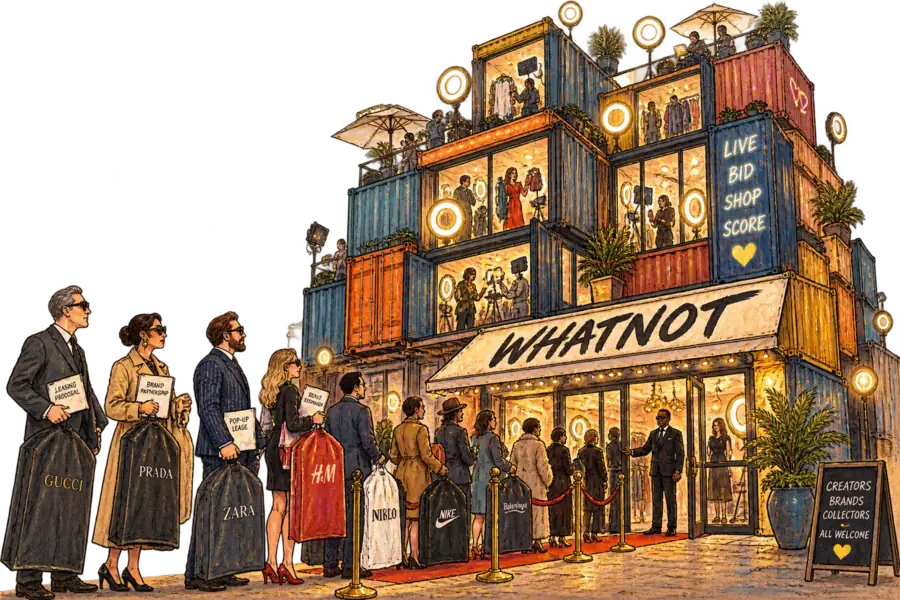
Whatnot's $545 million Series G values live commerce at two and a half times the goods its sellers moved last year, which is the multiple a distribution network earns. Western apparel brands are still filing livestreaming under marketing, which makes them tenants rather than owners.
Sir John Crabstone
Whatnot’s $545 million round, reported 7 August, valued the company at $20 billion — nearly twice the $11.5 billion it carried in its October 2025 round. The company holds no stock and photographs nothing. The round bought the moment of exchange, which is the one part of retail nobody has managed to make cheap.
The investor list is the tell. Wellington Management and Kleiner Perkins came in new, alongside leads ICONIQ, Lightspeed and Avra. Crossover funds of that description price against public comparables, and there is no public comparable for a marketing test.
The volume behind the price belongs to other people. Whatnot’s own announcement says its sellers sold more in the first half of this year than in all of 2025, and that the share of them earning a full-time living rose 25 percent. Capital of that size does not arrive for an audience; it arrives for throughput.
Those sellers moved more than $8 billion in live goods last year, womenswear up 223 percent, per Whatnot’s 2026 Live Selling Report as relayed by Value Added Resource. The new valuation is two and a half times that number, which is how a network that moves goods gets priced. None of that growth needed a brand’s permission. All of it carried a brand’s name.
Fortune’s own reporting notes that Whatnot has faced criticism over gambling-like spending patterns and thin seller margins after fees and shipping. That is a different argument about who benefits from the channel; this one is about who owns it.
The counsel running the other way is to treat all this as media. EMARKETER told marketers in January to begin with awareness rather than conversion, and found that 43 percent of American adults have no interest in livestream shopping at all. Nobody should be embarrassed to have believed that.
The same EMARKETER report puts US livestream commerce at $14.64 billion for 2025, near five percent of American e-commerce — a split it credits to ARK Invest, which sets the Chinese share around sixty. Five percent is a ceiling only if China is an aberration. Whatnot’s $8 billion in GMV last year was global, spanning the UK, Europe and North America, not just the US; split three ways, it still dwarfs the slice EMARKETER assigns America, and the American market is the only figure brands budget against.
The West did build some of this and then switched it off. Meta shut live shopping on Facebook in autumn 2022 and sunsetted it on Instagram in March 2023, removing the ability to tag products inside a broadcast. Brands read that as proof the format did not work in America. It was proof that Meta had lost patience — a different finding.
Every brand that discovers live selling next year will discover it as a tenant.
The terms are worse than the rent. By design, a seller here does not own the customer file and does not set the pace of the sale, and those were the two things the DTC decade was fought over. British seller numbers are up 360 percent year on year, FashionUnited reports, which is roughly the rate at which the terms are being signed.
Grant LaFontaine, Whatnot’s chief executive, would rather stay private as long as possible. Nothing in the numbers argues otherwise. The building is finished, and its tenants are still calling the visit a test.