Who Signs for the 2,000 Hours Behind Levi's Yeti?
Levi's, Dior and e.l.f. are selling the labour behind their handmade holiday films, and the only proof is the brands' own footage and their own word. Levi's gives its 2,000 hours to the whole film in one account and to a single set in another, and none of the Levi's files we checked carries a content credential.
Parallax Pincer
“Even the tiny red tabs,” reads the caption fifteen seconds into Levi’s 31-second making-of for its stop-motion holiday film. Levi’s, Dior and e.l.f. all released handmade holiday films this week that sell the labour along with the product. Only Levi’s puts a number on it, and the only proof any of them offers is its own footage and its own word.
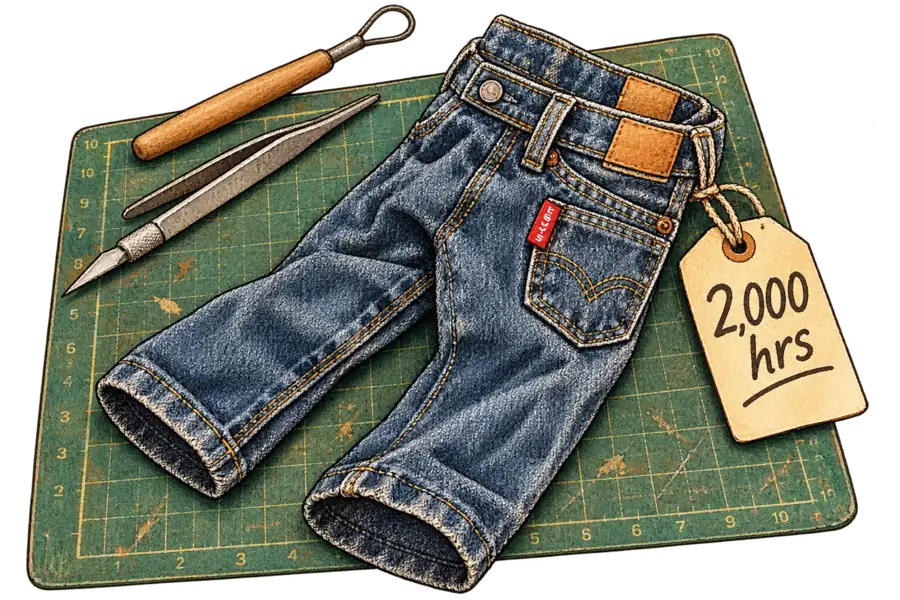
Levi’s figures do not describe the same work. Glossy reports that a Levi’s spokesperson said the one-minute film, “Let’s Get Fuzzy”, took around 2,000 hours; it gives no direct quote. In the making-of, a caption pairs “2,000 hours” with “One set”. Creative Bloq, which attributes the figure to that video, says a six-person team spent more than 2,000 hours over six and a half weeks building and painting the sets. Levi’s release says the film “required four hours of filming for each second of animation”, which puts a one-minute spot at about 240 hours of filming.
On the spokesperson’s count, filming took about an eighth of the total. Creative Bloq’s reading gives the 2,000 hours to the sets, a team that also built “four faces for each character”, and does not say whether stitching or filming hours are counted on top. Neither Levi’s caption nor its spokesperson says whose hours they were, and B&T’s credits name four animators, a production designer and a director of photography without assigning any of them a share. Whoever’s they are, the hours are the pitch: brand consultant Linda Orr told Glossy that consumers “use perceived effort as a heuristic for value”. Agency founder Dayna Carney told the same newsletter: “Finished is now the cheapest thing on the internet.”
The making-of spends its captions on the clothes. “The clothes are exact replicas,” reads one; “Every character has 4 faces,” reads another. Levi’s release calls the yeti Gus. Blinkink’s project page credits the directors, Stevie Gee and Essy May, and hosts its own behind-the-scenes cut.
Paris has used small clothes as evidence before. In 1945 the couture houses dressed one-third-life-size mannequins for the Théâtre de la Mode. The opening drew 100,000 visitors to the Louvre’s Museum of Decorative Arts, and the show toured Europe and the United States in 1946. The Maryhill Museum of Art, which now holds the mannequins, has displayed a 1946 ensemble “sometimes attributed to” Christian Dior and sells a book subtitled “The Survival of Haute Couture”. The proof was the object, and visitors stood in front of it.
Levi’s tours its miniatures on video.
That is the medium generators already imitate. MediaPost notes that “AI-generated Claymation-style ads explode on social media”, so the clay look alone proves nothing. The trade press takes the making-of as the receipt anyway. In August, Creative Bloq said Apple had published one for its Mac mini spot “just to prove its chops as a human-made piece of work”. Each receipt comes from the people whose work it vouches for.
Dior’s version rests on drawings. In a statement reported by WWD, Jonathan Anderson calls Sylvain Chomet’s film, narrated by Robert Pattinson with Rihanna voicing a star, “all hand-drawn using techniques that go back to the 1940s”. Launch text on Fashion Press, credited to Dior only by an image line, says that in animation and couture alike “countless hours of meticulous craftsmanship give rise to an impression of effortless beauty”. Glossy says hand-drawn sketches from the campaign are on display at Dior’s Paris exhibition space. WWD and DesignScene describe something different: the house’s own original sketches and miniature garments, which Chomet saw at La Galerie Dior.
The first holiday film from e.l.f., directed by Cami Kwan of Apartment D Films, was made “entirely through handmade stop-motion animation”, its release says. The release never mentions AI. Cosmetics Business supplied the anti-AI reading anyway, with a headline that has e.l.f. choosing stop motion “instead of AI”. Prada’s hand-drawn mice, covered here on 3 November, came with no word about AI on Prada’s own pages either.
Gucci’s and Valentino’s AI posts were labelled. Gucci’s February images for its Milan show were marked “created with AI”, the BBC reported. Valentino’s December handbag video carried a label saying it was made using AI, and commenters still called it “cheap” and “lazy”; Getty’s Rebecca Swift told the BBC that “even full transparency about AI use wasn’t enough to win them over”. A label is a claim anyone can type, which a signed credential is not. The handmade films carry no equivalent mark.
The nearest thing to a pledge from Levi’s is a line in Marketing Dive that no AI was used “in the filming process”, alongside its chief marketing officer Mitchell calling the film “created entirely with stop-motion Claymation”. The release says the set and characters were “fully crafted by hand”. B&T’s credits also list a VFX supervisor, two compositors and a 2D animator at Blinkink, and the XMP metadata in the stills on Blinkink’s page names Premiere Pro 2026 and After Effects 2026. Neither those stills nor the campaign photo Glossy ran carries a C2PA credential, the standard built to “establish the origin and edits of digital content”; most commercial files carry none, so the absence is the norm. Until someone signs, the 2,000 hours are part of the advertising.