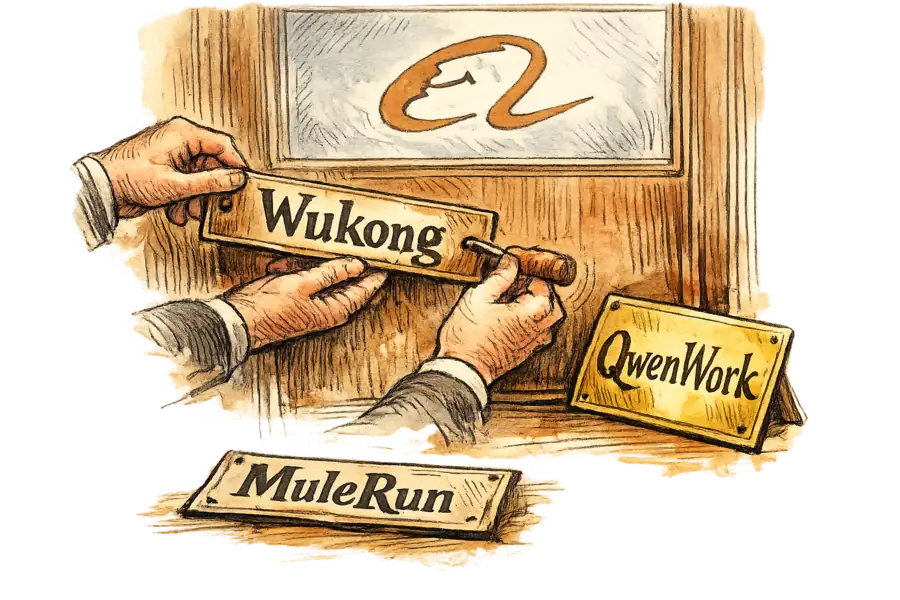
Wukong Lasted Four Months. Your Buying Season Is Six.
Alibaba launched Wukong on 17 March and had folded it into QwenWork by 3 August, four and a half months later. That is shorter than the merchandising cycle retailers are wiring those agents into.
Sir John Crabstone
Alibaba launched Wukong on 17 March as a B2B AI-native work platform. By early August it had been folded into a single suite and no longer existed on its own. Four and a half months, rounded down to four in most headlines. Either way, that is shorter than the season it was built to serve.
The replacement is QwenWork, in public beta since 3 August. It takes QoderWork’s desktop control, MuleRun’s cloud execution and Wukong’s enterprise permissions and sells them as one product. Alibaba announced a 2.4-trillion-parameter model in the same week. Nobody priced the three products that had stopped existing.
The mechanics are plainer than the branding. Wukong’s business unit was renamed the Qwen Office unit inside Alibaba’s Token Hub group and its staff absorbed. It now sits under Chen Yusen, who ran MuleRun until he was made DingTalk’s chief executive in June. Nothing about Wukong failed a benchmark. It was reorganised out of existence.
The trade read is convergence rather than collapse: every large platform is racing to fold separate agents into one work product. The reasoning is sound. It describes Alibaba’s problem, and it has nothing to say to the customer who standardised on one of the three.
Consolidation costs Alibaba a brand and some duplicated engineering. The buyer’s cost never appears on an invoice. It is the half-year spent teaching a system where the open-to-buy file lives and who may approve a markdown.
Alibaba published a depreciation schedule and called it a reorganisation.
Consider what a merchandising team wires an agent into. Assortment plans, supplier correspondence, the Monday trade meeting. None of that is a licence you cancel; it is a set of permissions and habits that took a season to build. Alibaba can rewrite its product in a quarter. You cannot rewrite a season plan at that speed.
Set that against the calendar the tool is meant to serve. Heuritech defines each selling season, spring/summer or autumn/winter, as six months. Its own forecasting data enters the design calendar eight to ten months before launch, and a collection shown to buyers in September may not reach the shop floor until January or February. Any system inside that process should survive one full turn of it. Wukong managed roughly half.
The pattern is not Alibaba’s alone. Tencent prices its rival work agent at 198 yuan per seat per month. The month is the honest number in that sentence. Software billed by the month is software the vendor may redraw by the month, and retail signs annually.
Buy at the vendor’s horizon, not your own. Short terms, exportable configurations, and a written answer to what happens when the product is renamed. Procurement writes that clause for payment processors without being asked. It has not started writing it for agents.
At the next vendor meeting, skip the roadmap. Ask what the last four products are called now, and count how long the answer takes.