Xiaohongshu Made Restraint a Brand. Then It Made Dots a Department.
Xiaohongshu's late April reorganisation made AI a first-tier department called Dots, installed a new president, and ended five years of community-versus-algorithm restraint at China's most cautious social-commerce platform.
Neritus Vale
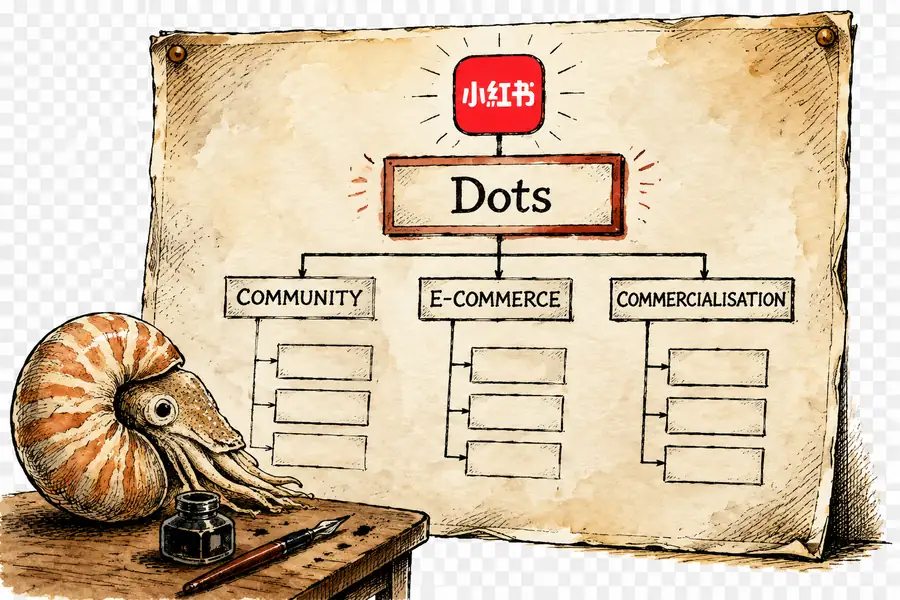
In late April Xiaohongshu elevated AI to a first-tier department called Dots, split out a separate Enterprise Intelligence unit, and installed Conan, under CEO Mao Wenchao, as president over community, e-commerce, and commercialisation in the same restructuring. The platform that for five years insisted authenticity could be defended against algorithmic pressure has now made Agent capability one of the four pillars it reports against. The reorganisation does not abandon community; it concedes that the restraint era has ended.
Xiaohongshu’s earlier identity rested on a structural argument about traffic. Its recommendation system distributed views more evenly across creators than ByteDance’s concentration model, and its leadership treated that distribution as a moat — the source of the lifestyle reviews that turned the app into a 350-million-user search substrate. Internal reorganisations through 2024 consolidated algorithm work into a single Application Algorithm Department but kept it underneath the technology stack rather than alongside the businesses. That choice mattered. It meant algorithm was infrastructure, not strategy.
The choice has now been reversed.
What Dots inherits is no longer a lab project. The Humane Intelligence Lab released dots.llm1 in mid-2025, a mixture-of-experts model trained without synthetic data and benchmarked against Alibaba’s Qwen2.5-72B. The platform has also shipped Diandian, a standalone search application, and OpenStoryline, a conversational video-editing Agent; nearly 600 million daily search queries now run through the platform. A first-tier department is the organisational form these products require to ship without negotiating shelf space with community operators every quarter.
Xiaohongshu’s revenue is in a different shape than its caution suggests. The platform booked $4.8 billion in 2024, most of it advertising, and advertising performance now turns on whether intent is captured inside the Agent layer or routed away. Profit is projected to triple to roughly $3 billion for 2025 as the company edges toward a public listing. Dots is the budget line that holds the answer to the question listing investors will ask first.
The community-versus-algorithm framing was always less stable than its proponents allowed. Xiaohongshu’s traffic distribution depended on the algorithm doing less; an Agent’s job is to do more. Once a conversational interface becomes the primary surface, the platform must decide which products surface, which creators are answered, and which categories are pre-resolved into a single recommendation. That decision is the editorial spine of social commerce, and it cannot be delegated to community ethics without becoming arbitrary. The Humane Intelligence Lab name was always a stand-in for the question Xiaohongshu will now have to answer in product terms: which lifestyle review wins, when only one is shown.
The counter-case is that promoting Dots is consolidation, not surrender. Three businesses still report to a president whose remit is to integrate them, the model is named for its humane intent, and labelling rules for AI content have been tightened, not loosened. The condition this counter requires is that Dots can deliver Agent capability without changing how content reaches users. That condition fails on contact, because Agents reach users by replacing the lifestyle-review feed with an answer. Promotion to first-tier is not a label; it is a budget priority and a vertical reporting line, and both arrows point away from community as the distribution authority.
If Dots ships an Agent that handles search, discovery, and editing under one model, the surface that fashion and beauty brands have learned to brief on Xiaohongshu narrows toward a prompt and a result. Peer reviews, KOC seeding, hashtag clusters: the structure of that craft assumes a feed. The cost of that narrowing would fall first on the long tail. Niche brands that built audiences inside Xiaohongshu’s flat distribution would find the Agent does not need them, only their content, while flagship advertisers with budget for whatever schema Dots prefers would inherit what was once organic reach. The platform that opposed engagement-first algorithms is converging on something more consequential than TikTok: an answer engine ranked by training data. That is the price Xiaohongshu has now written into the org chart, in board minutes rather than code.