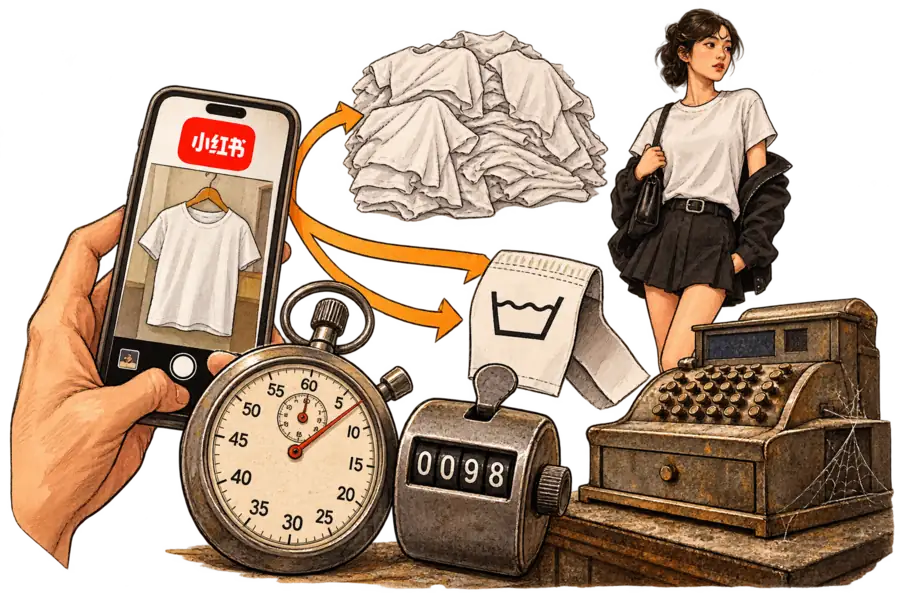
Xiaohongshu's Photo Search Tells a Tee Hunt From a Styling Question and Scores Itself on Clicks and Time
Xiaohongshu's IntentFlow sorts photo-and-text searches by intent, so one white-tee photo can fetch look-alikes, outfits or washing advice, and offline its intent rules lifted the top-result rate on outfit questions by 37.72 points on its larger test gallery. Its live test reports only relative gains in click-through rates on notes and time on results pages, with no duration, traffic share, product clicks or purchases.
Neritus Vale
Xiaohongshu has taught its photo search to ask what a picture is for, which is what clothing search needs. A technical report its engineers posted to arXiv this week shows a white-tee photo carrying three requests: find a similar tee, show outfits with it, explain how to wash it. The live test offered as proof measures click-through to user notes and time on results pages, and nothing anyone bought.
The system, IntentFlow, reads a reference image, a line of text and a box around the part that matters (task definition). A compact model assigns each query an intent from a list of seven. On 390 human-labelled queries it named the second-level intent correctly 91.54% of the time (recognizer results). A reranker then grades candidate notes against rules written for that intent. Software agents build the training data, checking candidate notes against each intent’s rules and passing ambiguous cases to human review (data construction). The authors are all at Xiaohongshu Inc, so the live test is self-reported.
Nowhere does the report say what share of queries concern clothing, though its examples lean on the wardrobe. Its panels illustrate Item Search with a Hermès Kelly bag, Attribute Variant Search with rose-stud earrings wanted in gold, and Outfit Styling with a white tee (intent panels). Only Outfit Styling is defined around a garment. A reconstructed screen shows the same retrieval feeding a search agent, Diandian, as it styles a dark jacket.
Offline, outfit questions show why the rules matter. Trained on generic matching rules, the retriever put a satisfying note first for 2.49% of Outfit Styling queries on the larger test gallery (per-intent results). A look-alike tee is not an outfit. Intent-specific rules added 37.72 points to that top-result rate.
Applying intent-specific rules did most of the offline work. Across intents, it raised the larger gallery’s top-result rate by 20.58 points (overall results). Later stages, from graded ranking to score correction, added far less. The yardstick is the model’s own rulebook: test positives are notes graded as satisfying under its intent rules. Whether shoppers share that rulebook has to be shown elsewhere.
The only intent whose top-result rate fell covers the tee’s washing question. In the opening figure, “How should I wash this tee?” falls under Transferable Information Seeking, where advice may come from another garment of the same material. There, intent-specific rules cut the larger gallery’s top-result rate by 6.84 points while widening recall (per-intent results). It is also the boundary the recognizer crosses most often: 15 of its 33 second-level errors confuse Target-Specific with Transferable Information Seeking (recognizer results).
Xiaohongshu’s live test pitted IntentFlow against the old image-first system, splitting traffic by user (online setup). Its headline measure is the share of searches in which a note among the top four results gets clicked. It rewards the top of the page for earning a tap. That rate rose 28.17% for the full system, against 21.65% for the first configuration, which had intent recognition and reranking but not multimodal retrieval (online results). Like every online figure, it is relative to a control whose rates are never printed, so it cannot be put in points.
A second click measure, any click at any rank, rose 18.96%. Neither click measure follows the tap past the note. The last, which the authors read as engagement, is the average user’s total time on search results pages over the test, up 12.56% (online setup). Better results can raise that total by drawing more searches, and worse ones by making each search slower. The report gives no count of searches per user, which would help tell them apart.
More time on a results page can mean appetite or friction, and nothing in the report tests which.
The report leaves out the basics a retailer would ask for first. It does not say how long the test ran, what share of traffic it took or whether any gain was statistically significant. It prints no query count per intent, so the offline gains have no stated denominator. Nor does it split the live results by intent or category. No online measure counts a product, although the results screens the authors draw carry a Products tab beside All (intent panels).
Xiaohongshu earns from attention, so its time measure has a commercial reading. In a September analysis carried by 投中网 (ChinaVenture), AIX财经 put advertising at about 76% of Xiaohongshu’s 2025 revenue, citing public data, and listed paid placements in search among its ad products. The piece ties ad exposure to time in the note feed: the longer users scroll, the more slots they see. If results-page time works the same way, a longer stay is ad inventory. The same piece adds that better AI search could cut impressions, because users scroll less. A clothing retailer is paid at the till, so a search that runs long without reaching it is a cost.
Alibaba measured its own photo search at the till. The Pailitao report we analysed in October gave the traffic share, the test’s length and both transactions and GMV; transactions rose 27.04% (online tests). IntentFlow’s authors cite Alibaba’s Pailitao-VL for a data-curation workflow (related work), but their live test reports neither measure.
The strongest objection is that in a community of notes, a note click is the honest measure of success. Content seeded on Xiaohongshu often converts on other shopping sites, 偲睿洞察 wrote in an analysis carried by Jiemian in May 2025. On that view, asking IntentFlow for orders applies a shop’s test to a magazine. For the thesis to fail, the purchase after a search would have to be invisible to Xiaohongshu, or beside the point for most queries.
Xiaohongshu has built ways to see that purchase. Under the Red Cat plan (红猫计划), launched that May with Taobao and Tmall, notes in some categories could link to Taobao product pages, the same piece reported. Merchants could follow a shopper from seeding to order, because Taobao and Tmall sent back store visits, searches and transactions. ChinaVenture’s September 2026 piece lists 种草直达 and the Red Cat plan among the programmes now live. A search test could have counted taps through to products, on those links or on the Products tab in its figures. The unsplit live results cannot say whether most searches concern buying at all.
If intent routing spreads to the visual search retailers buy, they should ask for results by intent, in points, ending at an order. Outfit questions need that most, because the garment that sells may be the skirt in someone else’s photo. Xiaohongshu taught its search to tell a tee hunt from a styling question, then graded it in taps and time, the currency of its advertising. For a retailer, the missing number is whether anyone who asked how to style a white tee bought something to wear with it.