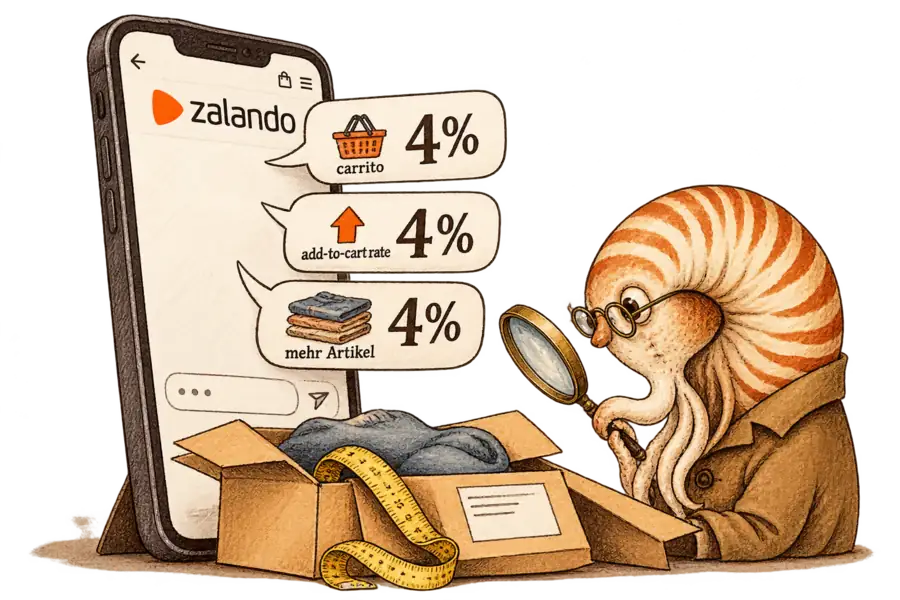
Zalando's 4% Reads Three Ways. None Counts a Return.
The only A/B-labelled result in Zalando's Assistant release tested a prioritisation of products available in the shopper's size. Its 4% reads as a rise in add-to-cart rates in English, a rise in items added in German and, in FashionUnited's account of a Madrid talk, a share of conversations ending in a basket; none is an order or a return, though Zalando reports its size tools' results in returns elsewhere.
Neritus Vale
Zalando’s chat shopping assistant will now tell a shopper which size is most likely to fit. Its 11 November release backs the feature with one A/B-labelled result, which tests something narrower: prioritising products available in the shopper’s size. The result counts baskets rather than kept orders. It also reads three ways: a rate in Zalando’s English, a count of items in its German and, in FashionUnited’s account of a Madrid talk, a share of conversations.
In Zalando’s English, the result is a rate. “By prioritising products available in customers’ sizes, the Assistant has already increased add-to-cart rates by 4% in A/B testing,” the release says. It does not say whether the rise is relative or in percentage points, or what rate it started from. Either reading stops at the bag.
Zalando’s German release counts items instead. In A/B tests, it says, “4 Prozent mehr Artikel” went into the basket. “Mehr” makes that a relative rise, which suggests the English rise is relative too. It also cannot tell more shoppers adding from the same shoppers adding more, a second size of one dress included.
In FashionUnited’s account of a Madrid talk, about 4% of chats end with something in the bag. The report, from the eShow fair and published in Spanish on 7 November, places the figure in its account of a talk by Eloisa Siclari, Zalando’s general manager for southern Europe. Its automated English translation reads: “Around 4 percent of conversations end with a product in the basket.” That is a share of conversations, compared with nothing: a description, not a test.
If the Madrid share and the English lift are both right, the absolute gain is modest. On simple arithmetic, a 4% relative rise on a 4% base adds fewer than two baskets per thousand conversations. That holds only if the test measured the same rate, which the release does not confirm.
Whatever its base, the test cannot show whether a size fits. The German release says the Assistant shows products available in the shopper’s sizes “gezielt”, on purpose; the effect is to remove a dead end, and more baskets are the expected result. The outcome stops at the bag. Yet fit is the release’s own case for the feature. General AI assistants can suggest what to wear, it says, but knowing which size will fit you is “a different challenge”.
Zalando’s size team reports its results in returns. An undated Zalando page puts size-related returns at “one third of Zalando’s overall returns”, calls shrinking that number “an important topic for us”, and credits size advice with 10% fewer size-related returns “compared to items where we don’t offer size advice”. A June 2026 update says its tools “prevented 8% of size-related returns overall” in 2025.
No return figure appears in the Assistant release, for the size advice or the prioritisation. Discussing its size services with Paperjam in October, Zalando said each new feature is first tested on a limited group of customers. The paper reported that Zalando “measures its impact on turnover, profit or returns before rolling it out more widely”, and put the size tools’ cut in returns at more than 9%, a third figure beside the 10% and the 8%. If the prioritisation went through that process, Zalando measured at least one of those. The release printed the basket.
The visitor count changed units between FashionUnited’s report and Zalando’s release. FashionUnited’s English edition has the Assistant receiving “over 22 million visits so far in 2026”, a count Zalando’s release gives as people. The 3 November results page said “unique users”, the wording behind our report that day. Read literally, a visit count of that size implies fewer people, because visitors come back.
A measure of wording became a measure of time. The release says Assistant queries are “on average three times longer than traditional search queries”; FashionUnited’s account applies the multiple to time spent instead. Longer requests show how people phrase a need; more time can mean they struggled. A 2024 Zalando interview already put Assistant searches at “three times the length” of search-bar queries, so Zalando’s earlier wording matches the release on length.
Only Zalando can say which version of the basket figure is right. FashionUnited published four days before the release, so it cannot have misread it. If the Madrid share is a level Zalando has never printed, it is the most useful figure here, showing how rarely a chat ends in a basket.
The strongest objection is that the prioritisation is itself size advice. Zalando’s release introduces the 4% right after describing “bringing this intelligence into the Assistant”. Its June page says that knowing a customer’s “usual sizes and preferred fit” lets it “surface products that are more likely to fit them”. A basket is also the step before an order. For the objection to hold, test-group baskets would have to become kept orders at least as often as the control’s.
Nothing in the release shows those baskets turning into kept orders. Without an order or return from either group, the test cannot separate good advice from bad: both fill the basket. Where the English offers the size “most likely to fit you”, the German says the Assistant will determine the “optimale Konfektionsgröße”, the optimal size.
A basket in the wrong size counts as a success until the parcel comes back.
TextilWirtschaft’s standfirst says Zalando already reports measurable successes (“berichtet schon von messbaren Erfolgen”). The figures are measurable. Every customer figure in the release counts use or baskets: visitors, query length, questions per chat, chats started from suggestions, order-card interactions and add-to-cart rates. None counts an order or a return.
If Zalando wants the Assistant judged as a size adviser, the number to publish is the size-return rate on test-group orders, set against the control’s. Its size team already reports in that currency. Until then, the lift shows only that prioritising available sizes fills more bags. Zalando chose to publish the basket; the returns, the figure that would test the advice, are still its to publish.