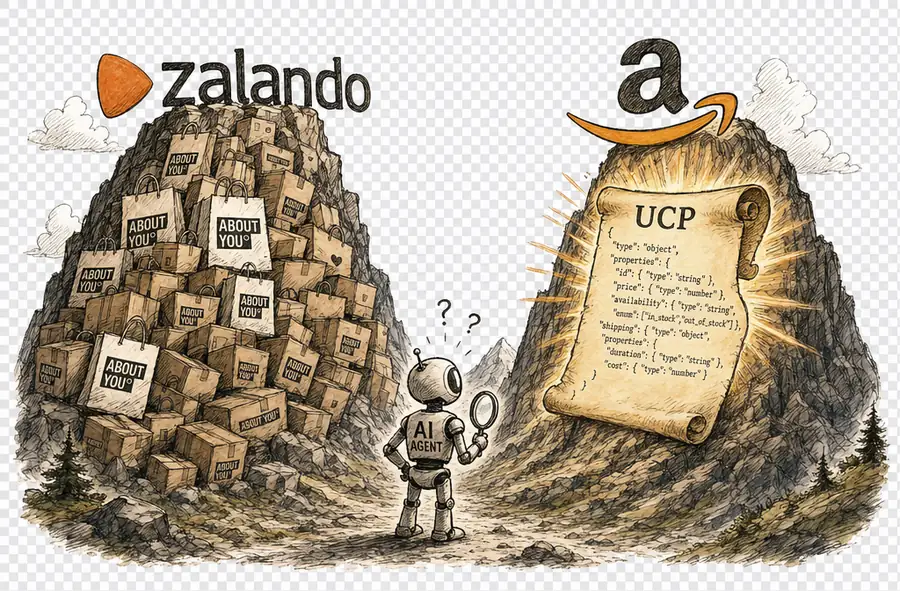
Zalando Picked Scale. Amazon Picked Protocol.
Zalando spent €1.13 billion absorbing ABOUT YOU; Amazon joined the Universal Commerce Protocol eight months after blocking its agents. Two large retail platforms, opposite defenses against the same threat.
Neritus Vale
Zalando and Amazon spent the past twelve months building opposite defenses against the same threat. The threat is AI agents picking the merchant on the buyer’s behalf, which makes discovery a question of schema rather than shelf. Zalando’s answer was to absorb its closest pan-European competitor; Amazon’s answer was to help write the protocol the agents will speak.
Zalando picked merchant-side scale. The acquisition of ABOUT YOU closed in early July at €1.13 billion, with the remaining minorities squeezed out by 22 September. The combined operation now reports 62 million active customers, a count that spans both platforms. Co-CEOs David Schröder and Robert Gentz frame the result as a pan-European platform for fashion and lifestyle, organised around B2C and B2B together; that is the language of firms that intend to host other merchants. The consumer business is downstream of that ambition. None of this is the geometry of a defensive merger.
The harder evidence sits one layer down, in the parts of the business that no longer look like retail. ZEOS, the logistics-as-a-service arm, serves more than 1,200 third-party partners; SCAYLE, the headless commerce engine ABOUT YOU brought to the deal, has been packaged for external clients including Levi’s. Retail media revenue crossed €316 million last year, which is the line item retailers grow when they begin to sell adjacency rather than goods. Zalando describes the underlying asset as an extensive data infrastructure and logistics network, sold to brands and other retailers as well as to consumers. Erfurt’s fulfilment centre is being closed by September 2026, with three partner-run warehouses also exited; the company is sizing its physical footprint to a B2B story, not a B2C one. Zalando has also registered as an endorsed UCP partner; the B2B platform and the protocol endorsement are the same position, not two separate ones.
Amazon joined the protocol it had spent eight months opposing. The Universal Commerce Protocol — an open standard for agentic commerce, backed from launch by Google, Shopify, and Walmart — covers schemas, payment handlers and capability profiles that let AI agents discover and transact with any compliant merchant without bespoke integration. On 24 April 2026 Amazon joined the UCP Tech Council alongside Meta, Microsoft, Salesforce and Stripe; in August 2025 it had blocked AI agents from OpenAI, Anthropic, Meta, Google and Huawei. The reversal admits what Amazon spent the back half of 2025 denying: if the agent layer converges on a single schema, the merchant who refuses to publish to it loses everything; if the schema remains contested, the merchant who helped author it loses least. Amazon prefers to author. Jassy has not offered that framing publicly; the Tech Council membership makes the argument without him.
Both responses concede the same prior. AI agents, built by OpenAI, Google, Perplexity and a half-dozen smaller labs, are increasingly the surface at which buyers form intent and merchants are discovered, and whoever shapes that surface keeps the margin between brand budget and conversion. Zalando wagers that scale on the merchant side renders the protocol question moot — a customer file of 62 million in apparel buys priority in any agent’s response regardless of which schema you publish. For Amazon, the schema decides the response, and authorship of the schema decides the merchant.
The premise of both bets is that AI agents will commoditise discovery; the disagreement is about which side of the trade survives the commoditisation.
The case against Zalando is concrete and worth stating in its strongest form. If UCP-aware agents become the dominant intake for European apparel buyers within three years, and if those agents rank merchants by schema completeness, payment-surface compliance and capability breadth rather than by customer file, then Zalando will have spent €1.13 billion on a slightly larger inventory of nodes the agent layer ranks as it pleases. Amazon would have bought editorial influence on the ranking criteria themselves. The reply is that European apparel is not a commodity. Buyers know the brand before they ask the agent; the agent’s job is to find the size, the fit and the delivery window, which Zalando, post-merger, controls at a granularity Amazon does not match in clothing. A protocol can route a request; it cannot manufacture inventory.
The price each firm has paid is the price of being wrong. Zalando has spent €1.13 billion and the operational discipline of a multi-quarter integration on the bet that owning the floor matters more than writing the protocol; if it is wrong, the floor is large but the agents do not care. Amazon has spent the public credibility of its April reversal on a Tech Council seat that confers influence but not control; if it is wrong, the schema will be written, the agents will use it, and the membership will have been the entry fee for a room where someone else still decides. Both have given up the third option, which was to bet on neither and to keep selling against the agents from outside the room. That option is no longer available, which is the most useful thing the past twelve months have told retail.