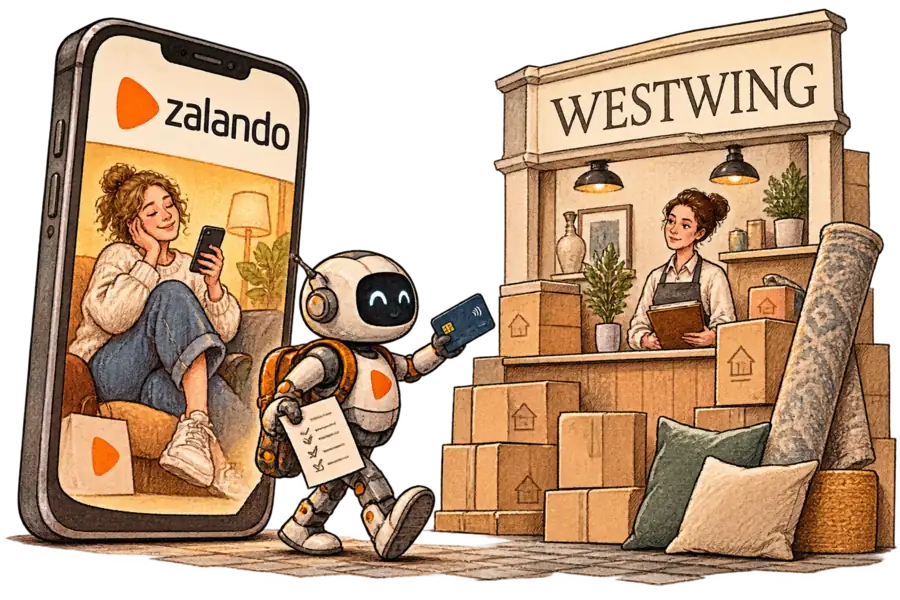
Zalando's Adjusted Profit Grew Only Where It Ships Other Brands' Stock. In 2027 Its Agent Shops at Westwing.
Zalando's consumer business earned €12.2m less adjusted EBIT in the third quarter after offers on its own stock, especially sneakers, and earlier marketing, while B2B services gained more than the whole group. Zalando Extended, whose AI agent will check out at Westwing from 2027, extends that stockless model into the app; the release names the ad income Zalando expects from partner shops, but not whether they pay per order or who handles returns.
Neritus Vale
Zalando’s adjusted operating profit grew this quarter only in the segment that handles other brands’ stock. Its new Zalando Extended will earn on other shops’ stock too: from 2027 its AI agent will check out at those shops for Zalando’s customers, starting with Westwing. The release names the advertising income Zalando expects from those shops, but not whether they pay per order or who takes back what the agent buys.
Zalando’s B2B arm gained more adjusted EBIT than the whole group did. The release’s table puts B2B, which stores and ships other brands’ goods and sells them shop software, at €42.2m against €19.6m a year earlier, a gain of €22.6m. The group’s gain was €10.2m, because adjusted EBIT in the consumer business fell.
Reported profit moved the other way. The earnings deck shows reported EBIT falling from €49.1m to €13.1m, with restructuring costs of about €58m the main driver. Net income swung to a loss.
The consumer business slipped on its own offers. B2C adjusted EBIT fell by €12.2m. The deck traces the gross-margin damage to “targeted investments in attractive offers for our customers in our retail business, especially in sneakers”. An earlier autumn campaign and World Cup marketing added to the cost, and the same slide credits partners and retail media with “positive contributions” to gross margin. The quarterly statement separately reports “softer demand mainly in the B2C sneaker category” over the first nine months, so discounting was not the only pressure.
Read together, the figures point to Zalando owning a shrinking share of what it sells. Partner goods, sold on commission, reached 33.6% of B2C GMV. That is why GMV now outgrows revenue: on partner sales, “revenue is limited to the commission earned”, the quarterly statement says. The release sets a 2028 target of 40% to 50% and calls the move a shift towards “a higher-margin, capital-light model”.
Retail media is the one Extended income the release puts in writing. Partner shops “will be able to advertise their products on Zalando”, it says, “creating an additional revenue stream for Zalando”. Retail media revenue already equals 2% of B2C GMV, and the release calls it high-margin. The deck reports it inside B2C, the segment whose profit fell.
The release names one thing Westwing can buy from Zalando and nothing it must pay.
Extended is sold to partner shops as a channel that asks almost nothing. Because “the AI agent does the work”, the release says, they gain sales “without complex technical integration or changes to their logistics”. It starts with “complex categories such as bulky home goods” and calls Zalando’s own logistics network “purpose-built for fashion and lifestyle”. That suggests the agent is the route for goods the network was not designed to move, and that Westwing keeps delivering whatever the agent buys.
The release’s description of Extended leaves out the products behind B2B’s gain. The deck says B2B, which sells logistics through ZEOS and channel software through Tradebyte, lifted its margin on overhead leverage and “a higher gross margin from scaling ZEOS”. The release mentions neither product. Its promise of no integration and no logistics changes suggests Extended partners need neither.
Zalando has not said how its agent will place orders at Westwing. The nearest working model is Amazon’s Buy for Me, whose agent completes a brand’s own web checkout by “securely providing the customer’s encrypted name, address, and payment details”. Amazon’s April 2025 announcement says brands “have the choice if they want to participate”. Merchants told Modern Retail in January that the feature listed their products without permission, and Amazon replied that businesses can opt out at any time. If Zalando’s agent works the same way, “without complex technical integration” would mean Westwing’s usual checkout page, filled in by software.
Amazon’s page also answers what Zalando’s release leaves open. “Delivery, returns and exchanges, and customer service are managed by the brand store”, it says. Zalando’s release is silent on whom a customer calls when a bulky delivery arrives damaged. If Extended copies Amazon’s split, the complaint lands at Westwing while the customer stays inside Zalando’s app.
Westwing’s investor site lists no publication since its 6 August half-year report, which does not mention Zalando and predates the announcement. Its third-quarter results are due on 5 November. Westwing’s adjusted EBITDA margin was 4.8% in the second quarter. A per-order fee, if there is one, would come out of that margin.
Early coverage treated the agent as this quarter’s news. Reuters’ lead says Zalando “launched its first AI shopping agent”; its body says Zalando “would launch Zalando Extended” with a Westwing pilot. TextilWirtschaft, in a report bylined Ulrike Wollenschläger, dpa, says a new AI agent is supposed to bring a push (“Einen Push soll ein neuer KI-Agent bringen”). The release dates the agent’s first checkout to 2027. This quarter’s adjusted gain came from elsewhere: the release credits lower fulfilment costs, ABOUT YOU synergies and strong B2B growth, and the deck names ZEOS as B2B’s main revenue driver.
Zalando sits on both sides of the agent trade that JPMorgan flags. JPMorgan cited “ongoing structural risk from agentic commerce development”, Reuters reported. The deck files a ChatGPT ads pilot and a Google UCP pilot under “Inbound”, and Extended under “Outbound”. Google pitches its protocol to merchants with “Keep all of your customer data and relationships.” Zalando’s release courts the shopper instead, who “will never have to leave the trusted Zalando app”.
The best objection is that this reads a strategy into a pilot. Extended has one pilot partner and no checkout before 2027. The B2C dip’s causes, sneaker offers, softer sneaker demand and an early campaign, could reverse within a quarter. On that reading Extended is a range feature for more than 22m Assistant users, and its terms are a detail. For the thesis to fail, Zalando would have to be indifferent to what the agent earns.
The release points the other way. It presents the pilot as the start of “an ever-growing range of products from shops across the internet”. Westwing’s terms would then be the first draft for every shop that follows. The release also names Zalando’s income before the agent can buy anything. Whatever the sneaker cycle does, Zalando has told investors what the agent is for.
The pilot’s terms will decide what kind of business Extended is. If partner shops pay mainly for ads, it is a shop window that Zalando rents out. If Zalando adds a per-order fee and leaves every return to the shop, it is a toll on other shops’ sales, collected from the agentic commerce JPMorgan calls an “ongoing structural risk”. Zalando has not published the price.