Zalando Rents Out Its Warehouses. Its New B2B Chief Lent Out Amazon's Promise.
Zalando credits its new B2B chief with creating Amazon's Seller Fulfilled Prime, which lent Amazon's delivery promise to sellers' own warehouses. Zalando earns nearly all its B2B revenue from logistics and, where several merchants offer the same size, still queues those warehouses behind its own.
Sir John Crabstone
Zalando has put the man it credits with creating Amazon’s programme for other people’s warehouses in charge of a business that rents out its own. Tom Christenson started on 15 October as senior vice president for B2B, reporting to co-chief executive David Schröder. Zalando’s announcement says he “created Seller Fulfilled Prime”, and that the unit passed €1bn in revenue last year. Christenson states the pitch plainly: “What we built ourselves, we offer our business partners.” Seller Fulfilled Prime ran on a different premise.
Amazon’s own page describes a programme with no building in it. Its pitch to sellers reads: “Put Prime branding on the listings for products you fulfill without Amazon.” A 30-day trial must first show the seller can deliver at Prime speed. Amazon lent the word customers trusted and took over post-order service; the warehouse stayed the seller’s.
The word proved easier to lend than to police. Amazon stopped admitting new sellers in 2019, and said the pause reflected shortfalls against shopper expectations and a wish for clearer standards. Enrolment reopened only in October 2023, behind a trial and a 93.5% on-time delivery floor, Supply Chain Dive reported. The promise had travelled faster than the parcels.
Zalando already grades partners who ship from their own warehouses. Its platform rules warn of “low visibility” if fewer than 95% of their deliveries in Germany get a first delivery attempt within four working days. Stock kept in Zalando’s own warehouses is exempt. A pass avoids the penalty but does not, in the usual order, earn a place in the queue.
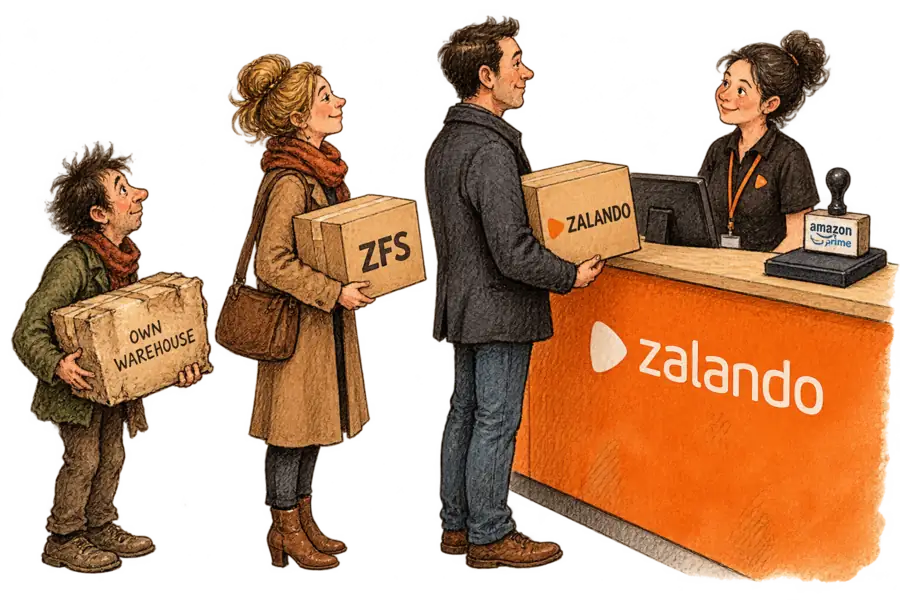
When several merchants offer the same size, Zalando’s own wholesale stock wins first, then partners storing goods in its warehouses, and only then “the remaining partners”. Zalando can switch to a price mode during sales. There, a partner meeting the targets joins the top tier but may still have to undercut stock in Zalando’s warehouses by 5%.
Amazon’s badge asked how fast a parcel arrived; Zalando’s queue still asks whose shelf it left.
TextilWirtschaft’s page title has Zalando landing an “Amazon-Manager” for its B2B expansion, and its standfirst speaks of “Know-how von Amazon”. Quite so. The know-how in question, though, is Amazon’s least Amazonian idea: that a platform can vouch for a warehouse it does not run.
Christenson left Amazon more than six years ago. In January 2020 he became head of Uber Freight Europe, a digital brokerage whose customers, he told FreightWaves, came in two sets: the shipper and the carrier. It matched other people’s loads to other people’s lorries.
Nothing in Zalando’s announcement points to a badge of its own, and its figures suggest why. Leave out Highsnobiety, and logistics, sold as ZEOS, made up 93% of B2B revenue last year. Software from Tradebyte and SCAYLE made up the rest. A standard that partners met from their own warehouses, on Zalando and elsewhere, could cut against ZEOS itself. The programme Zalando credits him with told sellers they could do without Amazon’s warehouses.