Zalando's Returns Robots Took the Sorting and Left the Judging
Sereact's dual-arm robots now grasp, identify and sort Zalando returns at two CEVA sites in Germany and Poland. Sereact's own product page promises inspection and resale decisions; the joint release points staff toward quality control and publishes no throughput.
Sir John Crabstone
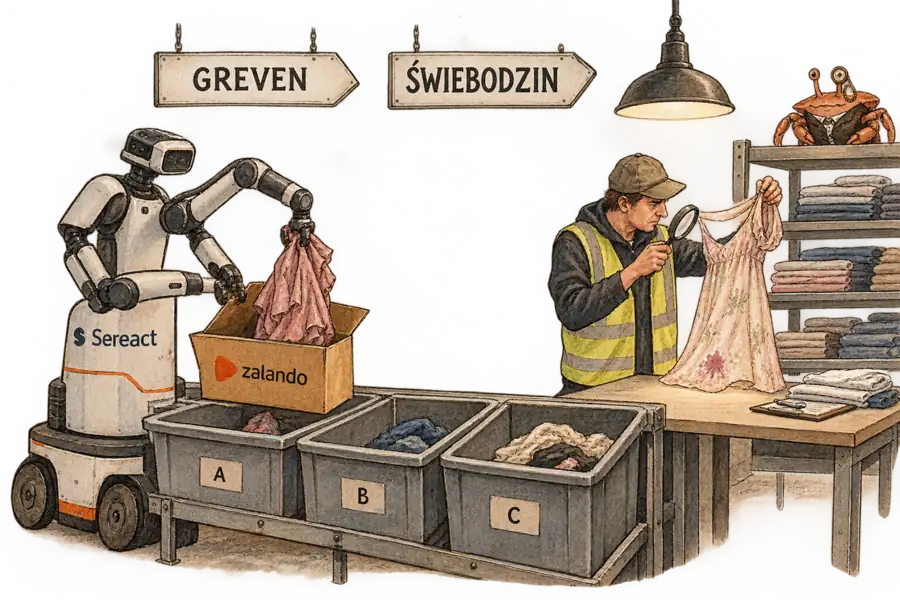
Robots now sort Zalando’s returns at two sites, and the warehouse staff are being steered toward quality control. A joint release from Sereact, Zalando and CEVA Logistics on 7 October says dual-arm machines that CEVA has deployed in Greven, Germany, and Świebodzin, Poland, “grasp, identify, and sort” returns. Warehouse teams are to “transition toward station supervision, exception management, and quality control”, upskilling into roles “where human expertise and judgement are required”.
Ebrun’s newsflash on 12 October kept the robots and dropped the staff, saying the machines “automatically process” (自动处理) returned clothing. Its author, Ebrun Go, is the site’s automated writing robot, so the omission may be solidarity.
The boldest claim came in July. Fashion Tech Weekly described a station that “opens a returned parcel, removes the garment, folds it and processes it without human handling”. Its source, tech.eu’s interview with Sereact’s chief executive, Ralf Gulde, described a system that can open boxes, fold garments and “process returns automatically”. Neither the release, the product page nor tech.eu says “without human handling”; the newsletter added it.
Sereact’s own product page promises more than the release. Its station opens parcels, inspects for damage, folds clothing and sorts items into “resale, refurb or discard”. The release claims neither inspecting nor folding, though it says the system “classifies items faster”. A brochure says what a machine can do; a joint release says what three companies are prepared to sign.
Zalando’s returns page, dated June 2025, says 50% of ordered items come back on average and that every one is checked for stains and loose threads, “completely independent of their actual merchandise value”. More than 96% are in “ideal condition” and go straight back on sale; minor flaws are fixed in refurbishment centres, and around 98% of returns are re-offered. The page does not say who grades the other four in a hundred, or whether a robot does.
The release trusts the machine to recognise a dress; it does not say who notices that the dress has been to a wedding.
Sereact offers customers a price guarantee based on the per-return cost, tech.eu reported, and says its robots are around 30% more cost-effective than manual processing in most regions, a company figure that is not specific to Greven or Świebodzin. The release calls the deal robotics-as-a-service without saying who pays: CEVA, which deploys the robots, or Zalando, a Sereact investor since July.
Zalando extended CEVA’s contracts in Germany, the Netherlands and Poland to at least 2030, trans.info reported, a deal Dr. Web places in July. Zalando supplies the parcels and CEVA the floor; Sereact gets a reference customer that is also an investor.
What none of them has supplied is a number. The partners name neither a robot count nor an hourly output, Dr. Web noted, and the release gives no error rate or robot share of returns.
Gulde calls production “at Zalando volumes” the “strongest proof point we have”. Until somebody publishes the volumes, the proof point is the press release.