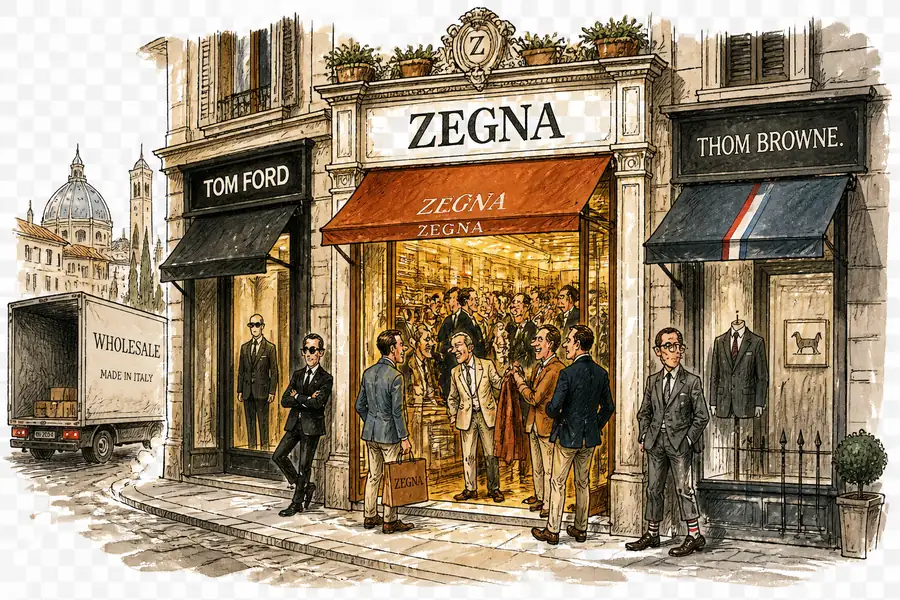
Zegna's 7.4% Came From One Brand And One Channel
Zegna Group's 7.4% organic Q1 was carried by the Zegna brand and the direct channel alone; Tom Ford and Thom Browne roughly cancelled each other out, wholesale collapsed 17%, and the thesis a multi-brand group is supposed to prove — that diversification reduces single-engine risk — was not visible in this print.
Neritus Vale
Zegna Group’s Q1 grew 7.4% on an organic basis, and the math behind that headline is unusually concentrated. The Zegna label, growing 11.3% organic, accounts for nearly the entire group lift; Tom Ford and Thom Browne roughly cancelled each other out, and the wholesale channel collapsed. A company that has spent two years selling itself as three signatures and a global retail footprint has, this quarter, narrowed its growth base to a single brand on a single channel. Whatever the press release says about momentum, that is what concentration looks like when it shows up on a financial summary.
The arithmetic is unforgiving when worked through, with the Zegna brand producing almost all of the group’s organic lift on its own. Tom Ford grew modestly and Thom Browne contracted by a comparable order; the pair delivered little combined lift at the group level. Tom Ford’s gain was driven primarily by its direct channel, with the March fashion show providing secondary support — a distinction that matters for judging whether the trend is structural or event-dependent. The two brands bought to give the group reach beyond menswear added little in the quarter when Zegna’s macro position is most exposed. As an experiment in portfolio construction, Q1 returned an answer the press release would prefer to mute.
Channel concentration tells the same story in a sharper register. Direct-to-consumer revenue grew at double-digit organic pace while wholesale fell 17% organic, with Thom Browne’s department-store distribution collapsing most violently. The directly operated channel now produces 85% of branded sales, against the low eighties a year ago. The group no longer has a wholesale engine in any meaningful sense; the channel that remains is an exit ramp it is still walking down. What should look reassuring, the high direct ratio, is also what limits where growth can come from: the company is now what it has chosen to be.
Thom Browne’s wholesale collapse is the most visible artifact of the channel shift. The brand’s wholesale revenue fell nearly 60% organic in Q1, the planned tail of last year’s department-store exit. What that figure also says is that Thom Browne’s growth story now lives entirely inside its own stores, and those stores grew at a double-digit organic pace. Until the directly operated network is large enough to absorb the wholesale shortfall in absolute euros, the brand is shrinking even when its DTC line is up.
Geography compounds the brand and channel narrowing. The Americas grew 17.5% organic, while EMEA was essentially flat and Greater China managed only mid-single-digit organic gains. A region that produces fewer than one in three group euros now carries most of the group’s positive momentum. If American luxury demand cools, and the 2026 trade and rate environment has offered no reason to expect otherwise, Zegna’s three-region balance becomes a one-region exposure. Gildo Zegna’s claim that “the worst has passed” in China is testable in two quarters; until then the group’s macro hedge is unfinished.
This is what a luxury company looks like when its diversification has not yet diversified.
The defense, as Gildo Zegna told investors, is that this concentration is by design. Thom Browne’s near-total wholesale withdrawal in 2025 was framed as a “traumatic” but necessary reset; the Zegna brand’s wholesale pruning has been similarly deliberate. Read this way, the thinness of the growth base reflects discipline, not exhaustion: the company is killing low-margin distribution to pour capital into stores it controls, where margin and brand control are higher. The argument has weight, and management has earned the benefit of patience after a decade of building out the directly operated network. It still requires one condition to hold — direct demand must keep outrunning wholesale loss every quarter, in every region, across all three brands, for as long as the wholesale exits continue. The Q1 print suggests that condition is being met today; it does not yet prove it can be met when luxury softens further, which is the only environment in which the discipline thesis is actually tested.
Concentration of this kind has a specific failure mode. If the Zegna brand stops outgrowing the group, or if the directly operated channel stops growing at fourteen percent organic, or if the Americas regress to the EMEA mean, the headline number does not soften; it inverts. None of those conditions is implausible in 2026: luxury sector deceleration has been the prevailing read through 2025 and into this quarter, and the Americas, however strong the number, is the region most exposed to the next twelve months of trade and rate uncertainty. Zegna spent years choosing to be a single-engine company; Q1 is when the choice became visible on a financial summary. The choice will look right if the engine keeps running, and badly wrong if it skips a beat. Q1 earned no other reading than that.