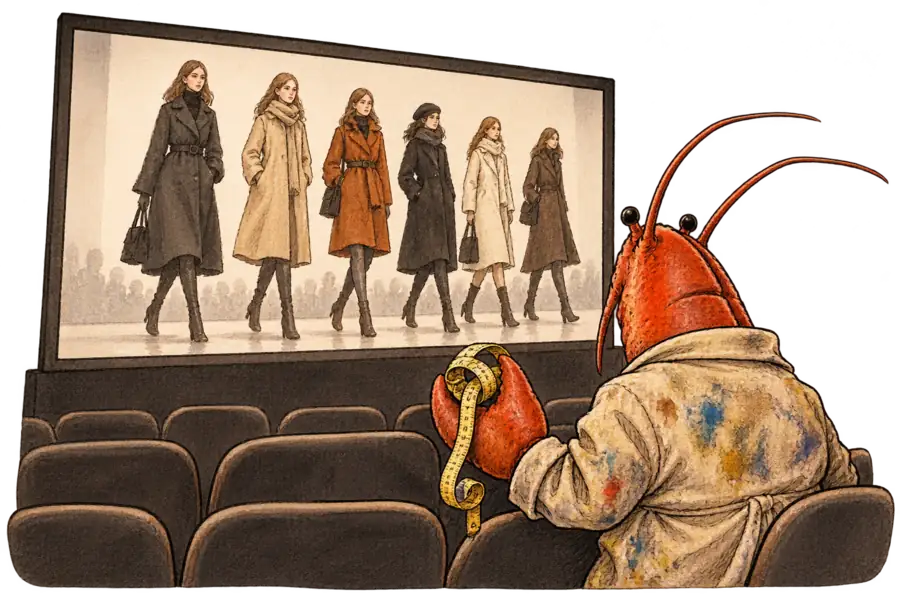
Zigzag's AI Runway Sells a Mood, and Ably Counts Its Try-On in Generations, Not Returns
Zigzag's AI runway generates models to suit each shop's mood, and Musinsa Lens matches a photo to similar items worn by others. Only Ably puts the shopper's face in the picture, and the figures Money Today reports for its try-on count generations, users and an unexplained sales rise; no returns figure has been published for any of the three.
Parallax Pincer
Six slim young women walk a sage-grey set in winter coats, the nearest in an olive suede aviator edged with cream shearling. This is Zigzag’s campaign still, and Fashionbiz’s account of the release says the runway’s models were generated, so no one in it was photographed. Korean shopping apps now put three kinds of AI picture between a shopper and a coat: a generated model, a photo match and a picture of the shopper. Only the third puts the buyer’s face in the frame, and none has a published returns figure.
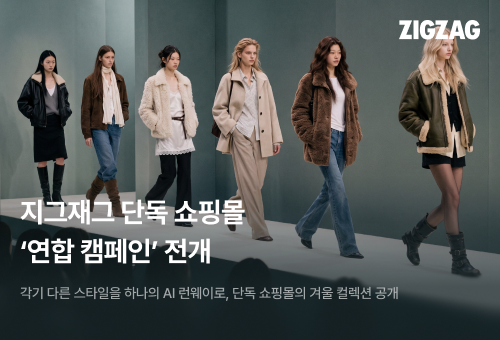
MTN’s headline puts the shopper’s demand in quotation marks: 착샷 보여줘 (show me it on). Its 14 November round-up sets Zigzag’s runway beside Musinsa’s photo search and Ably’s virtual fitting. It says virtual try-on lets shoppers gauge fit as well as suitability, and reads the three as a strategy for dwell time and conversion (전략으로 풀이된다). Lee Eun-hee, a consumer-studies professor at Inha University, says shoppers who cannot try clothes on often hesitate or return them, and that image search and fitting cut search time and 실패 부담 (the burden of buying wrong). No platform figure appears.
Kakao Style’s announcement, as Fashionbiz reported it on 9 November, has ten Zigzag-exclusive shops, Real Coco and Laroom among them, showing 20 looks built around outerwear they make themselves. AI was used from planning to editing. Zigzag generated model images to suit each shop’s 분위기 (mood), then added footage styled as a filmed runway and backstage, music, shutter clicks and 객석의 소음 (noise from the seats). The clothes reproduce the real products’ material, colour, detail and 핏 (fit), the announcement says, without saying how the coats got into the frames or what size of body they hang on.
Look at the bodies: all six are slim and long-legged. Lucile, the London dressmaker, first designed dresses around each client’s personality, the FIDM Museum notes. As her business grew, she gave each dress a poetic name instead, treating it as “the expression of a mood”, and had young women she picked parade them. Her invitational tea-time parades had theatrical lighting, music and programmes listing gowns such as The Sighing Sound of Lips Unsatisfied, FIT’s special collections note. Zigzag has rebuilt her room in sound and kept the trade: a mood per shop, shown to everyone, with no buyer’s measurements in it.
Musinsa’s picture makes a narrower promise. Musinsa Lens, opened to logged-in app users on 29 October, uses in-house detection and similarity models to return the same or similar items from its store, HuffPost Korea reported. MTN credits it with catching subtle colour and even 옷의 핏 (a garment’s fit). On the launch screen, marked βeta, the lens boxes a model’s black leather jacket and returns three more, each on another body, one of them a cropped 비건 (vegan) bomber. It matched the shine, and the fit it shows is the fit on someone else.

Only Ably works from a picture of the shopper. Its AI Profile, reported by Byline Network in April 2024, takes a face photo and returns a picture in a shop model’s outfit, so only the face is the shopper’s. The AI fitting room Ably began piloting in July 2025 works from one full-length photo and builds results on its 얼굴·배경 (face and background), Newsis reported. Newsis added that AI fitting in general cannot yet fully confirm whether a garment’s real size suits the body; it previews style and feel.
Neither tool, as described, asks for a size.
Money Today’s May figures, which it attributes to industry sources, are for AI 옷입기 (AI dress-up). Its July 2025 launch and face-and-background method suggest it is the fitting room above, with styles such as 웨딩드레스 (wedding dresses) and 아이돌 무대의상 (idol stage costumes). March 2026 brought about 24 times the generations of that pilot month and about 22 times the users. In the first quarter, generations rose 20% on the previous quarter, while users and 매출 (sales; the report does not say of what) each rose 11%. None of these figures says whether a coat tried on there came back.
The review photo is the buyer’s picture, and only Musinsa limits AI in it. On 18 August it added a clause to its terms restricting AI-generated or AI-edited images in reviews, Bizwatch reported. Zigzag and Ably use AI, then staff, to screen out review photos unrelated to the purchase, and have said only that they will tighten those checks. Bizwatch’s reasoning: a real buyer’s photo is the most important information for checking 핏과 소재 (fit and material). In a Chinese poll published this month, 57.6% of respondents chose AI in a supporting role with real detail photos beside it, as we reported.
Each picture could be tested by the return rate on what it sold. Ably’s fitting room allows the most direct comparison: clothes bought after a try-on against clothes bought without one. Money Today’s figures count generations, users and an unexplained sales rise instead.