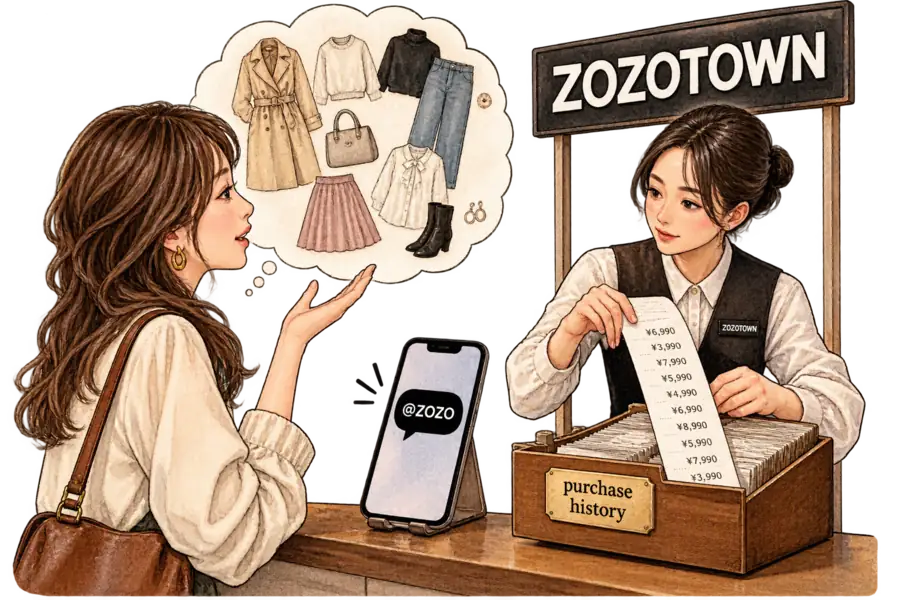
ZOZO's Defence Against Shopping Agents Rests on Yesterday's Receipts
ZOZO argues that taste is hard to read from public information, so platforms keep their value as AI shopping agents spread. Its own Q&A minutes name a plainer priority: keeping the payment, and the purchase data it brings, on ZOZO's own site.
Sir John Crabstone
ZOZO’s defence against AI shopping agents begins with taste. At the 29 October results briefing, chief executive Kotaro Sawada argued that fashion turns on preferences hard to put into words from public information alone, Diamond Chain Store Online reports. ZOZO’s investor papers end somewhere plainer: with who takes the payment.
The briefing deck, whose text names no outside agent, sets out two scenarios. Where product information is “clear and widely available as public information”, consumer-side agents go straight to suppliers and the middleman declines. “Finding your style” falls in the other scenario, where information is “ambiguous and scarcely available” and the shopper’s agent stays “less capable than supply-side agents”. Platforms keep their value there, and ZOZO, the slide notes, “is in a position to hold this data”.
ZOZO has already let a consumer-side agent handle that ambiguity. Its ChatGPT app, launched in March, suggests outfits and items from more than 14 million WEAR outfit posts (as of December 2025) and ZOZOTOWN’s listings, with no ZOZOTOWN or WEAR account needed. A conversation with ChatGPT, the release said, could pin down tastes that are hard to put into words. It said nothing about paying there.
The deck lists three assets “unique to ZOZO”, not one: preference data from purchase and browsing histories, outfit images linked to specific items, and vector databases of items and outfits. The app already serves from the outfit posts, and ChatGPT can draw out the taste a shopper cannot state. That leaves the purchase and browsing record as the asset no outside agent can reach; that is our reading, not the deck’s.
Sawada was blunter with investors. Payment, ZOZO’s Q&A minutes record, is “a critical turning point”: whoever handles it gets the fees and the “valuable purchase data”. The minutes are a summary translation of the Japanese, and this answer replied to a question on US payment processing. ZOZO’s marketing, they add, leans on what customers “purchased yesterday”; hence a “top strategic priority”: “at a minimum, to encourage customers to complete their payments on our own platform”.
The same minutes carry a growth case. niaulab members “approximately doubled their purchase amounts”, and stylist-level AI “could lead to growth in GMV”.
Taste may be hard to put into words; a receipt never is.
ZOZO’s next tools are built on those receipts. Lab-kun, a chatbot, and a 28-type WEAR style finder are already live; two advisers in development are “trained on purchase and favorites data”.
The receipts are not free. In the half to September, revenue rose 5.1% to ¥110.6bn and operating profit 5.6% to ¥32.8bn, ZOZO’s earnings report says. Gross margin fell 0.4 points to 33.2% of gross merchandise value, excluding other GMV. The report names the business mix from one more month of Lyst consolidation first, then stronger discounting and point-award campaigns, which it deducts from net sales.
When ZOZO is the intermediary, it wants the payment as well. Lyst, its global shopping platform, earns commissions from partner brands whose products it lists. Adding partners to Lyst’s own checkout is “a key initiative for the current fiscal year”, ZOZO’s supplementary results deck says.
Read in full, Sawada’s “at a minimum” continues: “and not to give up that part of the purchasing process”. ZOZO is also spending on the stages before payment, from Lab-kun to the WEAR style finder, to bring shoppers to ZOZOTOWN. Browsing is one of the two histories behind its preference data. A ZOZO that keeps the receipts and loses the browsing would know what its customers bought to the yen and, each season, less of why.