ABOUT YOU Cut Content Time 95 Percent. Now It Sells the Saving.
ABOUT YOU took more than eight million euros a year out of studio and editorial costs, then put the tool that did it on sale to other brands. A production saving cannot be defended, only converted — and the conversion has to happen before every rival buys the same capability.
Admiral Neritus Vale
ABOUT YOU took photography out of its own cost base, then put the machinery on sale. SCAYLE STUDIOS, the system that did it, shortened the group’s content time to market by more than 95 percent. It also removed over eight million euros a year from studio and editorial spend, and that figure is the reason the tool is now a product rather than a secret. A saving of that shape happens once. Recurring revenue is the only form in which it survives contact with a competitor who can buy the identical capability.
The strongest evidence that this capability was never defensible comes from ABOUT YOU’s own parent. Reuters reported in May 2025 that Zalando had already compressed image production from six to eight weeks down to three or four days, with most of its editorial campaign imagery generated rather than shot. The two companies were still separate then; Zalando did not complete its acquisition of ABOUT YOU until two months later, in July 2025. Matthias Haase, Zalando’s vice president of content solutions, put the cost reduction at 90 percent, the same number ABOUT YOU would publish fourteen months later. Two firms in the same market built the same thing separately and landed on the same figure. Nothing in that sequence is proprietary — it is what a commodity looks like in the months before its price adjusts.
The conversion into revenue is visible in Zalando’s accounts, and it is small. SCAYLE STUDIOS passed one million euros in annual recurring revenue within two and a half months of launch, ABOUT YOU said at launch. That is a rounding error beside a B2B segment which turned over 334.7 million euros in the same quarter, and the size is what makes the motive legible. The money is not the point at this scale. What the group is buying is a contract that keeps paying after the capability stops being rare, which is more than a line on an efficiency slide can promise.
The half-life of a production saving is however long it takes a competitor to sign a contract for the same software.
The buyer list describes the mechanism more honestly than the launch announcement does. s.Oliver Group, Betty Barclay Group and Goldner Fashion were named as the first enterprise customers, with the paying roster now past a hundred brands. FashionUnited reported this week that more than 140,000 outfits came out of the tool in the preceding thirty days, well above the rate ABOUT YOU claimed at the July launch. s.Oliver’s catalogue already sits on ABOUT YOU’s own shelves, which makes this a retailer selling its cost structure to a brand it hosts and competes with for the same German shopper. That reads as carelessness only if exclusivity was on the table. It was not. Pretending otherwise would only have meant watching those brands buy an equivalent tool from someone else within two years.

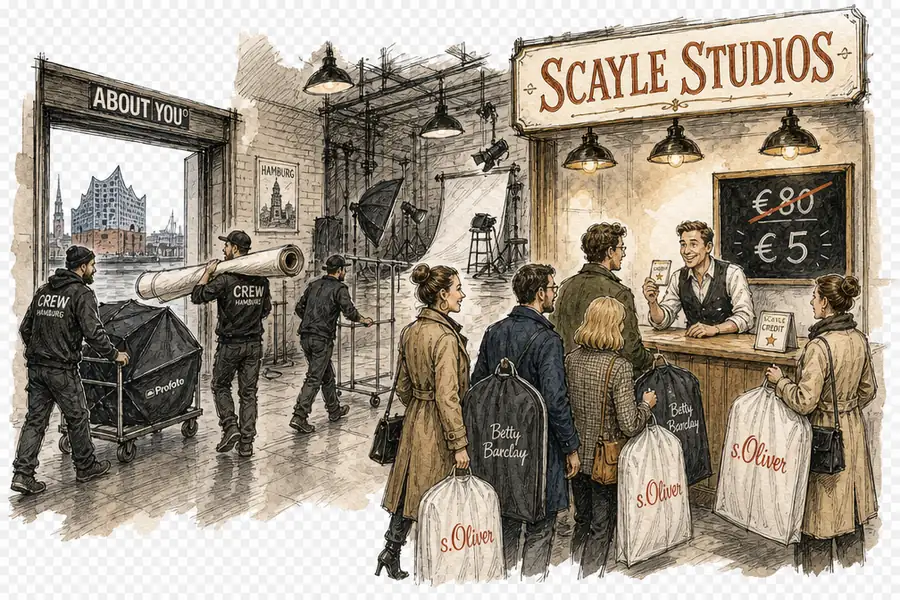
marketing4ecommerce, reading Zalando’s second-quarter materials, put a traditional product shoot at roughly 80 euros. That number used to be private, negotiated agency by agency and volume by volume, which is precisely what let large retailers hold a cost advantage over smaller ones without ever naming it. The same analysis puts SCAYLE STUDIOS pricing at four to five euros per product for standard self-service work, and roughly ten euros per SKU for enterprise packages. Any brand that reads it now holds a public anchor for its next studio negotiation, whether or not it ever buys a credit.
The strongest case against all of this says the render is the least valuable part of what SCAYLE STUDIOS sells. The product is a measurement loop: generate several image sets, run them against each other on live traffic, keep whichever converts. ABOUT YOU puts the gain from that routing at up to 20 percent of gross merchandise value when multiple sets compete for the same slot, roughly double what a single generated set delivers against studio photography. If the loop is the product, the moat is real, the capability is not a commodity, and selling access to it is an error rather than a hedge. One condition has to hold for that reading to work: the buyer needs enough traffic to run the test.
The traffic condition fails for most of the brands SCAYLE STUDIOS is selling to. Those uplift figures were measured on a retailer with more than 15 million active customers across 26 markets. A mid-market label running the same test on its own direct traffic, hunting a five-percent improvement in add-to-basket rate, will not reach significance before the season it was testing has shipped. What crosses to the buyer is the renderer and the workflow wrapped around it. That is the half of the product whose price is falling, and ABOUT YOU is charging for it while there is still a price to charge.
If content production keeps falling toward the cost of compute, the difference between two product pages moves back to what a model cannot supply: fit information, availability, and what arrives in the box. We argued last week that China’s marketplaces handed the same capability to their merchants free and are now buying back the credibility it cost them. The European version is being sold rather than given away, which earns ABOUT YOU a revenue line and hands its customers a floor. There were two things the group could do with an eight-million-euro saving: hold it and watch it become the market’s baseline, or sell it and be the company that sets the baseline. It took the second while that was still a choice.