The Agent Memorised the Checkout. Moving It Did Almost Nothing.
A new arXiv study tried four ways to invalidate a shopping agent's stored routine and could not produce the predicted errors. What protected the agent was the page in front of it, and Adobe scores retail product pages at 66 percent machine-readable.
Sir John Crabstone
Procedural memory was supposed to be what made shopping agents dependable: store the routine that worked, replay it tomorrow. A paper posted to arXiv on Wednesday set out to violate that assumption and barely managed it. Across thirty-two controlled cells in which a stored routine no longer fitted the task in front of it, none of the predicted interference errors appeared. Cao declines to call this safety. That restraint is earned: the result rests on a condition no retail site reliably meets.
Cao changed the world under the agent in four ways. Quantities moved from a single item to a four-and-three bundle, and evidence shifted out of search-result blocks into a table. A bundle discount set the local saving against the global optimum, and promotion terms were scattered across separate fields. Each cell ran once, at temperature zero, on a local qwen3:8b, with no retry.
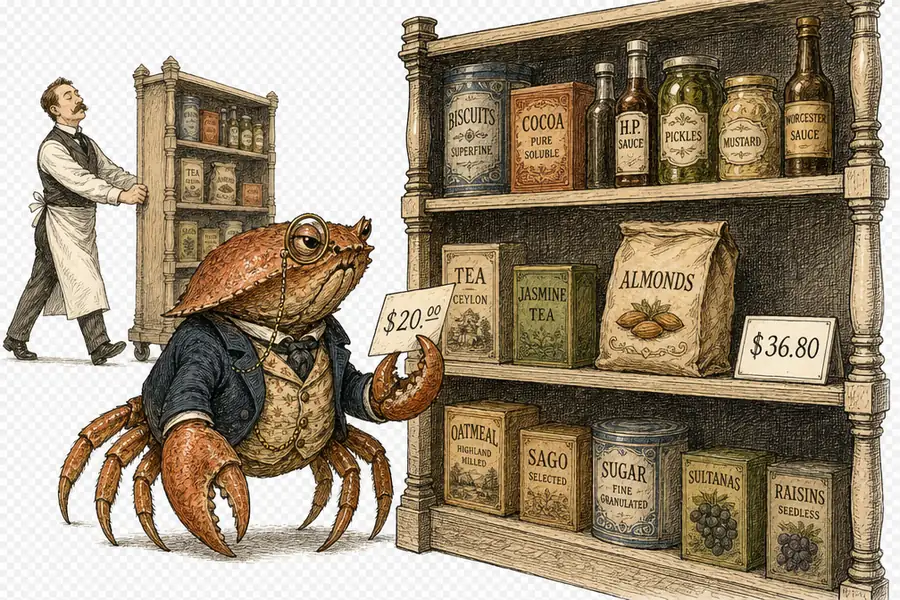
One early pilot did misbehave, in the direction that costs money. Two memory conditions picked the more expensive almond candidate and reported $36.80; the agent without memory took the reference minimum at $20.00. Follow-up probes could not reproduce it, so the paper logs the anomaly and moves on. Retailers, whose interest in agent error is chiefly financial, may wish to linger.
The non-interference holds under one stated condition: current-task evidence is “explicit and sufficient.” The page in front of the agent said everything the stale routine might have got wrong, and said it in a form the agent could read. Cao treats this as a boundary variable rather than a footnote, which quietly relocates the problem. Memory was not robust. It was redundant.
A retail page is built to persuade, which is a different discipline from being legible.
Adobe’s readability audit of US retail sites, reported in April by eCommerceNews, scores product pages at 66 percent machine-readable and homepages at 75, with the weakest homepage in the sample at 54.2. A third of what a product page says is invisible to the thing reading it. These are the pages on which an agent is expected to settle quantity and price before it spends. Explicit and sufficient they are not.
A moved button is the mild case. The harder one is a price that changed after the agent learned it. MERIT, a cost-aware memory benchmark, runs 23,440 scored episodes of tool-using agents and finds that memory lifts dependent-task success from a leak-verified floor of zero to as high as full marks on ordinary recall. Its trouble starts when a fact is superseded: embedding retrieval collapses unpredictably, and agents act on the correctly retrieved new value only 55 percent of the time. Swapping one memory implementation for another moves task success by up to sixty points. The agent found the new price and ignored it, nearly half the time.
The traffic riding on this is not hypothetical. AI-referred traffic to US retail sites rose 62 percent year on year in July and converts 60 percent better than the rest. Retailers have spent two years courting a visitor that reads the page literally, and two years redesigning the page for one that does not.
Cao’s proposed follow-up is to weaken the page’s evidence while keeping the task solvable, then watch what the stored routine does. That is a sound experiment. It is also next quarter’s checkout redesign, run at scale, with no control group and nobody reading the result.