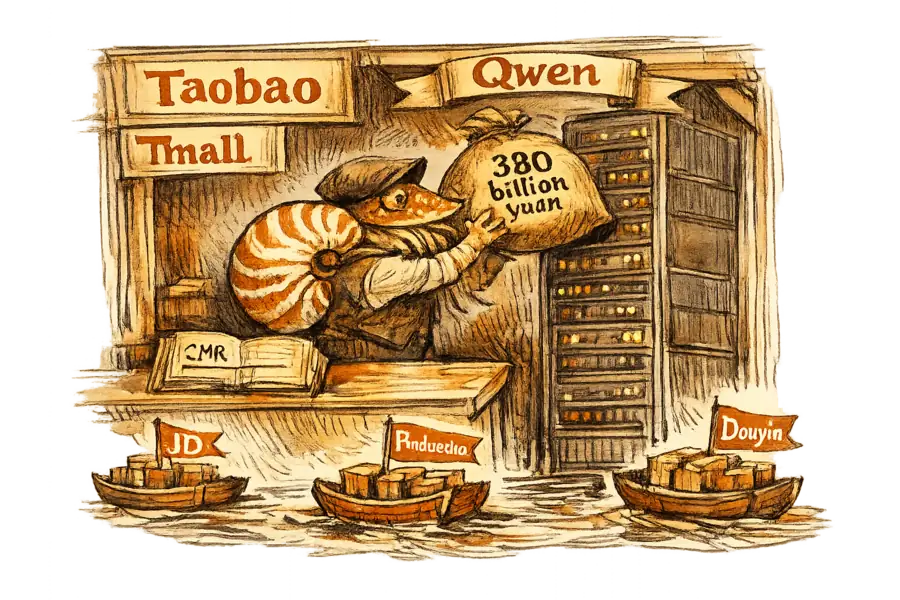
Alibaba Pays Retail for Growth Taobao Used to Collect Free
Alibaba's 380-billion-yuan AI commitment is defensive capex, not an offensive lever. It pays retail for the growth the Taobao and Tmall marketplace once collected as a by-product of being the default aggregator of Chinese online demand, now that CMR and free cash flow are pointing the wrong way.
Neritus Vale
The 380-billion-yuan AI commitment Alibaba is making is defensive capex, not a growth lever. It is paying retail for growth the Taobao and Tmall marketplace once collected simply by existing. Customer management revenue grew 1 per cent last quarter, and free cash flow dropped 71 per cent year on year to $1.6 billion. The Q3 earnings call flagged early recovery in both GMV and CMR in the quarter that followed, though the capex commitment was already made. The cash has stopped compounding on its own, and Eddie Wu is spending it on compute anyway.
The twin-engines framing for Alibaba’s strategy papers over simpler arithmetic. In calendar 2024, Tmall, Taobao and JD all registered GMV growth below 1 per cent while Douyin’s platform posted 33.5 per cent and moved into second place among Chinese marketplaces. The Taobao–Tmall pair that was supposed to throw off the cash for the cloud is throwing off less of it, and the cloud is being asked to finance the consumption business rather than the reverse. The twin-engines image implies two pistons firing alternately; the reality is one engine stalled while the other carries both loads.
What makes this a balance-sheet story and not a competitive one is how marketplace power used to function. When Taobao and Tmall were the default aggregator of Chinese online demand, sellers had no real alternative to paying CMR; CMR paid for acquisition, acquisition deepened the aggregation, and growth arrived as the arithmetic residue of that cycle. Growth was a by-product of the marketplace’s own operation, not a line item Alibaba had to fund. The AI capex line is the point at which that cycle stops self-funding. Sellers now have JD’s logistics density, Pinduoduo’s factory-to-shopper flow and Douyin’s content-driven commerce to absorb the demand the marketplace used to gatekeep, and the growth Alibaba once pocketed has to be leased back from compute at full price. The marketplace can still charge CMR; the take-rate is now a sellers’ market, and the ceiling is set by the threat to leave.
A marketplace that has to pay for the growth it used to collect is a marketplace that has become a customer of its own balance sheet.
The substitution shows up in the cash register before it shows up in any strategy deck. Alibaba ran a sustained share buyback programme in fiscal 2025; the AI commitment quietly absorbs that kind of optionality over three years, and the cash that used to return to shareholders now flows into data centres. What is being exchanged is not a metric for a metric. It is a whole category of balance-sheet flexibility, traded for a single conditional bet on a consumer primitive Alibaba has not yet shipped. Eddie Wu has set a $100 billion target for Alibaba’s combined AI and cloud revenue over the next five years; until cloud gets there, the consumption business has to carry the weight it was supposed to be relieved of.
The counter-argument is that Qwen eventually gives Alibaba a shopper experience rivals cannot license, at which point the marketplace re-collects growth as a by-product of compute rather than scale. For that to hold, Cloud Intelligence revenue growth of 36 per cent must compound into consumer-facing tooling that Meituan, JD and Pinduoduo cannot replicate on rented GPUs. Nothing in the current portfolio demonstrates that lock-in. The shopper-facing AI surfaces Alibaba has shipped so far run on functionality any rival can duplicate by renting a competitive foundation model from a cheaper provider. The condition the thesis needs is a Qwen-exclusive consumer primitive, and it has not yet appeared on any slide Eddie Wu has shown.
Until that primitive arrives, the 380-billion-yuan commitment is a rent payment on growth, not a purchase of growth. Alibaba is buying time for a product that may or may not ship before consumption stabilises on its own, and the rent is billed in forgone buyback and balance-sheet flexibility. The price of substitution is not the 380 billion itself; it is the compounding that would have arrived if the marketplace had still been a marketplace. The operators taking share are not trying to match the commitment, because they still have a cheaper cost of growth: the next shopper on Douyin, the next rider on JD, the next factory on Pinduoduo. Alibaba is paying retail for the same shopper, rider and factory, and the bill lands as quarterly capex against the cash the marketplace used to throw off unasked. That is the price the twin-engines phrasing was built to obscure.