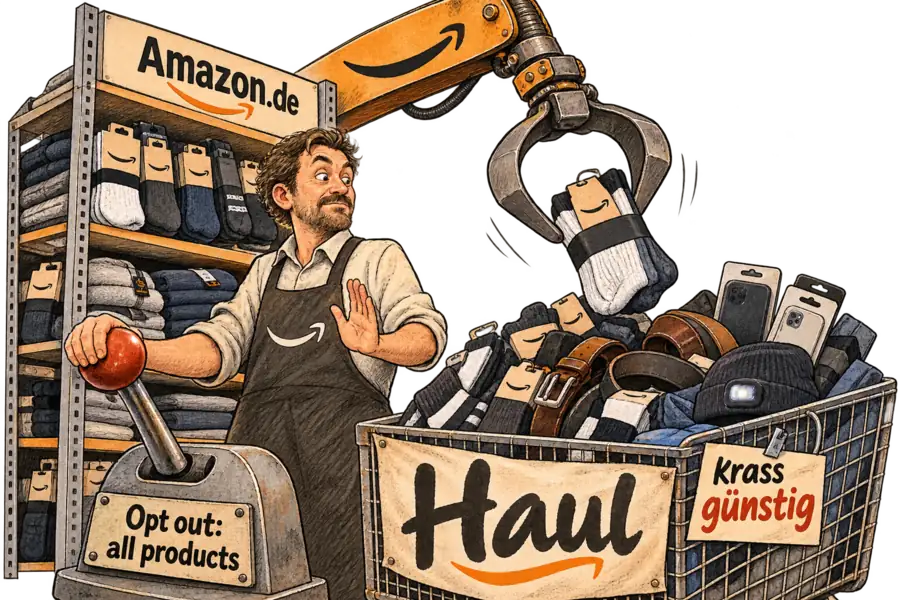
Amazon Adds Sellers' Stock to Haul Unasked. Saying No Takes the Whole Account Out
Amazon now cross-lists selected FBA stock into Haul, its discount store, in Britain, Germany, France, Italy and Spain at unchanged fees, and sellers can opt out only for their whole account. Its help page gives no selection criteria and is silent on Brand Registry and selective distribution; on 17 November the German store showed adidas socks 35% off beside belts listed under names like Heshebuy.
Neritus Vale
Amazon now decides which sellers’ warehouse stock appears in Haul, its discount store in Britain, Germany, France, Italy and Spain. Fees stay the same, and a seller who objects can leave only with its whole account. A clothing brand loses any item-by-item say over where its garments are sold, in a store capped at €20 on the continent and still stocked partly from China. Ecommerce News Europe reported the rollout on 16 November.
A seller help page sets out Amazon Haul Distributed Fulfilment. The programme cross-lists “select” FBA products from local warehouses, which stay on sale in the main store too. Orders carry “the same fulfilment fee and referral fee as FBA”. Sellers can see which offers were cross-listed but are “not able to unenrol individual products”. To leave, a seller contacts Selling Partner Support, which removes “all of your cross-listed products”.
The page does not say how Amazon chooses. Eligibility requires an existing main-store listing and local FBA fulfilment, and the page calls its thresholds minimums that “don’t guarantee listing”. Brand Registry and selective distribution go unmentioned. On price, it says only that Amazon-funded promotions in Haul “will not affect your net proceeds”, and it does not say what price Haul will show. Ecommerce News calls this Haul “evolving beyond its original model”. For sellers, it is a placement decided on their behalf.
Amazon’s American rules are more specific. Its US selection page admits stock held in Amazon’s domestic fulfilment network to “Domestic Haul” if the item sits under a cap for its product type or is “on discount (have a strike-through price) and below $20”. A markdown is therefore one of two price routes into Domestic Haul. The European page states no price rule.
On 17 November, Germany’s Haul front page, viewed from Germany, offered adidas crew socks at €8.49, marked 35% below the €13.00 recommended price. Beside them sat belts and an LED beanie listed under names like Heshebuy and CNMTCCO. A “Marken-Lieblinge” (brand favourites) tile shared a row with “Krass günstig” (crazy cheap). The card names no seller and no fulfilment channel, so the page does not show whether the pack is a seller’s cross-listed stock, Amazon’s own or a brand’s listing.
Amazon.de’s main search showed the same pack at the same price, so the difference lay in the neighbours. Amazon’s German Haul guide, dated June 2025 and updated that September, promises delivery “binnen zwei Wochen oder weniger” (within two weeks or less). It predates the programme and describes Haul as app-only. Neither the guide nor the seller page says which promise a garment from a German warehouse carries when bought through Haul.
Haul was built as a separate shop for a separate supply. Amazon opened it in Britain on 6 May 2025 with “its own shopping experience, search, basket, and checkout”, then in Germany on 4 June and France, Spain and Italy on 1 October. At the American launch, Marketplace Pulse recalls, products had to carry the brand “Generic”; the US selection page still requires it on the direct route. Haul’s German front page now sells adidas.
Haul’s original supply came through American accounts. The seller page limits the direct-from-China route to invited “China-based sellers who have a US Amazon selling account”. For sales abroad, Amazon’s expansion FAQ says, “Amazon will buy the product from you”, and Ecommerce News reports that in Europe “either Amazon or a third-party merchant can be the seller of record”. Amazon decides which goods enter Haul and can be the seller of record itself.
Amazon signalled a year ago that branded goods belonged in Haul. In November 2025, as Haul shed its beta label, Amazon executive Dharmesh Mehta presented it as the answer to a question about how it could offer “everything from hidden treasures to clearance-like discounts on branded products”. Mehta did not mention cross-listing. Read beside this week’s rollout, though, his words suggest the branded half could arrive that way.
About 40% of active sellers on Amazon.com now have listings in Haul, Marketplace Pulse finds, counting sellers with at least one feedback in the past year. “Most of them did not sign up; Amazon cross-listed them,” it reports, inferring this from the invitation-only direct route. Four in five Haul sellers are based in China or Hong Kong. The figures cover Amazon.com only.
In the US, Amazon has begun folding Haul into its main search. On 9 November it announced, in half a sentence of a holiday-sale release, that “Relevant Amazon Haul products now surface within Amazon search results when they’re a great match for what you’re looking for”. Whether it applies in Europe is unclear, Ecommerce News says. If it arrives, Haul’s direct-from-China goods would sit beside a brand’s listing in the main results, even if the brand has left Haul.
The seller page offers one switch, and it removes the brand from Haul, not Haul from the brand’s results.
The strongest case for Amazon is that the seller loses nothing it can count. Fees are unchanged, Amazon-funded Haul promotions do not touch net proceeds, and the item stays on sale in the main store. Marketplace Pulse calls Haul “closer to a price band within Amazon”. If European shoppers use Haul as a price filter, the thesis fails: a brand’s socks there are simply socks found by a thrifty shopper.
In Europe, Haul is still built as a separate shop. It keeps its own basket, checkout and delivery promise, under tiles that advertise “Krass günstig”. Search integration would bring the filter reading closer to true, as Haul’s goods began to appear among a brand’s own listings. A brand whose price point is part of what it sells would pay for that reach in positioning, and it could not test the trade one garment at a time.
Brands and their authorised resellers face a question the page does not raise. In Coty, a 2017 case over amazon.de, the EU’s Court of Justice held that a ban on authorised distributors selling through third-party platforms “such as Amazon” can be compatible with EU competition law. That held for luxury goods in a selective distribution network and subject to conditions, and the national court had the final word. Most clothing is not luxury, but a brand whose contracts bar authorised stock from discount channels may ask whether a reseller breaches them when Amazon puts that stock in a sub-€20 store.
For a clothing brand on FBA in Europe, the only decision left is whether to leave. Staying means letting Amazon pick which garments join a store it built to answer Temu. The alternative is to leave and, as Marketplace Pulse notes, give up “any discounts Amazon pays for”. Amazon has left the fees alone and taken the shelf.